Showing posts with label Burrows. Show all posts

Saturday, March 23, 2024

#52Ancestors52Weeks...Week 13...Worship.... It Happened on Church Street


 Emmanuel Episcopal Church 
235 South Church Street Grass Valley, California
Pen and watercolor  by local artist Loana Beeson 

This framed picture hung in my grandfather's house for many years. This is the church he and his family grew up in. 


 Grass Valley United Methodist Church
236 South Church Street Grass Valley, California
Pen and watercolor by local artist Loana Beeson
This framed and matted picture was a wedding present from the artist to my husband and I in June of 1981. This is the church I grew up in. 

 
    Emmanuel Church first opened its doors for worship on August 1, 1858. The Carpenter Gothic style building was built on land donated by the Gold Hill Quartz Mining Company and many pioneer families regularly worshiped there.  Directly across the street was the Methodist Episcopal Church which was formed in 1852 and began as a house with several additions before the grand new church was built in 1872. The steeple which housed the church bell was 125 feet tall. Cornish families worshiped there as they had done in their Cornish Chapels back in England. 


The 1872 church building.  
This church burned in a spectacular fire in August of 1936.  Luckily, Emmanuel Church, which was directly across the street, did not catch fire. The worry was the steeple would fall outward but it eventually fell back into the church itself and the entire church was gone in less than an hour. 

  This week's writing prompt is Worship....   I am not focusing on just one ancestor this week,  but rather a place that has influenced my family since the 1800's. When I think of  Church street (or more specifically South Church street) in Grass Valley, California I am reminded of the role it has played in my family history and in my continuing faith.   


    Church street was so named because of the  five original churches built on the quiet dirt road just one block up  from Mill street, which was the heart of town.  The Congregational Church (built by pioneers in 1853) was on the corner of Church and Neal streets.  St. Patrick's Parish Church (1855) was located at the intersection of Church street and Chapel street.  The African Methodist Episcopal Church (1854) was also located on Church street until 1894.  Even though my family did not worship at these other three churches, St. Mary's Academy, next door to St. Patrick's,  was where Uncle Jack took commercial classes as a young man and my grandfather took choral classes. Their Norwegian father John Hartwig Hansen was involved in drama productions there to learn to speak English.  My mother took piano lessons there from Sister Mary James. The building now houses the Grass Valley Museum where the Burrows family cradle is located. 

   My great great grandparents Alexander Burrows and  Elizabeth Jane Hurd Burrows attended the Emmanuel Church on Church street with their growing family in the  late 1800's. This is my great grandmother's original Baptism certificate from 1895 and her later confirmation card from 1899.


  There are only three documents that have Clara's name written as Clara Vere de Vere:  Her graduation diploma and these two religious records. She was named after Clara Vere de Vere in the Alfred Lord Tennyson poem!


  The next generation also worshiped at Emmanuel:


 Vere Burrows Hansen with her boys (l-r) Robley, Harold and Jack
 Harold was my grandfather. 


  Clara Vere Burrows married John Hartwig Hansen and together they had three boys: Jack, Robley and Harold (the youngest).  Vere made sure the boys were baptized and eventually  confirmed in the Emmanuel Church. The above picture was taken around 1912 and was found in Vere's photograph album. 


My grandfather's confirmation card from 1922. 


    The Methodist Church across the street was built by Cornish miners who came to Grass Valley to work in the gold mines. The church was heavily influenced by the preaching and music of John and Charles Wesley and became known for the Cornish Carol Choir, Pasty Bake Sales and the Cornish Fair (all of which continue on to this day).  

   My other great grandmother, Emma King Hayes VanDuzer, was a resident of Grass Valley from a young age when her parents immigrated from Cornwall to Grass Valley. They were staunch Methodists who had previously worshiped in the small Methodist Chapel on East Hill in St. Austell, Cornwall.  After living in San Francisco, Nana later made Grass Valley her permanent home with her daughters.  She was very involved in the church and was a very active member there for the rest of her life. She was known for heading up committees, singing in the choir, sewing drapes for Wesley Hall, and for her flower arrangements.  She started the "Friendly Club" and the quilting group.   Her daughters Dorothy, Fran and Margaret (Betty, my grandmother) were life long members as well. 


The new Methodist Church was dedicated on Palm Sunday, 1939.  The architecture style was California Mission Revival. All the solid oak pews with their red velvet cushions came from the Temple Methodist Church in San Francisco. The pipe  organ came from a theater in Chicago.  

   My grandfather Harold Hansen (of Emmanuel Episcopal Church) recorded his "life story" later in life, and told how Emma VanDuzer cornered him on Mill Street one day to ask if he could help with Easter music at the Methodist Church.  My grandfather had a beautiful tenor voice and sang at other churches in the area as well as  in San Francisco.  He crossed the street to attend choir practice at the Methodist Church,  met Betty (who was a soprano), and "took a shine to her from the start".  They were married on July 2, 1939.  They were my grandparents. 


 Jack Hansen, Harold Hansen and Betty Hayes Hansen , Dorothy Hayes in the new Methodist Church July 2, 1939.  Jack and Harold grew up in the Emmanuel Church, Betty and Dorothy grew up in the Methodist Church.  Nana made sure Grandma and Grandpa stayed Methodist....


Margaret "Betty" Hayes Hansen (my grandmother)
July 2, 1939.  The beautiful walnut woodwork is still in the church.


    My Dad's family came to Grass Valley in 1947 (a little later than my pioneer relatives on my Mom's side....).  My Grandmother (Nino) was raised in the Catholic faith but decided the Catholic ritual and teaching were not for her.  She attended Emmanuel Episcopal Church for quite awhile, because she liked the priest. She then switched to the Methodist Church across the street after the Episcopal priest left. Nino helped my sister and I memorize the Lord's Prayer at a very early age.  Her mother, Nonna, belonged to the Methodist Church in San Francisco where she worked in the church kitchen and was loved by all.  When she died new kitchen equipment was purchased in her memory and a plaque was placed designating the space as "The Caterina Brondolo Memorial Kitchen". Nonna attended the Methodist Church in Grass Valley when she visited Nino. Nonna was known to have a constant conversation with her Jesus who could help her with anything at all. 

 My Dad went to the youth group at the Methodist Church and later joined the Methodist Youth Movement at University of the Pacific in Stockton.  Both my Dad and Mom attended UOP, which was founded in 1851 by three Methodist ministers. When he and Mom were married, the Methodist Church became our family's place of worship, and our second home on Sundays. My sister and I would often spend the night with either Nana or Grandma and Grandpa and go to church the next morning with our quarters ready for the collection plate. 


Dale  and Margaret (Hansen) Boothby with Tersilla Boothby (Nino) in Wesley Hall after their wedding.  June 25, 1961


In front of the Methodist Church at my parent's wedding June 25 1961
I recognize: Nonna, Dottie, an unknown couple, Nino, Little Mary, Aunt Dena, Uncle Frank and ? Little Mary's husband?

   Growing up in the this church gave me many happy memories.  Worshiping with a large congregation of people who truly loved the Lord and each other,  singing hymns from the red hymnal (especially at Christmas and Easter) and hearing my own grandparents sing in the choir every Sunday will always stay with me.  Seeing the flowers my Nana and Auntie Dot placed on the altar every spring also comes to mind.  I can still smell the daphne and the daffodils. Sunday school songs and stories, Youth Group and Vacation Bible School. Church potlucks and picnics. Hearing both my Mom and Dad play two piano duets during the service. Playing in the handbell choir while my Mom directed.  

    Later on my husband and I were married in this church, as were my sister and her husband.  My Dad's funeral was held here with standing room only.  In fact, many family weddings, baptisms and funerals were held in both churches on Church street over the many years.  


 June 28, 1981 
Methodist Church Grass Valley, California
 
  
The large "Christ" window in the front of the church.  This is the view I had every Sunday growing up. Photograph taken May 21, 2023.

     
    I still visit the Methodist Church with Mom (who still attends) on occasion.  I love just sitting in the pews and meditating on the beautiful stain glass windows that all tell a story. The church my husband and I attend now with our children and grandchildren is nothing like the church I grew up in.  It has no stain glass, no wood pews with a smooth patina and history, no altar flowers, no homey feel.  The music is loud and the service is presented in multimedia. Change is inevitable.  But, the preaching is solid and from the Gospel. In the end, that's what matters the most. I still have my lasting faith which was handed down from all my relatives worshiping on Church Street. 

References: 
The Church With the Golden Past; A History of the Grass Valley United Methodist Church. By Don Alexander and Dorothy Peavy  October, 2006


Once again, thanks Mom, for all your help with this post!
 

Thursday, November 4, 2021

52Ancestors52Weeks Week 44 Voting.......Roy Burrows Was Elected To City Council in 1915 As Women Exercised the Suffrage For the First Time in Reno


Roy Alexander Burrows b. January 23 1881 Grass Valley, California d. October 23 1943 Reno, Nevada.  Picture taken at the Riverside Studio in Reno 1920. 

  The theme for this week is voting...do you have any politicians in the family tree? Anyone involved in the women's suffrage movement?  I learned that My Great Grand-Uncle Roy Burrows served for several years on the Reno City Council.  In fact, he won another term in 1915 after women in Nevada were given the right to vote in local races.   His wife Lucie would also participate in another local election as a clerk in 1918. 
        It would still be another 5 years before women could vote in national elections. 


      Taken from the Nevada State Journal May 5 1915:  

ALL RECORDS FOR VOTING SMASHED BY ELECTORS OF RENO

"Reno smashed all records for voting yesterday....The large vote was due to the fact that women exercised the suffrage for the first time in the city of Reno and few of them neglected the opportunity to participate in an election that held a large interest for the community....

  In the Sixth ward there was real excitement; Roy A. Burrows and Joseph E. Johnson running neck and neck as the count progressed. On account of the large number of candidates for councilman the vote progressed slowly in the sixth, and that added zest to the contest, for there was the element of suspended interest to thrill those interested. Burrows won finally by 54 votes.....

  First Women Voters...There was rivalry among the women voters to see which would be the first to cast the ballot. Lucy M. Van Deventer claimed the honor in the first ward. Miss Minnie Flanagan was the first in the booth in the second ward.  And Mrs. Josie Lancaster was the first to cast her ballot in the third ward. 

  Women took the time to go to the polls, while many men neglected to perform their civic duty. For instance, in the second ward 162 men who were eligible to vote failed to put in an appearance, while only 8 women did not vote. 

  One new face will appear at the city hall, that of Roy Burrows, elected to the council from the sixth ward. Burrows will fill the vacancy that has existed for about a year. "

  The article continues on...

  "Early in the day women, voting for the first time in Nevada, outnumbered the men as voters. They did not have the slightest difficulty and it was evident that they had studied their sample ballots well and had made up their minds for whom they intended voting, and they did it without confusion.

  The afternoon found the streets thronged, every store in town having closed at 1 o'clock to permit their employees to vote and work for their favorites....there wasn't the least bit of disturbance in any section during the day in any part of the city. In this respect this election was one of the quietest held in Reno.  Although Chief of Police Hillhouse had taken the precaution to station extra officers at the polling places there was nothing for them to do". 


Nevada was a "black hole" in the west when it came to suffrage in 1914. 


  Women were not granted the right to vote on Nevada's entrance into the Union in 1864.  A bill was introduced in 1869 to allow women the vote by Curtis J. Hillyer, who argued that "women possessed at least as much intelligence as men, followed the same laws, paid the same taxes, and most importantly would introduce a new standard of public morality to the public process".  Both houses of the Nevada legislature passed the amendment that year, but it failed the mandated second vote two years later. It would be forty years more before suffrage became an issue again in the state, and on November 3, 1914, women were given the right to vote.  They voted for the first time in local races in 1915, in statewide races in 1916, and gained the right to vote nationally with the 19th Amendment ratified in 1920.  
https://nvsctlawlib.libguides.com/c.php?g=1078723&p=7870328

  A big question on the ballot in the election of 1915 was the saloon ordinance.  The initiative would have cut down the number of saloons in town to forty. The above article read..."A strenuous campaign was waged both for and against the measure, and the final count shows that the proposed ordinance was defeated by a majority of 1,411".  It would be interesting to see how many women voted for the ordinance as opposed to men! Was the prognostication of  Curtis J. Hillyer correct? 


  Roy Burrows was not new to politics in Reno.  He had previously been on the Central Trades Council in 1907, and had appeared before the Reno City Council (Nevada State Journal Aug. 31, 1907) to get a permit amended so that laborers could hold athletic events on North Virginia Street and Commercial Row on Labor Day of that year.  Maybe he got the bug to run for a bigger office at that time, or just saw the need to provide leadership in a growing community. 

   Roy was a prominent  contractor and builder in Reno, and was instrumental in constructing many beautiful neighborhood homes in the older part of the city.  For a time, he worked with Robley/Bob Hansen (his nephew), as Roy Burrows and Hansen Contractors until Uncle Bob started his own construction business in town.  In 1936 Roy took out a building permit for a brick home at 524 Ridge Street in Reno, to build  a home for F. P. Strassburg (a stock broker).  The architect was the prolific F. J. De Longchamps.  (Reno Evening Gazette April 2, 1936).  De Longchamps was a local architect and  is best known for his design of the Washoe County Courthouse, the Riverside Hotel, the Reno Post Office, and several buildings on the University of Nevada, Reno campus to name a few!  He also designed stately brick homes for prominent Reno residents, as well as smaller English Tudor cottages, that still remain a charming part of old Reno. 


  Roy's wife Lucie (Mrs. Roy Burrows in the Fifth Precinct) was listed as an election official for the September primary election  in 1918.  The first three names listed were those of inspectors, the last were clerks.  She served as clerk for the Fifth Precinct that year.  Nevada State Journal August 8, 1918.  I can imagine how excited she was to vote for the first time in the 1915 election!

  Roy  was first elected to the city council in 1912 and served through 1916.  He ran again in 1920 according to this ad in the Reno Evening Gazette September 4, 1920. 


Reno State Journal 1931.  He was still running for City Council.  This was a year after his daughter Gertrude died of appendicitis at the age of 13 (see the post from October 12, 2020 on Roy Burrows and his family for more history). 


Roy Burrow's obituary from The Union (Grass Valley) October 26, 1943.  He passed away on October 23, 1943 in Reno, Nevada.   He was remembered as a contractor and builder, but it should be remembered that he also participated in the growth and development of his community by serving his constituents as a councilman from the Sixth ward for many years. 

   Roy's wife Lucie participated in the election process as well after the 1914 vote to allow women suffrage in Nevada elections.  Many women were instrumental in the fight for women's suffrage in Nevada (indeed, they were not "given" the right, but had to fight for it).   I could not find any sources to give me insight into Lucie's part in the change in state law, or what she thought about women's rights to vote,  but I do know she thought her right to cast a vote as a full citizen was important enough to get involved in the local  primary election of 1918.  


**********

  The Burrows/Hansen side of the family was always staunchly Republican.  Mom (Margaret Hansen Boothby) remembers being allowed to walk into town each day to watch the proceedings of the Republican Convention to elect Eisenhower on Grandma Hansen's (Vere Burrows Hansen) brand new TV.  She thought it was "beyond exciting to watch all the wrangling and parading and voting" while Grandma Hansen explained what was going on. She remembers that it was the beginning of her interest in politics.  And of course, remember that  Grandma Hansen did shake the hand of Teddy Roosevelt in 1903!  (see the post of 1/14/21 "Her Patriotism Unbounded").

  There were also many political arguments in Mom's house when they lived with Nana (Emma King Hayes Van Duzer) as Nana was an FDR Democrat and Mom's dad (Harold Hansen) was a Republican.  "They could really get into it!"  I can imagine!  Mom always took great pride in voting, and passed it down to my sister and I.  


 Other Burrows/Hansen family members who were elected to public office:  
John Hartwig Hansen (Mayor of Grass Valley) (see the post of 5/3/20 "John Hartwig Hansen")
William Lockyer (California Attorney General (6 years) and California State Legislator 25 years  (see the post of 10/16/20 "Alfred Lord Tennyson and Arnold Schwarzenegger; Their Connections to the Burrows Family in Grass Valley").
 
  My Dad, Dale Boothby, also served on the Nevada County School Board for 20 years, which was an elected position.   Mom took me to the firehouse (our polling place) to see his name on the ballot!  My family has a wonderful history of serving their communities for which I am thankful. 


Relationship Reference:  Me->Margaret Hansen Boothby->Harold Hansen->Vere Burrows Hansen (sister to Roy Burrows).  


Saturday, October 23, 2021

52Ancestors52Weeks Week 40 Theme: Preservation...............The Burrows and the Hansens Took a Road Trip to Virginia City


     October is National Family History Month! Since October of 2001 families have been encouraged to think about their family histories and origins, and ways to honor them. The theme for this week is preservation.  This prompt got me thinking about how my family has preserved our history in the last several generations, and how we preserve it now.  

   I recently found this photograph in the Bob Hansen Family photo album.  The location of this photograph tells a story, as well as the grouping of family members.  The Burrows and the Hansens were very proud of their family history and the unique connections between Virginia City, Nevada and Grass Valley, California. This was one way they shared and preserved their family history for future generations.  They took a multi-generational road trip........


  This picture was captioned by Alma Goins Hansen, who probably took the picture as well.  She wrote: "Lucy Burrows, Bob, Mother H, Skip, Jack, Dad Hansen, Gay...Geiger Grade Lookout     Road to Virginia City".  Lucy Burrows was the wife of Roy Burrows; they lived in Reno where their 13 year old daughter Gertrude died of appendicitis in 1930 and Roy was in the construction business.  Roy was an older brother of my Great Grandmother, Vere Burrows Hansen (Mother H. in the picture).  Bob and Jack were two of three sons of Vere and John Hansen (Dad Hansen in the photo).  Bob married Alma Goins, and their children were Skip and Gay; they lived in Reno as well where Uncle Bob was also in the construction business.  The John Hansens, as well as Jack Hansen, lived in Grass Valley, as did my Grandfather Harold Hansen, who was not on this particular trip.  So, three generations of family were on this trip exploring family history.  It must have been quite a day!


  I love the candid feel to this picture. I'm not sure what Uncle Jack was thinking of Skip at this particular moment....he was probably worried Skip might go backwards down the steep drop offs that Geiger Grade is famous for!  Uncle Jack probably drove his parents over the hill (over the Sierra Nevada mountains to Reno) in one of his fancy cars, as he loved to buy a new car every year or so. Vere was always very interested in family history and was the family archivist all those years ago.  Her origins were very important to her and she made sure everyone else knew the family history also.  She probably thought you were never too young to get in the car with your family and visit the cemetery. 


  Geiger Grade is the curvy, steep and very scenic 20 mile route from Reno, Nevada up to the mining town of Virginia City, Nevada. The summit sits at 6,889 feet and provides spectacular views of the Truckee Meadows.  My own family has driven that route many, many times to visit the unique mining city, ride the train and wonder about the stories I had heard of family who lived here at one time.  However, quite a bit of detail was lost (to me at least) of the more important details in this narrative.  I was not taken to Virginia City as a young child (that I can remember) and only experienced the area after moving to Reno from Grass Valley as an adult.   I have been rediscovering those details in the last few years and making sure they are preserved beyond just the oral stories and visits to cemeteries.  I too value my family history! 

 
This picture was taken the same day as the above picture.  

    Pictured are Lucy Burrows, Bob Hansen, Jack Hansen, John Hansen and Vere Hansen.  This picture was taken sometime before John Hansen died on April 10, 1945; probably around 1940 and right before Bob and Jack enlisted in the war.   I was glad to see Lucy Crampton Burrows in these pictures.  Her family history revolved around Virginia City, as well (see my post from October 12, 2020 Roy Burrows). She probably provided quite a bit of oral history that added to this trip, as she was born in Virginia City in 1884 and spent her early childhood there.  

  Uncle Bob moved to Reno after his high school graduation from Grass Valley High School in 1926.  He loved exploring the area and probably learned about family history from Uncle Roy and Aunt Lucy.  

Virginia City photo taken around 1930 by Bob Hansen from the Bob Hansen Family Album.  This looks like the view was taken down C Street towards Carson City.  You can see the St. Mary in the Mountains Catholic church steeple on the left in the distance. 


  Even before this particular trip other family members would make a day of it and visit the town and cemetery to remember family buried there.   In fact, I shared this story of another relative, Alta Powers, who had quite the adventure at the cemetery in Virginia City in 1935 when she went to place flowers on Harriet Hurd's grave (see February 20, 2021..How a Weird Tale Solved a Family Mystery).  Unfortunately, this bit of information was not handed down to the next generations as they (and I) had been searching for this particular gravesite for years. Which goes to show, oral history is very, very fragile. 

3 June 1935 Nevada State Journal


Margaret Hansen Boothby (Mom) with Gay Hansen in the photo booth at the Bucket of Blood Saloon in Virginia City, Nevada.  Around 1944-45? Another trip to visit the cemetery, and some new memories made with cousins. 

  I have previously posted quite a bit of history and the results of my research on the Burrows and Hurds who lived and worked on the Comstock during the silver mining boom in the late 1800's.  That part of our family history has never been formally researched or written down up until now. Auntie Claire made a good start by constructing a family tree, back when the internet was just starting to be a  useful tool used by genealogists.  I have been working to flesh the tree out with more research,  organize the many pictures that were saved from this branch of the family, and present it all to my children and other family  members so that it becomes meaningful and personal to their own lives.  That's what preservation means to me. 

  Preserving family history is on on-going and ever-changing process.  My goals are much different than the goals of the family members in the above pictures.  I am continuing the work started by my Auntie Claire who was the "keeper of the stuff" many years ago, and by my Great Grandmother Vere Burrows Hansen who kept everything to begin with (we are so very lucky!).   It seems that now I am the "keeper of the stuff".  So, what do I do with it all?  I am working to digitize,  archive and store all of our  pictures and documents (and there are a lot!) so that my grand children and great grandchildren can enjoy them and wonder about them  as much as I have over the last few years.  I am working to document those few precious cherished items handed down that tell certain stories themselves before they are gone.  I am in the process of doing much more research and writing down family history, as well as the memories and stories of family members who are able to contribute.  And the best part of preserving all this is that I get to share it with family (and friends) through email, texting, blogging and social media.  Those are things that were certainly not available way back when! But, in the end, I would like to change it all back to print form.  Something tangible for future generations.  I am not sure I trust technology!  And who knows where technology will take us in the future?  How will my great grandchildren be documenting my life? Who will be the "keeper of the stuff"? More things to ponder. 

  How do we preserve family history?  In my family, we have honored family members by visiting the towns and places where they lived and the cemeteries where their final resting places are.  We have passed down pictures, cherished items and oral histories.  My personal preservation efforts have utilized even more modern methods with the help of technology.   But, in the end, I still do go visit cemeteries every so often.  When my grandchildren are a little bit older,  we can even all go together.  After all, it is  a family tradition! 


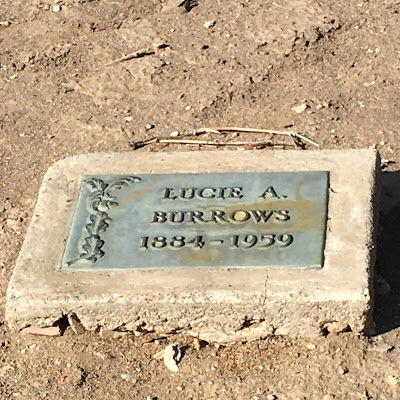
These pictures were taken from a very recent fall visit to the Knights of Pythias Cemetery, located on Nevada Street here in Reno.  It is the final resting place for Lucie A. Burrows, her parents Lena Koehler and Henry Crampton,  and her daughter Gertrude Burrows who died so young.  I hope their stories will not be forgotten. 


  Relationship Reference: Me->Margaret Hansen Boothby (sister Claire Hansen Clark)->Harold Hansen->Vere Burrows Hansen m. John Hansen

Sons of Vere and John Hansen:  Jack, Robley (Bob) and Harold Hansen

Friday, August 20, 2021

Friday's Featured Photo


   I recently discovered this picture in the collection of family pictures from Cousin Skip (Hansen).  It took me a few minutes to figure out who these little girls were, and how they fit into the family tree. 


  On the back, written in faded ink, is "Marjorie Inez and Evelyn Adele Burroughs August 15, 1905".  The picture was taken in Seattle, Washington.

  The little one on the left is Evelyn Adele Burroughs (Burrows), born April 11, 1905 and her older sister is Marjorie Inez Burroughs (Burrows), born May 12, 1904.  They are the daughters of Don Francis Burrows, older brother to my Great Grandmother Vere Burrows Hansen.

    Marjorie was born in California, and her middle name was given in remembrance of Inez Francis (sister to Don and Vere) who passed away in 1899 at the age of 8 in Grass Valley, California.  Evelyn was born in Washington state.  Adele is the middle name of another Burrows sister, Wanda Adele Burrows Nankervis.  

  Don used the spelling of Burrows on all of his official records, so I am not sure how the spelling of Burroughs made its way onto the back of this photo. But it is very precious! 

  My post of July 26, 2020, entitled "A Hurd of Burrows",  lists all of the Burrows children (there were 12).  I do not have any pictures of Don Burrows, but I have several letters he wrote, as well as this picture.  He eventually settled in San Francisco with his family (wife Lillian and their last child Don Steven) and was also a lawyer by profession, as were both of his parents. 

     Marjorie and Evelyn, it was nice to meet you!  


Friday, April 30, 2021

Friday's Featured Photo


     This is an unidentified photograph of a young woman taken at the turn of the century.  It was found in the Burrows file, along with this photo below, which I believe is the same woman.  There were no other clues written on either picture.  
                      Which photograph do you think was taken first? Which one was later? 


  Enlarged version of the first photograph.  

Friday, April 23, 2021

Friday's Featured Photo


**************************************************************************

I have toyed with this idea for several months, so today I am launching a new blog theme that will feature one specific photograph every Friday.....I have a growing pile of photographs full of unknown (ukn) family or friends of family.  I also have pictures that never made it into blog posts for one reason or another, and I want to add these so that family members can enjoy them as much as I have.  Any help with identification would be appreciated!  I hope you enjoy this new addition to our family stories.  

**************************************************************************

  This photograph was in with  the Burrows family pictures, and all the identification I have is "Dolores Street" written on the back.  These two girls are simply precious, and I would love to know who they are!

Thursday, January 14, 2021

52Ancestors52Weeks Week 2 Theme: Family Legend HER PATRIOTISM UNBOUNDED (Vere Burrows)


Daily Evening Tidings (Published in Grass Valley, California) May 21, 1903


Week 2 Theme:  Family Legend


  In my post of June 25, 2020, I touched briefly on a family story that my Great Grandmother, Vere Burrows Hansen, was the only one to shake hands with President Teddy Roosevelt during his train stop in Colfax, California on May 19, 1903.  I suppose you could say that it was a family legend of sorts.  Merriam Webster defines legend as a story handed down from the past, popularly regarded as historical but not verifiable.   This story has indeed been handed down! But, as intriguing as that story was, I hadn't found any real proof that Vere was actually at the train depot, or had really  shaken the hand of Teddy Roosevelt. 


Nevada County Narrow Gauge Rail Road advertisement for transportation to Colfax.  Ladies and Children were only charged 50 Cents. 

   At the time I wrote the post of June 25, I had not yet rummaged through all the papers and photos that my Auntie Claire had in boxes that were semi organized.  I spent the rest of the summer combing through newspaper snippets, receipts, unidentified pictures, obituaries, and report cards belonging to my grandfather and his brothers.  I came across a fragile pile of whole newspapers from 1903 and 1904 that were published in Grass Valley and Nevada City,  California.  I could tell that several were saved as they contained  articles relating to the death by suicide of my Great Great Grandfather, Alexander Burrows in 1904.  He was Vere's father.  Then, I came across two very brittle newspapers that I carefully unfolded and read several times, as I could not figure out why they were important enough to save.  Lo and behold, this headline stood out in a small article on page 8 of the Daily Evening Tidings, printed May 21, 1903.  HER PATRIOTISM UNBOUNDED it said....

Here is the transcribed article in its entirety. 

DAILY EVENING TIDINGS May 21, 1903. Page 8. HER PATRIOTISM UNBOUNDED Young Lady of this City Receives Unusual Distinction. ________________ Miss Vere Burrows has the Honor of Being the Only One of Her Sex to Shake Hands with the President. _________________ Miss Vere Burrows of this city is a most enviable young lady. She has the distinction of being the last to shake the hand of President Roosevelt during his recent stop at Colfax. That is certainly an honor to be proud of and she is carrying the distinction with becoming grace. This young lady is nothing if not patriotic. She is imbued with the spirit which has made Columbia celebrated in prose and poetry for the daring and patriotism of her sons and daughters. When the idea of tendering a reception to the President was first mooted she made up her mind that she would see him. It would be her first glimpse of a President and she reasoned that it would be an honor worth going miles to witness. She was among the hundreds who left on the excursion Tuesday afternoon and when she reached Colfax her patriotism was ablaze at the sight of so many thousands waiting to do homage to the distinguished guest. She waited patiently for the President’s special to arrive and when it hove in sight her enthusiasm knew no bounds. When the train stopped she was one of the first to elbow her way to the platform on which the President stood. Nothing could cool her patriotic ardor or deter her from her purpose to get close to “strenuous Teddy,” as he is familiarly called. She jostled and elbowed with the good natured crowd until she found herself directly below the rear platform of the train on which the President travelled. Then the improvised platform from which the presentation speech was made was brought forward and she was crowded somewhat out of place. For a moment she was chagrined at being forced from her position, but for a moment only. She stood and watched the President as he intently absorbed every word uttered by Judge Nilon and when he began to speak she was brimful of enthusiasm and patriotism. What a pity it would be to permit such a splendid opportunity to pass without shaking the President by the hand. In a moment she was on the improvised platform standing face to face with the nation’s chief. The engineer had already whistled the signal to start and she saw the opportunity slipping from her when she reached out her hand and exclaimed “Mr. President I would like to shake hands with you.” “Glad to have the honor, young lady,” replied President Roosevelt, and he extended his hand and gave her a hearty strenuous shake. Just then the train pulled out and the President was quickly out of sight. That’s the reason why her friends are envying her the honor he had bestowed on her. And in the after years, when the evening of life begins to cast its shadows like the edge of an approaching shroud, and when the hair that is now beautiful and fair shall be supplanted with locks of silvery gray, she will delight in gathering her loved ones around the hearthstone and telling them that out of hundreds of women who went to Colfax to see the President she was the only one to shake him by the hand.


Nevada County Daily Morning Miner Thursday May 21 1903 Page 5.  This paper was published out of Nevada City, California. 

  So, my Great Grandmother did indeed shake the hand of President Teddy Roosevelt! I had found verifiable proof that she not only was there, but that the family story was true.   She had her "15 minutes of fame",  and then  went on to lead a life full of patriotism and pride in her country.  

  The local Grass Valley paper, The Union, recently published a story that involved this incident in Vere's life.  The author, Steve Cottrell, was writing a series of stories on Teddy Roosevelt and his whistlestop tour that included Colfax, California.  Margaret Hansen Boothby (my mother) relayed the information and the newspaper articles that I had discovered to Mr. Cottrell,  thinking he could use the story somehow. He did  use Vere's story as "bookends" to his story on the search for the Navy ship the Levant. Here is the article as it appeared in The Union December 25, 2020.   I especially loved how he used Vere's High School Graduation picture from 1900. He got the  marriage date wrong by a year...she married in 1904.  And so, her story continues! 


Searching for an uncharted Pacific island

The search for an uncharted island

By Steve Cottrell | Special to The Union

Last month we explained how three Nevada County men arranged to present President Theodore Roosevelt with a collection of gold specimens when his train stopped at the Colfax depot on May 19, 1903. It was a brief stop, less than 15 minutes, but those who were present never forgot seeing and hearing the president — especially Vere Burrows.

A 1900 graduate of Grass Valley High School, Vere managed to nudge her way through the crowd and stood below the train’s rear platform as Roosevelt spoke. When he finished to loud cheers, Miss Burrows called out, asking to shake his hand, so the president reached down and obliged.

Roosevelt then began motioning to James Hague, president of the North Star Mine and one of the Nevada County men who arranged for the Colfax ceremony. Hague and Roosevelt knew each other as members of the elite Century Association, a private club in New York City, and the president wanted his friend to join him as the train proceeded to Sacramento.

While Vere Burrows and other Nevada County residents headed home with life-long memories, Hague sat with Roosevelt in his private car, explaining why a search of the Pacific Ocean south of Honolulu, in an area where Navy sloop-of-war Levant apparently met with tragedy in 1860, was needed. The Navy had long ago concluded that Levant foundered in a storm, but Hague believed it wrecked, not foundered, and some survivors might still be alive on an uncharted island. He needed Roosevelt’s help to undertake a search.

Hague’s theory was based in large part on a mast that washed up south of Hilo in May 1861. It was consistent with a Levant mast and had spikes driven into it in a manner suggesting it came from a jerry-rigged raft. The August 4, 1861, New York Times reported that if the mast was from Levant, “it would go far to sustain the belief that the ship had been wrecked on some shoal, reef, rock or island, and not foundered.”

James Hague was 24, living in Hilo, when Levant set sail for Panama, and prior to its departure had become friends with the ship’s commanding officer, William Hunt, and several sailors. Forty-three years later, with TR’s assistance, the 67-year-old Nevada County mine owner hoped to solve the mystery of the vessel’s disappearance.

Asking Roosevelt to make a ship available to hunt for an uncharted island more than four decades after Levant disappeared may have been stretching their friendship, but in 1904, as part of a May shakedown voyage for the freshly christened Navy cruiser USS Tacoma, Roosevelt and Secretary of the Navy William Moody authorized the ship’s commanding officer to work with a special passenger, James Hague, to search for a possible Pacific island and any evidence of it having been a safe haven for survivors of Levant.

SEARCH

Nearly 8,000 square miles were covered during a zigzag search hundreds of miles south of Honolulu, but no uncharted land was spotted. Although Hague’s charts encompassed about 30,000 square miles, Tacoma, running low on coal, was forced to return to San Francisco after only four days of searching. On June 3, 1904, the Associated Press reported that in addition to needing more coal, “(Tacoma) carried no appliances for deep-sea sounding, so her exploration was wholly superficial.”

Three months later, Hague spoke at a session of the International Geographical Congress in New York City, introduced by Arctic explorer Robert Peary. His topic, naturally, was Levant’s 1860 disappearance and the search for an uncharted Pacific island.

“I had the honor to bring the matter to the attention of President Roosevelt,” Hague told the IGC delegates, “and thereafter…Secretary of the Navy, Mr. Moody, determined to send an expedition as soon as one or more suitable vessels could be spared for the service.”

Although the ill-prepared search was unsuccessful, Hague remained optimistic, suggesting to his audience that the ship’s company “might have landed without the loss of a single life, in which event there might still be some survivors.”

During his lecture Hague talked about a possible second search, but it never materialized. And on August 3, 1908, the 72-year-old owner of the North Star Mine died at his summer home in Stockbridge, Massachusetts.

As for Vere Burrows, 45 days after shaking TR’s hand she married miner John Hansen, a native of Norway and veteran of the Spanish American War. Vere, a founder of the Grass Valley PTA and charter member of the Nevada County Historical Society, died in Grass Valley in 1974.

Historian Steve Cottrell, a former Nevada City Council member and mayor, can be contacted at exnevadacitymayor@gmail.com.

Navy sloop-of-war Levant sailed from the then-Sandwich Islands in September 1860, bound for Panama, but never reached port and was thought to have foundered during a storm. North Star Mine owner James Hague, however, believed Levant wrecked, not foundered, and in 1903 asked President Theodore Roosevelt to authorize a search for an uncharted Pacific island.
Courtesy Library of Congress
James Duncan Hague was a prominent Nevada County mine owner, geologist and friend of Theodore Roosevelt. In 1903, Hague asked Roosevelt to exercise his presidential powers and help him search for an uncharted Pacific island — a request the president fulfilled in 1904.
Courtesy Searls Historical Library

Grass Valley native Vere Burrows Hansen, a 65-year member of Manzanita Parlor No. 29, Native Daughters of the Golden West, was reportedly the only female to shake President Roosevelt’s hand when he spoke at the Colfax railroad depot on May 19, 1903.
Courtesy Patricia Alden and Margaret Boothby


Relationship Reference:  Me->Margaret->Harold Hansen->Vere Burrows Hansen