Showing posts with label Hurd. Show all posts

Saturday, November 23, 2024

#52Ancestors52Weeks...Week 47...Random Number....Putting the Life of William Henry Bluett Into Context


List of All People from my Ancestry.com Rodda/Bluett Family Tree.
William Henry Bluett was number 62 on the list. 


    The theme for this week was "Random Number".  As a fun exercise the idea was to pick a random number between 1 and 100, and find the corresponding ancestor on your tree to write about.  I thought it would be interesting to see who popped up on my Bluett/Rodda tree since I have not visited that tree for awhile.  I decided to go with my current age (should I divulge?) for my random number....and William Henry Bluett came up as lucky number 62.  I have briefly written of his life before, but I thought this week I would take a deeper dive into William's life story.  Even though he was not a direct ancestor, William's place in our family tree and within Nevada County history was uniquely his own and worthy of writing down. 


    William H. Bluett was the son of  John Bluett and Susan Tonkin, both originally from Cornwall, England.  John Bluett was the older brother of my third great grandmother, Harriet Bluett Hurd; William was her nephew. I previously wrote about John and Susan's family who lived at the top of Nevada Street in Nevada City, California, back in 2021 (March 21, 2021 The Bluett Family in Nevada City).

      William was the third child of John and Susan, and was born in Nevada City on December 3, 1864.  He lived to be 50 years old. He was buried in the Pine Grove Cemetery and his grave location is currently unknown.  Here is William's life story in timeline form...

1864    Birth on December 3 in Nevada City, California. William's  older siblings were John Wesley Bluett and  Susie Virginia Bluett (Durbin).  Williams' cousin Carrie Amelia Hurd had been born in Nevada City in February of that year while William Hurd and Harriet Bluett Hurd were living near the Manzanita Mine.  His other Hurd cousins were John Henry Hurd, Elizabeth Jane Hurd (Burrows)...my great great grandmother, William George Hurd (born in Nevada City in 1857) and Ella Hurd (born in Nevada City in 1860).

1865   William's uncle Joseph T. Bluett arrived back in Nevada City after serving in the Civil War, and brought back the small bible he was given before he left by my great great grandmother Elizabeth Jane Hurd. 

1866   Birth of his brother James Edward Bluett in Nevada City, California. 

1868     Birth of his cousin Winifred Melvine Hurd in Nevada City on September 3 while William and Harriet Bluett Hurd were living near the Manzanita Mine. 

 1869    Birth of his sister Abbie J. Bluett in Nevada City, California. 

1868-1869    The family of William Hurd and Harriet Bluett Hurd moved back to Pennsylvania sometime during this period and were back in Pennsylvania by the 1870 Census. 

 1870   The 1870 Census for William looked like this: 


 William's father John was a gold miner making a good living and Susan was at home taking care of 5 young children.  It must have been a very busy home!  William was most likely just starting school.  The family lived in Nevada Township, Nevada County California.  Their home was in the vicinity of Nevada Street and Old Washington Road. 
1870 US Federal Census for William H Bluett
Ancestry.com


 1873   Death of his sister Abbie J. Bluett on September 6, 1873.  She was 4 years old, and her cause of death is unknown.  William was 8 years old at the time and this must have been a very sad event for him.  I can't imagine what John and Susan felt after losing their baby. But, unfortunately, it was a common occurrence for  the time and place.  She was buried at the Pine Grove Cemetery in Nevada City, California. Plot location unknown. 

1875  The Hurd family was back on the west coast living in Virginia City, Nevada where William Hurd was working at the Ophir Mine.  The Great Fire occurred on October 26, 1875.  William was sure to have heard about the devastation the fire caused and how it affected his uncle and aunt and his cousins. 

1876  Death of his father John Bluett who was 50 years old.  John's cause of death is unknown.  He was a miner, so his death could very well have been related to his occupation. He was buried at the Pine Grove Cemetery, plot location unknown. William was 11 years old at the time.   Also, William's uncle William Hurd died in an accident in the  Ophir Mine in Virginia City, Nevada. His cousins had lost their father, too. 

1878   Death of his mother Susan Tonkin Bluett. Susan was 43 years old and died of cancer.  In her will she bequeathed the home and property to all of her remaining children.  The oldest child John Wesley was 18 years old.  He became the head of the Bluett family in the Bluett home at the top of Nevada Street.  William was 13 years old.  Susan was also buried in the Pine Grove Cemetery, plot location unknown. 

1880  The 1880 Census looked like this:


 The household looked much different by 1880.  John Wesley was working as a laborer at the age of 20 (and was head of the household), sister Susan was taking care of the home at the age of 18, and "Willie" and Eddie were most likely in school still, being 16 and 13 years old. The home was listed as being located on Nevada Street. 
1880 US Federal Census for William H Bluett
Ancestry.com

1880   William's sister Susie married Alexander Durbin in Nevada City, California after the census was taken. They lived as a married couple in the same home as the Bluett boys. Eight children were eventually born to the Durbins, beginning in 1881. William became an uncle! 

There is a large gap in records between 1880 and the 1900 census.  William's brother Eddie was married and living in Yuba County, working as a farmer by 1900 and continued to live the rest of his life in Marysville.  They had no children.  William's brother John Wesley was still living in Nevada City, as he was found on the California Voter Registers for 1892.  He worked as a painter. 

 1892  William Henry was found in the California Voter Registers also. The Presidential election that year was between Grover Cleveland and Benjamin Harrison (Cleveland's win made him the first president in American history to be re-elected to a non-consecutive term....shades of our future 2024 election...).  This source is important for several reasons.  


Great Register of Nevada County 1892 California Voter Registers
Ancestry.com
   
 We get a good look at William's appearance from this source; he was 5 feet 4 1/2 inches tall with a dark complexion, blue eyes and brown hair.  His right hand was missing the second finger at the last joint.  His darker complexion was probably due to the fact that he worked out of doors as a mill man.  At that time this was a hazardous occupation, especially regarding digits! William had already lost one finger. 

 We also get a look at where William was working in a mill;  the town of Maybert, California.  I had to do some quick research on where Maybert was located.  It was a mining town in Nevada County, California, on the south side of the Yuba River and about 6 miles east of the town of Washington.  


Maybert is located about 22 miles from Nevada City.   You can drive Highway 20 from Nevada City up to the turn off to Washington and follow the road to what's left of Maybert in about 40 minutes.  It may have taken a bit longer by stage in the 1890's. 
Google maps


 The little town of Maybert's heyday was from the mid 1880's to the early 1900's.  It had sprung up to house and serve the area mines and their workers. A road and a bridge were constructed to connect the town of Washington and the large Yuba Mine in 1876. A newer bridge was constructed in 1895. 
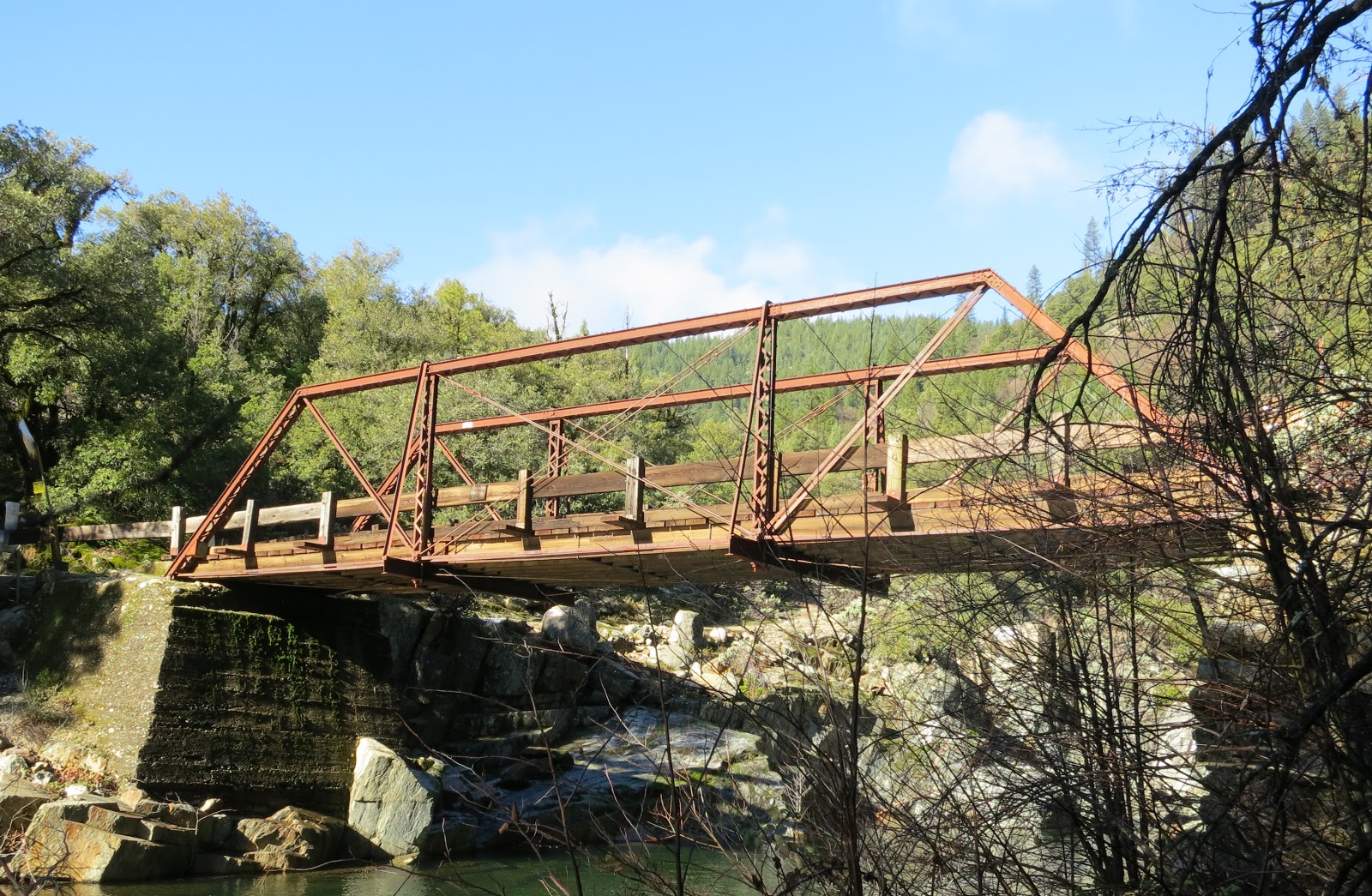

  The 1895 Maybert Road bridge crossing  Canyon Creek, pictured before it was taken down in 2016 and replaced with a modern bridge.  Nevada City plans on using the old bridge as part of its trail system in the future. 
www.bridgeoftheweek.com

  Maybert boasted a school, its own election district (32 votes were cast in the 1892 election...one was probably William's!), its own telephone company, a post office and a hotel with a saloon.  It was connected by stage to Washington, Nevada City, Downieville and other points in Nevada County.  Even though William was living and working up the mountain from Nevada City, he was able to take the stage and visit his family on Nevada Street.

  William worked at one of the sawmills in the area.  The mills served the mines; the principal mines were the Yuba, Eagle Bird, Blue Bell and the Blue Jay.  These mines had their own mills, and could pay their mill men $3-$3.50 a day.  It was a hazardous job, as I found out by looking at the 1896 Voter Registration...

1893    Death of William's aunt Harriet Bluett Hurd in Virginia City, Nevada. 

1896   William was back living in Nevada City and was recorded in the 1896 California Voter Register. He was still working as a Mill Man, but had a new injury...the end of his first finger on his left hand was gone.  I wonder if he voted for William McKinley or William Jennings Bryan? 

1898   William's brother John Wesley served in the Spanish American War as a private in the 8th California Infantry. 

1900  The California Voter Register recorded William as living in Graniteville, Nevada County, still working as a Mill Man.  He was a registered Democrat by this time. Did he vote for William Jennings Bryan? William McKinley won that rematch.  Graniteville was a small community located on the San Juan ridge separating the middle and south forks of the Yuba River.  


Google maps


 Graniteville (formerly Eureka) was a small community.  Everyone knew each other's political tendencies....
California Voter Registrations for William H Bluett 1900
Ancestry.com


1900 Williams' brother John Wesley had moved to Marysville and was working as a painter. 

1910  Death of brother John Wesley on April 5th.  He died from his injuries sustained in a motorcycle accident some months before. He was just shy of his 50th birthday.

1915  Death of William Henry Bluett on November 17th.  He was 50 years old. 


The Morning Union 18 March 1915
Newspapers.com
   
 William Henry Bluett is a collateral descendant on the Bluett tree, but thanks to a random number we got to take a much closer look at his life this week.  He wasn't a gold miner as  many of my direct descendants were, but he became a skilled mill man who was well respected in the communities he lived and worked in.  His occupation supported the mines that were economically important to the area of Nevada County. He was an integral part of the mining culture that gave Nevada City and the surrounding areas  their unique identities as part of the "Gold Country".

   William was also a son, nephew, cousin, brother, and uncle within a very loving and supportive family.  He had his own unique place in the family tree and I'm glad I took the time to dig deeper into his life.  His story weaves richer threads into our family tree tapestry, don't you think? 


  Pine Grove Cemetery late October 2020.  Photograph by PattiA. 
We are still looking for the Durbins and the Bluetts! 

Pine Grove Cemetery, Nevada City, California


References:

YubaNet.com Maybert Bridge Construction and Road Closure by Nevada County Public Works August 26, 2016  https://yubanet.com/regional/maybert-bridge-construction-and-road-closure-starting-on-monday/

 Maybert, California         https://en.wikipedia.org/wiki/Maybert,_California

Graniteville, California    https://en.wikipedia.org/wiki/Graniteville,_California


For more Bluett and Hurd family posts, click on the labels on the right.  


Thursday, July 11, 2024

#52Ancestors52Weeks...Week 28...Trains....150 Years of Family History on The Nevada County Narrow Gauge Railway. Woooo Woooo!


    Engine Number 5, an 1875 Baldwin steam locomotive that was
part of the Nevada County Narrow Gauge Railway from 1899-1940.
Photograph taken at the Nevada County Narrow Gauge Railway Museum's Second Sunday Steam-Up on  June 9, 2024 by AliA.


      This week's theme is Trains...Family on my maternal side has connections to the Nevada County Narrow Gauge Railway which span around 150 years or so and continue to this day! 


 Map of Nevada County Narrow Gauge Railroad
from Nevada County Narrow Gauge Railroad by Gerald M. Best Howell-North Books-Berkeley California 1965 Page 12.


    The Narrow Gauge Railroad ran between Nevada City, California and Colfax, California from 1876 to 1943.  It provided service between Nevada City and Grass Valley, as well as service to the station in Colfax which was a stop on the Central and then  Southern Pacific railway going east to west across the country.  The little railway provided passenger services, as well as freight, lumber and produce shipment services to the communities it served along its 22.64 mile route. It also began providing transportation for  Sunday School Picnics and Miners Picnics, where many a Cornish pasty was eaten! 


   Riding on the Narrow Gauge Railroad began with the Hurd family living in Virginia City, Nevada and the Burrows family living in Grass Valley, California.  The transcontinental railroad was completed in 1869, and passed through Reno, Nevada on its way to Sacramento, California.  Passenger service of the Virginia and Truckee  Railroad from Virginia City to Reno  began in late 1871.  The Hurds were in Virginia City by 1875 and their eldest daughter Elizabeth Jane Hurd Burrows was married to Alexander Burrows and living in Grass Valley.  If the families wanted to visit coming from Virginia City, it was just a small matter (!) of taking the V & T to Reno and then transferring to the Central Pacific line which took them over Donner Pass to Colfax.  From Colfax, they could then ride the Narrow Gauge line to Grass Valley.  The distance traveled was about 100 miles. It must have seemed like a modern revelation to be able to see family so far away in such a short time! Although, I'm sure the trip took the better part of a day or longer.  The train trip these days from Reno to Colfax is a short and relaxing three hours.  The drive from Reno on I-80 to Grass Valley takes an hour and a half to two hours depending on weather, traffic and never ending road construction.  Sometimes riding the train is still the way to go! Plus, it is still an affordable way to travel at around $30 one way. 


 From The Morning Union October 13, 1881.  Mrs. Burrows (my great great grandmother) and her children rode the train to Virginia City to visit her mother, Harriet Hurd as well as her sisters and brother who still lived there.  By this date Elizabeth Jane had 4 children; the youngest was just 9 months old.  My great grandmother hadn't been born yet. 


From The Morning Union, August 23, 1882
Harriet Hurd rode the train over the mountains to visit her daughter, Mrs. Burrows.  Trips and visitors were always hot topics in the newspapers of the day. 

   Also from The Morning Union, September 10, 1893: 

"Mrs. A. Burrows left for Virginia City about midnight of Friday, being summoned on account of the serious illness of her mother, Mrs. Hurd."  No doubt Elizabeth Jane rode the train.  Sadly, Harriet Hurd died that night on the other side of the Sierra Nevada mountains at the age of 59.  The train wasn't fast enough.  


Engine No. 5 at the Carson City Nevada Great Western Steam Up July 2, 2022. Photograph taken by PattiA. 


   Nevada County  Narrow Gauge Railroad Engine No. 5 was built in 1885 for the Carson Tahoe Lumber and Fluming Company in Carson City, Nevada. It was named "The Tahoe".  In 1899 it was purchased for the NCNGR and renumbered the No. 5; it began service between Grass Valley and Colfax and was certainly one of the several  locomotives that transported family members at one time or another. 


This picture was found in the King Album, and may have been taken at a Sunday School Picnic or other function in the woods.  I would put the date at around 1900 when the Kings were living in Grass Valley.  My great grandmother Emma King is seated on the right, second from the front.  There may be George relatives in this picture also.  Cornish scones, clotted cream,  jam and tea were on the menu! 

 
There were cars just for picnic baskets, which needed to be dropped off the evening before. Was that car packed with ice and straw?  I hope so!

    No doubt we had relatives attend these picnics, riding the train to Chicago Park.  The Kings and Hayes were members of the Methodist Church, and the Burrows and Hansens were members of the Episcopal Church.  These picnics were a community tradition and were annual affairs. It must have been exciting to have the  train ride and picnic to look forward to every year. 

    Special picnic trains also took passengers on Fourth of July excursions;  moonlight excursions, and special event trains continued for many years. The little train even brought the circus until 1893 when the circus train derailed causing two deaths.  The circus played in Colfax or Sacramento from then on.  I don't know of any relatives that saw the circus, but it would have been possible! 

 In my post of January 14, 2021 (Her Patriotism Unbounded) I shared the story of  how my great grandmother Vere Burrows took the train to Colfax in 1903 to meet Teddy Roosevelt (and she shook his hand!).  


   My great grandmother took the President's Special to Colfax where she shook the hand of Teddy Roosevelt.  She paid 50 cents for the roundtrip ride. 


Vere Burrows is in this picture somewhere!  This was a wonderful opportunity for community members to meet the President in person, and the train brought them there. 

From Nevada County Narrow Gauge by Gerald M. Best
Howell-North Books, Berkeley, California 1965.  Page 84.


   Vere Burrows also rode the little train from Grass Valley to Colfax in 1904 very early in the morning.   She and her new husband, John Hansen, caught the Southern Pacific main line in Colfax to go the coast for their honeymoon!


    Enlargement of the original newspaper article
The Daily Morning Union July 3, 1904


     By 1940 No. 5 was relegated to helper service, having survived a fire in which its cab and running boards were burned off.  The tender still shows signs of the fire by the notable wavy pattern in its sheet metal.  The Nevada County Narrow Gauge ceased operations in 1943.  The automobile and better roads made travel to the main line faster and more convenient. 

     The No. 5 (the "Tahoe") was rebuilt and  sold to Hollywood where it starred in the movie "The Spoilers" in 1942, and appeared in over 100 movies and T.V. series. It returned to Nevada County in 2018 where the boiler was restored.  It  can be found at the Nevada County Narrow Gauge Museum where it now operates. The No. 1 (The "Glenbrook") can now be found at the Nevada State Railroad Museum in Carson City.  Locomotives No. 2, 3, 4, 6, 7, 8 and 9  were all eventually scrapped. 

  We  love to celebrate our Narrow Gauge Railroad history by supporting and visiting our local museums who have done such a wonderful job preserving the historical locomotives and continue to run them for the next generations.  What a treat! We also support and ride the steam train in Virginia City, but that's a  story for another day. 


 Our Grandson was invited to sit in the cab of the Tahoe No. 5! 
July 2, 2022 Carson City Nevada Great Western Steam Up
Photograph taken by PattiA. 


 Our grandson in front of No. 5, a piece of his history! 
July 2, 2022 at the Carson City Nevada Great Western Steam Up
Photograph by PattiA.


On October 5, 2023, I had the opportunity to take the train back home from the Colfax Depot.  I did not get to ride the train from Grass Valley to Colfax as my ancestors did, (we drove), but riding the train over the Sierra Nevada mountains to Reno was a wonderful experience.  I think my ride may have been smoother than theirs!
Photograph by PattiA.


 Photograph by PattiA. 


 My view out the back window of the Amtrak car.  We were coming into Reno in the late afternoon.  This could have been a Maynard Dixon painting.  Photograph by PattiA. 


 Our son, grandson and granddaughter at the NCNGRR Museum in Nevada City, California. Photograph taken June 9th, 2024.  The No. 5 was back home in Nevada City. 


Our daughter-in-law, grandson and granddaughter in front of the Tahoe No. 5.  Photograph taken June 9th, 2024.  


 Exploring Mill Street, Grass Valley, with Grandma Boothby.  Time for some ice cream after all the history lessons!
Photograph taken by AliA.  June 9, 2024. 


References:

Nevada County Narrow Gauge Railroad Museum
https://ncngrrmuseum.org/

Nevada County Narrow Gauge by Gerald M. Best Howell-North Books Berkeley, Ca. 1965 (in our family collection). 

Nevada County Narrow Gauge Railroad Wikipedia
https://en.wikipedia.org/wiki/Nevada_County_Narrow_Gauge_Railroad

Thursday, August 17, 2023

Our Bowers Mansion Visit 2023....In Search of Valuable Heirlooms......


  Bowers Mansion, New Washoe City, Nevada
June 30, 2023
Photograph by Amy Bridges

      I've had a genealogy "to do" list for quite some time, as most avid family researchers do.  Visiting Bowers Mansion has been on my list for several years and due to Covid and various other reasons I haven't taken the time to make the 40 mile trip down the road to accomplish my goal.  It was finally  time to plan my visit.  I'm so glad I was able to share this trip with my daughter and her husband at the end of June this year!  What were we looking for?  Valuable family heirlooms, of course! 

  In a very previous post from February 19th, 2021, I told the story of how our Hurd relatives donated some items to Bowers Mansion (The Hurd Family: Valuable Heirlooms Donated to Bowers Mansion 19 Feb 2021).  At that time (1949) the community was asked to donate family heirlooms to the mansion as they began to restore it back to its former glory.  Miss Gloria Mapes  herself was president of the furnishing committee.  Over 500 people donated items, including Annie Hurd Smith, Edith Hurd (my Great Great Aunts)  and Alta Powers (daughter of Hattie Hurd Powers, another Great Great Aunt). 

  Earlier that month I had contacted the curator of Bowers Mansion, Tammy Buzick.  She knew right away what family I was talking about and even knew where one item was (in the upstairs Porters closet)!  She had a file somewhere on her desk....and what day would be good to come visit? My daughter Amy and her husband David were going to be in town for a summer visit, so we all decided to go on the search together. 

  What exactly were we searching for?  This is an excerpt from the Nevada State Journal article, 7 March, 1951, listing the items.  

  Piano Cover

  "Now, on the piano in the Bowers Mansion is the piano cover that covered the Steinway piano sent around Cape Horn to James Fair, one of the 'Big Four' of those early days. This is a gift of Alta Powers, of Oakland."

  "It is a large cover, 6x7 feet, of beautiful tapestry. Its colors are blue and tan, and completely around the cover is a deep fringe. The piano was purchased by Robert Meacham, the only coal and wood dealer in Virginia City at that time, and by him given to Alta Powers, his granddaughter, a daughter of Mrs. Ina Powers Sample, of Pasadena, California. (Correction:  Ina was Alta's older sister, not her mother). Mrs. Sample died a few years ago, and the piano was disposed of, but Alta Powers kept the piano cover, which is now the property of Bowers Mansion."

Other Gifts


  "From Mrs. Annie Hurd Smith and Miss Edith Hurd, the mansion received some exquisite pillow slips, bordered in crocheted lace seven inches wide, with insertions set between clusters of hand run tucks.  At the same time Miss Hurd and Mrs.  Smith gave Bowers Mansion some pillow shams, less ornate, embroidered in turkey red thread, and some splashers, fringed and embroidered in turkey red hem are handmade, indicating that the women of that day had much time to spend on work of this kind."

  "But probably the most valued gift received from the members of the Hurd family was one of the original bedsteads that was purchased for the mansion by Eilley and Sandy Bowers, bought from them by Robert Meacham and in turn turned over to the Hurd family. The chair, table and bureau of the early days that were part of the bedroom suite are in Pasadena, but the original bed has never left Nevada, and in the spring will be placed in a suitable room in Bowers Mansion."

  Now those were wonderful descriptions! We could not wait to see these valuable heirlooms.   Here's what we actually found.....


 This is a signed slip giving Washoe County entitlement to Edith Hurd's personal property, namely "One pair lace trimmed pillow slips, One other lace trimmed pillow slips, Two outlined "Splashers" and One pillow sham". 


Mrs. Hattie Powers donated the Walnut Bed Stead.  Notice the ? after the entry.....


  Miss Alta Powers donated the Tapestry Piano cover.  Notice the ? after the hand written entry....

  Unfortunately, and rather disappointingly, the walnut bedstead, the piano cover  and the pillow cases/sham were not found during an inventory done in 1971.  Tammy explained that some items were sold off at one point, and that things like piano covers and pillow cases and pillow shams did not have a long life and were probably discarded at some point before 1971.  The only items left were the splashers.  At least we still had those!


The splashers could be found in the North Porter closet in 1970 and were located in the dining room in 1972.  As of 2023, they were back in the closet.  Tammy knew right where they were and gingerly took them out of their container; she then generously displayed them for us.  Here they are...


 Close up detail of the embroidery and crochet work.  They are in remarkable condition still....

These are embroidered in Turkey Red thread which was a bit more expensive than regular thread, and was colorfast.  Red work was all the rage beginning in the 1880's. Embroidered splashers were hung behind the sink or on wash stands to protect the walls.  http://www.womenfolk.com/quilting_history/redwork.htm

  I wonder if these were ever used?

  Mom (Margaret Hansen Boothby) still does red work embroidery and uses it in her exquisite quilts.  These splashers reminded me of the work that Mom does.  I was surprised to learn how long this beautiful craft has been in existence!  And how it has continued in our family after many, many years.  That was a pretty special connection.


  Finding these treasures made the trip worthwhile, even though the "big" items were no longer at the mansion. I had my heart set on seeing that bedstead and piano cover.  But,  just looking at the embroidery and crochet work brought me that much closer to knowing my relatives and learning about this  part of their lives.  They probably had  embroidery and crochet projects going for years....all those pillow cases and pillow shams, towels, dresser scarves , napkins, chair covers...... I could visualize one of the Hurd girls sitting by a lamp or window working on this particular project, thimble on one finger and needle and thread going through the linen over and over.  I have fond memories of learning embroidery from my Nana (Emma King Hayes VanDuzer) and working on my own pillowcase projects.  And, there is nothing like seeing tangible objects from a family member's life that tell a unique story.  Priceless. 

  Tammy was done showing us our "valuable" heirlooms.  She has worked as the curator at the historic mansion for 14 plus years and is very knowledgeable about the contents of the museum as well as the Bowers family that lived there long ago.  She is also very passionate about her work and was so excited to show "donor" members (that's us!) the beautiful home.  We got an almost private tour, as there was one other couple there to see the mansion that morning.  They were as impressed with the splashers as we were! If you get a chance to visit the mansion (located in Bowers Mansion Regional Park) there is a great tour filled with lots of history of the Comstock.  I feel so privileged to be a part of that history and of being able to pass it on.  And I'm glad Amy and David came along.  We extended our trip to Virginia City (home of the Hurd girls) and toured the Fourth Ward School once again, searching for some of David's family Comstock history this time.  It was a great day of discoveries and  of spending time together as a family. 

  I would still love to know what happened to that bed!


These pictures were taken by Amy Bridges and Patti Alden June 30, 2023


 This is a walnut bedstead in one of the bedrooms.  It must have been similar to the one from the Hurd family.  


 This is an older photograph of the mansion when it had a third floor, which removed during the restoration. 


 This is a framed map of the V & T Railroad when it went passed the mansion, taking passengers from Reno or Virginia City or Carson City to Washoe Valley for a day trip.  


 The view from the second story hall overlooking Washoe Valley. 


 The fountain on the front lawn. 


 PattiA., AmyB. DavidB. June 30, 2023

Relationship Reference:  Me->Margaret Hansen Boothby->Harold Hansen->Vere Burrows Hansen->Elizabeth Jane Hurd Burrows.  

The "Three Hurd Girls" were Elizabeth Jane's younger sisters.  Her sister Hattie Hurd Powers was the mother of Ina and Alta Powers. 


Here is the article in its entirety as it appeared in the Nevada State Journal, March 7, 1951


Original Bedstead, Other Valuables Given To Bowers By Hurd Family

 "Last week, Mrs. B.R Addenbrooke, curator of the Bowers Mansion, received some precious heirlooms that were part of the mansion's original furniture." 

  "They were gifts of the 'three Hurd girls', two of whom are living today in Reno.  Mrs. Annie Hurd Smith and Miss Edith Hurd, two of the well known 'three Hurd girls' in Virginia City in the heyday of the Comstock, live at 120 Stevenson St. in Reno.  Unfortunately many of the pictures of those historic days which the sisters had were destroyed in the flood last winter."  (The Thanksgiving Flood of 1950)

  Piano Cover

  "Now, on the piano in the Bowers Mansion is the piano cover that covered the Steinway piano sent around Cape Horn to James Fair, one of the 'Big Four' of those early days. This is a gift of Alta Powers, of Oakland."

  "It is a large cover, 6x7 feet, of beautiful tapestry. Its colors are blue and tan, and completely around the cover is a deep fringe. The piano was purchased by Robert Meacham, the only coal and wood dealer in Virginia City at that time, and by him given to Alta Powers, his granddaughter, a daughter of Mrs. Ina Powers Sample, of Pasadena, California. (Correction:  Ina was Alta's older sister, not her mother). Mrs. Sample died a few years ago, and the piano was disposed of, but Alta Powers kept the piano cover, which is now the property of Bowers Mansion."

Other Gifts


  "From Mrs. Annie Hurd Smith and Miss Edith Hurd, the mansion received some exquisite pillow slips, bordered in crocheted lace seven inches wide, with insertions set between clusters of hand run tucks.  At the same time Miss Hurd and Mrs.  Smith gave Bowers Mansion some pillow shams, less ornate, embroidered in turkey red thread, and some splashers, fringed and embroidered in turkey red hem are handmade, indicating that the women of that day had much time to spend on work of this kind."

  "But probably the most valued gift received from the members of the Hurd family was one of the original bedsteads that was purchased for the mansion by Eilley and Sandy Bowers, bought from them by Robert Meacham and in turn turned over to the Hurd family. The chair, table and bureau of the early days that were part of the bedroom suite are in Pasadena, but the original bed has never left Nevada, and in the spring will be placed in a suitable room in Bowers Mansion."

 Former Teacher

  "Edith Hurd, who came from Pennsylvania to Virginia City when she was six months old, knew the 'Big Four' of that era very well.  She taught school later in Virginia City.  Her father, William Hurd, was a mining engineer in Virginia City and her brother, John H. Hurd, ran a hoist in the old C and C Mine."

  "The 'Three Hurd Girls' are the survivors of a family of 11.  Their father, William Hurd was killed in an accident in Virginia City.  Mrs. Hattie Hurd Powers was one of the three sisters and Alta Powers is her daughter."

  "Both Miss Gloria Mapes, president of the furnishing committee, and Mrs. Addenbrooke, curator of Bowers Mansion, were very happy yesterday when they got the history of the old bedstead, one of the original pieces of furniture in the mansion.  The response of the 'old timers' who wish to see the mansion restored to its original splendor has been remarkable, and the work of completing the job has been speeded up through the cooperation of many to whom the early day history of Nevada has become highly important."