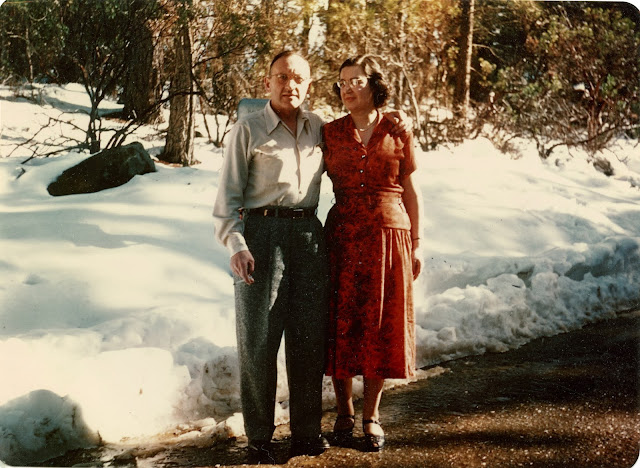
Showing posts with label Betty Hansen. Show all posts

Thursday, June 6, 2024

#52Ancestors52Weeks....Week 23 Theme....Health....Grandma Was Administered the Necessary Antivenom For Rabies


 Newspaper article from the Sacramento Bee, Monday, August 27, 1934
Newspapers.com


      This week's theme is Health.  I came across this little article a few months ago on Newspapers.com.  I had never heard any stories about my grandmother being  bitten by a rabid dog when she was little!  And neither had Mom.  This story was just too incredible.  I had to do some more research...


      At first,  reading this article didn't make any sense.  Grandma (she was Betty Hayes, but went by Van Duzer after Nana remarried) was not quite 17 when she was bitten that summer.  So, the description of her as Emma Van Duzer's small daughter just didn't fit.  I did some more digging in the local paper, The Morning Union.  


 The Morning Union August 23, 1934
Newspapers.com

    So, the real story was that Grandma was bitten by a small dog.  The paper in Sacramento had gotten a few details wrong, taken from the article below, as it turned out.  What was going on in Grass Valley that summer? 


   The Morning Union August 23, 1934
Newspapers.com

     This reporter described Grandma as a small child. Which wasn't quite true.  But, the story peaked my interest.  How did people survive rabies 100 years ago? 


 Margaret Elizabeth Hayes Van Duzer 
November 7, 1917-March 26, 1991
This was Grandma's 1936 high school graduation picture, taken a year after her rabies scare. 
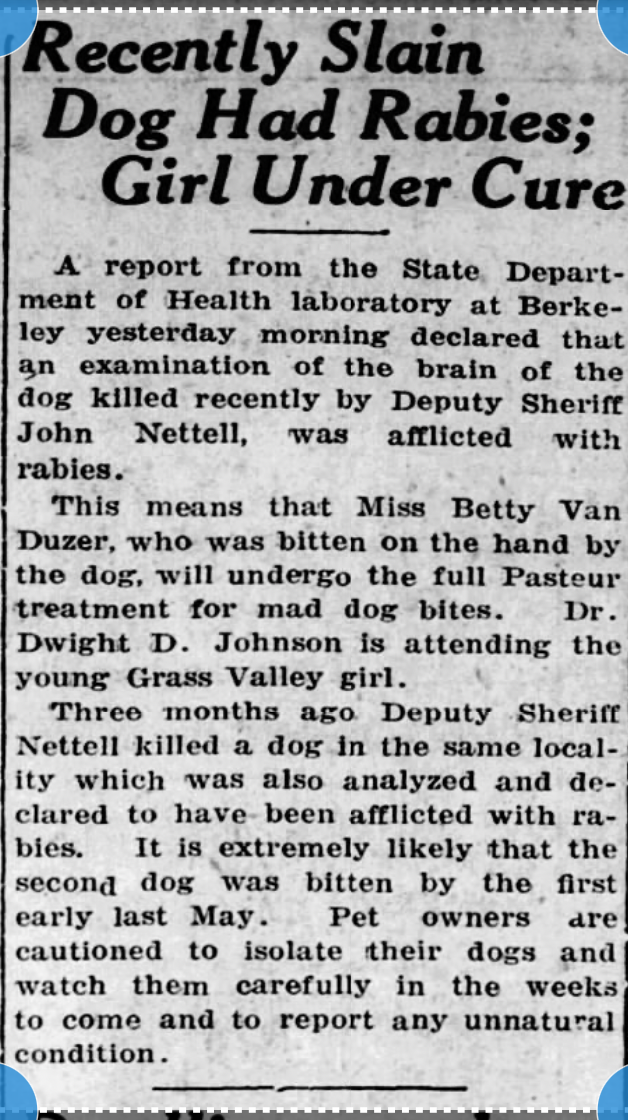

 
The Morning Union August 25, 1034
Newspapers.com

     Nowadays we vaccinate our pets against rabies and incidents in humans are rare, thank goodness.  But 100 years ago that wasn't the case.  How did doctors treat exposure to the fatal viral disease? What treatment did Grandma experience?  


  "Notice:  This Rabies Vaccine Treatment will comprise a total of 21 doses, to be administered in numerical order, one dose each day for 21 days"....
National Museum of American History
Outside of a rabies vaccine outfit from the 1920's.


 The inside of the rabies vaccine outfit from above.
National Museum of American History


 The vaccine, syringe, and plunger from the museum's rabies vaccine kit. 
National Museum of American History

    Louis Pasteur developed the first rabies vaccine in 1885, and getting treatment was difficult for most people as it was not widely available.  People had to travel great distances and spend time and money receiving treatments in "Pasteur Institutes".   By 1911 a new rabies kit was developed which could be shipped directly to doctors making treatment not only affordable, but widely available.  

  The treatment itself (in 1911) consisted of 25 injections of rabies vaccine: three on the first day, two on the second, two on the third, and one each day after for 18 days.  This helped the body build up immunity to the virus.  By 1920 the treatment had been reduced to 21 injections.  Injections were given in the stomach. This is what my grandmother had to experience! 

   Today, the post exposure treatment for rabies consists of four doses of vaccine over a two week period, given in the arm.  Which is what my daughter and son-in-law experienced this spring after waking up to a bat in their bedroom!  It turns out this is standard protocol for someone who wakes up to a bat in their room.  Apparently it is difficult to tell if you have been bitten or not.  Doctors still take extra precautions, as once you've been bitten and symptoms develop the mortality rate is nearly 100 percent. 

    Rabies remains a serious disease, although it is more prevalent in Asia and Africa where vaccines are often inaccessible or unaffordable to marginalized populations.  It causes 30,000-70,000 deaths a year, world-wide. 

   I am thankful that Grandma had a treatment available to her in August of 1934, although I couldn't  imagine going through 21 days of injections in my stomach.  It was something that had to be endured, as it would have been her only option aside from experiencing a very painful, early death.  I have to wonder why this very scary incident of her teenage years was not passed down.  It was a very interesting story to me, anyway! 

Resources: 

National Museum of American History: Surviving Rabies 100 Years Ago    By Diane Wendt, NMAH October 28, 2013

World Health Organization: Rabies June 5, 2024


Relationship Reference:

Me->Margaret Hansen Boothby->Margaret Hayes Hansen (Betty)->Emma King Hayes Van Duzer
    

Sunday, January 21, 2024

#52Ancestors52Weeks...Week 4...Witness to History...Betty Hansen and the Top Secret SR-71 Blackbird


 Betty Hansen's Skunk Bracelet. The charms are a Skunk, a U-2 Aircraft and the SR-71 Blackbird. 

In the possession of Margaret Hansen Boothby.


  The topic for Week 4 of the 52 Ancestors in 52 Weeks writing challenge is Witness to History.  My grandmother, Betty Hansen (Margaret Elizabeth Hayes), was born in 1917 during World War 1, her husband fought in World War 2 and she worked in a civilian capacity at McClellan Airforce Base during the Korean War. When the Cold War was on there was a secret effort to build an airplane that would greatly improve intelligence gathering and that couldn't be shot down like Gary Powers' U-2 aircraft was in May of 1960.  Grandma witnessed the birth of the SR-71 Blackbird program at Beale Airforce Base (Ca.),  came to know many of the pilots, and was part of the civilian team at Beale from 1967 to her retirement in 1979.  The SR-71s out of Beale flew reconnaissance during the Viet Nam War until 1975.   


 Grandma worked at McClellan Airforce Base in the North Highlands area of Sacramento during the Korean War.  She commuted everyday from her home in Grass Valley, California leaving at 6 am in the morning and arriving home at 6 pm at night. Her position was not necessary after the war so she applied for a position at Beale Airforce Base, just outside of Marysville. The job was a secretarial position as opposed to her McClellan job which was duty as an airplane part "washer".  Certainly the new job was easier, as was the commute!


  While at Beale, Grandma was transferred to a job that required special security clearance and was Top Secret.  She warned her family that the FBI might be calling as she needed a background check.  She ended up working as a Civilian Supply Clerk to the SR-71 project in 1967. 

   The SR-71 was developed as a top secret project by Lockheed's Skunk Works division during the early 1960's. It was developed from the ground up in a mere 20 months as a result of a pressing Cold War-era need for a high speed, high altitude strategic reconnaissance aircraft.  The U-2 was simply too slow.   From the U-2 evolved the A-12 and then into the final SR-71 Blackbird (named because of its dark color).  It's existence wasn't revealed to the public until July of 1964.  The first Blackbird to enter service was delivered to Beale Airforce Base on January 7, 1966. From Beale AFB the Blackbirds flew to the Kadena AFB in Okinawa where they then flew and performed strategic reconnaissance over North Vietnam and Laos for several years. 


My husband and I saw an SR-71 at the McMinnville, Oregon Evergreen Aviation Museum several years ago.  It was impressive!

    To this day, the titanium covered SR-71 holds the records for the world's fastest jet-propelled aircraft and the fastest aircraft to be propelled by air-breathing engines.  It could attain speeds of Mach-3 (over 2,000 mph) and cruise at altitudes of up to 85,000 feet.  The SR-71 served for more than two decades before being retired in 1990. It was briefly reactivated between 1995 to 1998 and finally retired in 1998. This once top secret, legendary aircraft played a major role in the Cold War and also performed missions in the Middle East, Vietnam and North Korea. 


  While working at Beale with the SR-71 team over the years Grandma had several memories that stood out to her. She worked in an office with a lot of officers involved in the project and after awhile got to recognize and know some of the test pilots. She was liked and respected in the office so much that one of the pilots came to her one morning and said he would be flying to Japan that day.  "Would she like him to pick up anything at the BX?"  She asked if he could look for a doll for her granddaughters; that's what he brought back for her that very afternoon! The beautiful doll was part of our extensive and multicultural doll collection for years. Imagine flying to Japan and back all in one day!

Our doll was very similar to this one and stood 18" high.  Sadly, the original didn't make it 50 years into the future. 

  Another memory she loved to relate was when she was invited to a special event with other civilian workers to have breakfast with the pilots. The pilots gave a demonstration on how they suited up for their flights (they needed specialized protective pressurized suits) and it was a very complicated process to get the suits on.  It must have been fascinating to watch! 


Buddy Brown and Dave Jensen in front of an SR-71 wearing their special flight suits.
theaviationgeek.com 

 Buddy Brown and Dave Jensen took off on March 8, 1968 from Beale AFB at 11 am and arrived in Kadena at 9 am, two hours before they took off from Beale.  They beat the sun! Were these the pilots that brought back our doll? Probably not.  I believe we acquired our doll in the mid 70's. 


     Grandma wasn't the only one to watch the SR-71 fly;  many residents in the Grass Valley and surrounding areas experienced what they thought were alien space ships flying overhead in the 70's and 80's.  They related how quiet the craft was flying overhead and how they didn't hear it until it was out of sight. The Blackbirds were doing touch and goes out of Beale or doing test flights. I remember the frequent sonic booms that shook our windows and Dad's fishtank! 
(FB private group  You Know You're From Nevada County If You Remember...January 2024)


 Betty Hansen's retirement picture from Beale Airforce Base 1979 showing the SR-71 Blackbird in flight. It was signed by co-workers at the base. 


Betty Hansen's retirement picture from Beale Airforce Base 1979 showing the U-2 and the SR-71 in flight. 

   These two pictures hung in Grandma's home and now hang in mine.  They were given to her by her coworkers at Beale. One inscription says "Don't get too much sand in your bikini in Tahiti....Good Luck!" or "The ASPO will miss the continuity and outstanding support you have provided to the program"....She enjoyed her retirement trip to Tahiti and later on to Alaska with Grandpa.  They brought back more dolls for our collection.  


Grandma and Grandpa's 40th Wedding Anniversary in 1979.  Held at the Methodist Church in Grass Valley, California.  The dress was made by her daughter Margaret Hansen Boothby with fabric from my parents'  trip to Hawaii.  This was just after Betty's retirement. 


Grandma and Grandpa Hansen with Margaret Hansen Boothby December 1980.  Grandma looks very relaxed after her retirement!


  I  wonder what supplies she ordered for the project...top secret parts? Top secret materials? Toilet paper? Ball point pens? She couldn't say.  She certainly had a front row seat to one of the great chapters in aircraft history. All of her life was marked by war.  She understood how important this next chapter was to the country and she was proud to be a part of it.   She wore her bracelet after her retirement and loved to tell about her time at Beale.  

(Thanks to Margaret Hansen Boothby for helping with this story! I love our collaborations!) 


   The SR-71 was developed as a top secret project by Lockheed's Skunk Works division during the 1960's.  The name Skunk Works was taken from the "Skonk Oil" factory in the comic strip Li'l Abner.  After WWII a select team was brought together to develop a new aircraft; they had to operate in strict secrecy.  Their operation was housed in a large army tent at what is now  Burbank airport.  In the same neighborhood was a plastics factory that produced a terrible odor that permeated the tent. In the comic strip Li'l Abner there was a running joke about a mysterious place deep in the forest called the "Skonk Works".  There, a strong beverage was brewed from skunks, old shoes and other strange ingredients. The odor was so bad that everyone stayed away from the people that worked there. One day, the phone rang at the top secret site and was answered by a team engineer who was a fan of the comic strip.  He answered "Skonk Works, inside man Culver speaking..." Soon the employees adopted the name for the mysterious division of Lockheed.  The name eventually evolved into Skunk Works and is an official pseudonym for Lockheed Martin's Advanced Developmental Programs. The group was known for its unfailing sense of duty , its creativity in the face of technological challenges and its undaunted perseverance.  https://generalaviationnews.com/2005/11/04/how-skunk-works-got-its-name/

Resources:

 https://www.lockheedmartin.com/en-us/news/features/history/blackbird.html

https://www.beale.af.mil/News/Article-Display/Article/2102872/legendary-sr-71-blackbird/

https://en.wikipedia.org/wiki/Lockheed_SR-71_Blackbird

https://www.cnn.com/style/article/sr-71-blackbird-spy-plane-design/index.html


Relationship Reference:  Me->Margaret Hansen Boothby->Margaret Elizabeth Hayes Hansen (Grandma; Betty). 

Wednesday, January 17, 2024

#52Ancestors52Weeks....Week 3...Favorite Photograph.....Margaret Elizabeth Hayes Hansen


 Margaret Elizabeth Hayes Hansen ("Betty")


   I have not posted much about my maternal grandmother Margaret Elizabeth Hayes Hansen on this blog, probably due to the fact that I have boxes and boxes of pictures from this side of the family I am still slowly wading through.  I remember taking this one out some time ago and scanning it right away because it was so special. I've kept  this picture on my bookshelf for quite awhile now because really it is one of my favorites!  


 Grandma's picture is small.  Her future mother-in-law sits above her, her great grandchildren sit beside her.  

   I particularly love this picture because it shows Grandma as a teenaged girl, perhaps around 15 or 16, which would put the date of the photograph at about 1933 or so.  A snapshot in time. According to the 1930 US Census she was living "Back off the Auburn Highway" in Grass Valley, California, with her mother Emma King Hayes VanDuzer, her stepfather George VanDuzer and her two sisters Dorothy (Auntie Dot) and Frances (Auntie Fran). She was the baby of the family, having been born in 1917. The census records the family as owning a radio and living on a farm (they probably raised chickens).  At that time, they were far enough out of town that it was still pretty rural. Mr. VanDuzer was a local barber. 

  This picture was probably taken in Grass Valley, although it could have been taken in Los Altos where Papa and Granna (pronounced Gran-ay) lived on their prune farm on Grant Road.  The girls were frequent visitors to their grandparents' home and had a close relationship with them. 

  Grandma's picture is in a small paper card, perhaps to make it more sharable with friends and family. 

front cover

 Did she have several copies made?  Who did she share them with? She had probably just started high school and a picture this size would have been perfect for sharing with friends. What I love about this picture is her smile, and how happy she looks. I wonder: Did she like school? Who were her school friends? What did she like to do for fun? She looks like she has the whole world ahead of her.  

  Eudora Welty was quoted as saying "A good snapshot keeps a moment from running away".  I think that's what I love most about this little picture.  This moment was preserved forever. 


Relationship Reference:  
Me->Margaret Ann Hansen Boothby->Margaret Elizabeth Hayes Hansen 

Sunday, November 14, 2021

52Ancestors52Weeks Week 45 Theme: Stormy Weather ........Snow , Snow and More Snow! Family Pictures Are Wonderful Documentation of Storms.....


  This week's theme is stormy weather....I have always been struck by how many pictures I have of family members posing in the snow.  Living in Northern California and Northern Nevada always meant winter and spring snow storms.  What better way to remember the fun after the storm than by having your picture taken? 

  These are a few pictures taken from various family albums on both my mother's and father's side of the family.  They document how we all "weathered" the storms in our own  neck of the woods.  Enjoy!


*****


Written on back...."Gertrude Elizabeth, her two sleds and her two playmates and all the snow we've had this winter"  (no date).....probably taken around the early 20's.  Reno, Nevada.  Gertrude Burrows (middle) lived on Thoma Street in Reno with her parents Roy and Lucie Burrows. 


Dorothy Ross Hayes  in the snow with her dog.  Auntie Dot was born May 17, 1910, and this picture looks like it may have been taken around 1915/16-ish.  Grass Valley, California. 


Dorothy Hayes (Arthur) fourth in from the left and Betty Hayes (Hansen) on far right, bending over.  Auntie Dot was born in 1910, and Grandma (Betty) was born in 1917, so this was probably taken around the early 30's.  It looks like a girls' day out in the snow, somewhere in northern California, complete with skis and a sled.  


Robley Hansen (Bob) with giant fur mittens.  Taken around the late 20's, early 30's.  Uncle Bob was living in Reno at this time.  From the Bob Hansen Family Album. 


Claire and Margaret Hansen (Mom) wearing their wool snowsuits after a Grass Valley snowstorm around  1946-47? This is one of the pictures that survived the 1950 house fire.  This is one of my favorite pictures!


 Lavinia Claire Hansen in her wool snowsuit.  Taken the same date as the above picture. 


 Millicent Gay Hansen on a toboggan on her way down a street in Reno, Nevada.  Gay was born March 9, 1934 so this picture may have been taken around 1936.  Her parents were Robley (Bob) and Alma Hansen.  From the Bob Hansen Family Album. 


Skip Hansen and Greta in front of the new house on Arlington in Reno Nevada, 1948.  Skip's parents were Robley (Bob) and Alma Hansen.  From the Bob Hansen Family Album. 


  Alma and Bob Hansen after the snowstorm in 1948.  I love the perspective in this picture!   From the Bob Hansen Family Album.  


*****

And, yes, I have pictures of houses and neighborhoods to go with pictures of people in the snow! 


Francis (Hayes)  and Joe Holman's house in Grass Valley after a 1946 snowstorm.  Auntie Fran and Uncle Joe lived across the street from Nana (Emma King Hayes Van Duzer) and the Harold Hansen family on South Auburn street for awhile.  This is another picture that survived the fire at the Hansen house in 1950.  I believe this is the same storm that my Mom and Auntie Claire are pictured in above. 


1012 S. Arlington, Reno, Nevada.  "First Winter in Home That Bob Built 1948".  Taken from the Bob Hansen Family Album. 


Unknown young man shoveling snow in front of Grass Valley Drug mid to late 40's.  Sterl Boothby was owner and head pharmacist in the late 40's and then the 50's. 


Frank and Dena Brondolo.  Picture taken in 1952, on Mainhart Drive,  Grass Valley, California.  They lived in San Francisco, but loved coming to Grass Valley and then up to Reno for some casino fun.  Frank was Terry Brondolo Boothby's (Nino's) older brother.  From the Brondolo Album.


 Mainhart Drive in a snowstorm, sometime in the 50's.  Grass Valley, California.  This is the house that my Dad, Dale Boothby, grew up in!


Late 1960's snowstorm on Banner Mountain, Nevada City, California. That is Dad's (Dale's) jeep buried in the snow.  This is the house that I grew up in!


The Alden home after a January 2021 snowstorm, Reno, Nevada.  


Still documenting!  (My Grandson ).....Reno, Nevada. 


*****


Tuesday, April 28, 2020

The Life Story of Harold Hansen (continued) (Hansen)

Margaret Elizabeth Hayes and Harold Lloyd Hansen
2 July, 1939
  Harold Hansen's Life Story is compiled from his own writings and audio cassettes that he recorded in 1991.  They were transcribed and written down by my Auntie Claire.  We continue with Harold's story after he completed his trip to Norway.  Louise, the young lady he thought he had been in love with, had gotten married while he was gone.  The family story goes (as retold by Margaret Hansen Boothby) that when he went to see her she met him at the door and told him he had been gone too long.  She had met and married someone else.  She then proceeded to "throw all my stuff at me" (things he had given her).  But, that was not the end of his story.  

  "The young lady that I thought I was in love with had gotten married while I was gone.  I lost interest in being a sailor, as it was hard work and not as exciting as I had expected.  So, I went to work at the Idaho-Maryland Mine."

  There I worked as a rock crusher that prepared rocks for the stamp mill, for $2.88 per hour.  In a couple of months I went to work as a 'mucker' underground with partners Jack Dunavan, Ernie Angove and Homer Simon at the 850 foot level.  That's where (we had) a close call down there.  In the process of running a drift we had to drill a new piece of ground.  At the end of the drift was a pile of muck blasted down the day before.  Jack and I were shoveling out the pile of muck into the shoot.  We went to eat lunch when there was a drip where we were sitting.  We heard the tommy knocker warn us to get out of the way.  When that happened underground, we were thankful for the warning.  Another time I turned up a whole stick of  powder with the blasting cap still there.  The cap was on the end of my pick.

  After some time working in the mines I decided that mining wasn't for me.  So, I went to work for Uncle Roy, mother's brother, in Reno.  He had an iron works making columns for buildings.  I went to the Baptist Church with brother Bob and Alma.  All along I  kept up my singing in churches and for concerts.  There in Reno someone suggested that I take singing lessons.  So, I went to Oakland, Ca because I found that there were some good teachers there. 
Caption on the back...The "Ensign" in the "Sho-Gun"
Heath Club Show at Auditorium Oct. 1-2 1937

  First, I found a Welsh man.  He had me think of singing with expression, feelings. He didn't give lessons though.  Paul Ralston was an organist and he gave me the name of a woman who lived in the Piedmont.  She taught me to breath properly, sing right, and I had to find places to sing while she coached me. As she was a Christian Scientist, she told me of some churches that were having tryouts for soloists.  I went to these try outs and I won a position with the 2nd Church of Christ Scientist in the Fruitvale area of Oakland where I worked for 3 years.  Each Sunday (I sang) new songs that were not repeated for 6 months.  I found a practice room too.  Also  in those years, I had a radio spot on KROW Oakland, 1934-35, but as I couldn't get a sponsor the station dropped my show as it was the depression days.  I went back to Grass Valley to work in the mines. 


The Idaho-Maryland Mine as it looked in the 1930's

  I kept up singing in churches of Grass Valley. There was a woman who came to me to ask if I would come to the Methodist Church to help them with their Easter music.  She just cornered me on Mill Street one day.  Her name was Emma Van Duzer.  Well, I did attend their practice.  There I met up with Emma's daughter, Betty, who was a sweet soprano in the choir.  She wanted some help with her singing.  So, I went to her house.  Well, I took a shine to her from the start.  I don't know if she ever had any lessons.  But, she became my wife on July 2, 1939, until she died March 26, 1991. We had just celebrated our 50th (wedding anniversary) with a big family party a couple of years before her death."  


Emma Van Duzer with Harold Hansen

Jack Hansen Harold Hansen Margaret Hayes Hansen Dorothy Hayes
Methodist Church Grass Valley, Ca  2 July, 1939


Betty and Harold Hansen 2 July, 1964
25th Wedding Anniversary


                                                           Harold and Betty Hansen sometime in the 1980's.  


    Harold Hansen went on to serve in WWII along with both of his brothers,  raise two daughters with Betty, and continued to sing tenor in the choir at the Grass Valley United Methodist Church until his death, 21 October, 1993.