Showing posts with label Vere Burrows Hansen. Show all posts

Wednesday, January 15, 2025

#National Hat Day.... Vere Burrows Hansen Poses in Her Hat


Vere Hansen (on left) with an unknown group of adults.  Her oldest son Jack Hansen is standing in front of the group. This was probably taken around 1911 or so.  Enlarged from the original.
From the Hansen Family Photograph Album

  
    Happy National Hat Day!  Yes, there is such a thing.  It has been celebrated since 1983, and the date marks an occurrence that took place on January 15,  1797 when London haberdasher John Heatherington appeared in court.  His crime was disturbing the peace by wearing the first ever top hat in public. Several women fainted and a young boy broke his arm after being frightened by the tall hat.  Imagine that!

   The above photograph was found in the Hansen Family photograph album.  My great grandmother, Vere Hansen, is sporting a very fashionable hat for the day (this picture was taken around 1911-1912).  Women's hats around this time were at their largest; the brims often extended beyond the wearer's shoulders.  Hat pins (some as long as 18") were skewered through the hat and the hair to secure the headpiece.  The unknown ladies posing with Vere are sporting stylish headwear also.  


   This is the original photograph. It almost looks like this group is on a boat; the photo may have been taken in San Francisco while Vere was staying with her mother because her husband John Hansen was away in Central America. It may also have been taken when Vere and little Jack boarded a ship to La Union, San Salvador, to meet John in 1912.  The young woman third from the left might be Vere's sister Gladys Burrows at around 19 years of age. 

    This photograph was found in Vere's family photograph album.  No identification was found on the back. 


Relationship Reference:
Me->Margaret Hansen Boothby->Harold Hansen-Vere Burrows Hansen m. John Hartwig Hansen


Thursday, July 11, 2024

#52Ancestors52Weeks...Week 28...Trains....150 Years of Family History on The Nevada County Narrow Gauge Railway. Woooo Woooo!


    Engine Number 5, an 1875 Baldwin steam locomotive that was
part of the Nevada County Narrow Gauge Railway from 1899-1940.
Photograph taken at the Nevada County Narrow Gauge Railway Museum's Second Sunday Steam-Up on  June 9, 2024 by AliA.


      This week's theme is Trains...Family on my maternal side has connections to the Nevada County Narrow Gauge Railway which span around 150 years or so and continue to this day! 


 Map of Nevada County Narrow Gauge Railroad
from Nevada County Narrow Gauge Railroad by Gerald M. Best Howell-North Books-Berkeley California 1965 Page 12.


    The Narrow Gauge Railroad ran between Nevada City, California and Colfax, California from 1876 to 1943.  It provided service between Nevada City and Grass Valley, as well as service to the station in Colfax which was a stop on the Central and then  Southern Pacific railway going east to west across the country.  The little railway provided passenger services, as well as freight, lumber and produce shipment services to the communities it served along its 22.64 mile route. It also began providing transportation for  Sunday School Picnics and Miners Picnics, where many a Cornish pasty was eaten! 


   Riding on the Narrow Gauge Railroad began with the Hurd family living in Virginia City, Nevada and the Burrows family living in Grass Valley, California.  The transcontinental railroad was completed in 1869, and passed through Reno, Nevada on its way to Sacramento, California.  Passenger service of the Virginia and Truckee  Railroad from Virginia City to Reno  began in late 1871.  The Hurds were in Virginia City by 1875 and their eldest daughter Elizabeth Jane Hurd Burrows was married to Alexander Burrows and living in Grass Valley.  If the families wanted to visit coming from Virginia City, it was just a small matter (!) of taking the V & T to Reno and then transferring to the Central Pacific line which took them over Donner Pass to Colfax.  From Colfax, they could then ride the Narrow Gauge line to Grass Valley.  The distance traveled was about 100 miles. It must have seemed like a modern revelation to be able to see family so far away in such a short time! Although, I'm sure the trip took the better part of a day or longer.  The train trip these days from Reno to Colfax is a short and relaxing three hours.  The drive from Reno on I-80 to Grass Valley takes an hour and a half to two hours depending on weather, traffic and never ending road construction.  Sometimes riding the train is still the way to go! Plus, it is still an affordable way to travel at around $30 one way. 


 From The Morning Union October 13, 1881.  Mrs. Burrows (my great great grandmother) and her children rode the train to Virginia City to visit her mother, Harriet Hurd as well as her sisters and brother who still lived there.  By this date Elizabeth Jane had 4 children; the youngest was just 9 months old.  My great grandmother hadn't been born yet. 


From The Morning Union, August 23, 1882
Harriet Hurd rode the train over the mountains to visit her daughter, Mrs. Burrows.  Trips and visitors were always hot topics in the newspapers of the day. 

   Also from The Morning Union, September 10, 1893: 

"Mrs. A. Burrows left for Virginia City about midnight of Friday, being summoned on account of the serious illness of her mother, Mrs. Hurd."  No doubt Elizabeth Jane rode the train.  Sadly, Harriet Hurd died that night on the other side of the Sierra Nevada mountains at the age of 59.  The train wasn't fast enough.  


Engine No. 5 at the Carson City Nevada Great Western Steam Up July 2, 2022. Photograph taken by PattiA. 


   Nevada County  Narrow Gauge Railroad Engine No. 5 was built in 1885 for the Carson Tahoe Lumber and Fluming Company in Carson City, Nevada. It was named "The Tahoe".  In 1899 it was purchased for the NCNGR and renumbered the No. 5; it began service between Grass Valley and Colfax and was certainly one of the several  locomotives that transported family members at one time or another. 


This picture was found in the King Album, and may have been taken at a Sunday School Picnic or other function in the woods.  I would put the date at around 1900 when the Kings were living in Grass Valley.  My great grandmother Emma King is seated on the right, second from the front.  There may be George relatives in this picture also.  Cornish scones, clotted cream,  jam and tea were on the menu! 

 
There were cars just for picnic baskets, which needed to be dropped off the evening before. Was that car packed with ice and straw?  I hope so!

    No doubt we had relatives attend these picnics, riding the train to Chicago Park.  The Kings and Hayes were members of the Methodist Church, and the Burrows and Hansens were members of the Episcopal Church.  These picnics were a community tradition and were annual affairs. It must have been exciting to have the  train ride and picnic to look forward to every year. 

    Special picnic trains also took passengers on Fourth of July excursions;  moonlight excursions, and special event trains continued for many years. The little train even brought the circus until 1893 when the circus train derailed causing two deaths.  The circus played in Colfax or Sacramento from then on.  I don't know of any relatives that saw the circus, but it would have been possible! 

 In my post of January 14, 2021 (Her Patriotism Unbounded) I shared the story of  how my great grandmother Vere Burrows took the train to Colfax in 1903 to meet Teddy Roosevelt (and she shook his hand!).  


   My great grandmother took the President's Special to Colfax where she shook the hand of Teddy Roosevelt.  She paid 50 cents for the roundtrip ride. 


Vere Burrows is in this picture somewhere!  This was a wonderful opportunity for community members to meet the President in person, and the train brought them there. 

From Nevada County Narrow Gauge by Gerald M. Best
Howell-North Books, Berkeley, California 1965.  Page 84.


   Vere Burrows also rode the little train from Grass Valley to Colfax in 1904 very early in the morning.   She and her new husband, John Hansen, caught the Southern Pacific main line in Colfax to go the coast for their honeymoon!


    Enlargement of the original newspaper article
The Daily Morning Union July 3, 1904


     By 1940 No. 5 was relegated to helper service, having survived a fire in which its cab and running boards were burned off.  The tender still shows signs of the fire by the notable wavy pattern in its sheet metal.  The Nevada County Narrow Gauge ceased operations in 1943.  The automobile and better roads made travel to the main line faster and more convenient. 

     The No. 5 (the "Tahoe") was rebuilt and  sold to Hollywood where it starred in the movie "The Spoilers" in 1942, and appeared in over 100 movies and T.V. series. It returned to Nevada County in 2018 where the boiler was restored.  It  can be found at the Nevada County Narrow Gauge Museum where it now operates. The No. 1 (The "Glenbrook") can now be found at the Nevada State Railroad Museum in Carson City.  Locomotives No. 2, 3, 4, 6, 7, 8 and 9  were all eventually scrapped. 

  We  love to celebrate our Narrow Gauge Railroad history by supporting and visiting our local museums who have done such a wonderful job preserving the historical locomotives and continue to run them for the next generations.  What a treat! We also support and ride the steam train in Virginia City, but that's a  story for another day. 


 Our Grandson was invited to sit in the cab of the Tahoe No. 5! 
July 2, 2022 Carson City Nevada Great Western Steam Up
Photograph taken by PattiA. 


 Our grandson in front of No. 5, a piece of his history! 
July 2, 2022 at the Carson City Nevada Great Western Steam Up
Photograph by PattiA.


On October 5, 2023, I had the opportunity to take the train back home from the Colfax Depot.  I did not get to ride the train from Grass Valley to Colfax as my ancestors did, (we drove), but riding the train over the Sierra Nevada mountains to Reno was a wonderful experience.  I think my ride may have been smoother than theirs!
Photograph by PattiA.


 Photograph by PattiA. 


 My view out the back window of the Amtrak car.  We were coming into Reno in the late afternoon.  This could have been a Maynard Dixon painting.  Photograph by PattiA. 


 Our son, grandson and granddaughter at the NCNGRR Museum in Nevada City, California. Photograph taken June 9th, 2024.  The No. 5 was back home in Nevada City. 


Our daughter-in-law, grandson and granddaughter in front of the Tahoe No. 5.  Photograph taken June 9th, 2024.  


 Exploring Mill Street, Grass Valley, with Grandma Boothby.  Time for some ice cream after all the history lessons!
Photograph taken by AliA.  June 9, 2024. 


References:

Nevada County Narrow Gauge Railroad Museum
https://ncngrrmuseum.org/

Nevada County Narrow Gauge by Gerald M. Best Howell-North Books Berkeley, Ca. 1965 (in our family collection). 

Nevada County Narrow Gauge Railroad Wikipedia
https://en.wikipedia.org/wiki/Nevada_County_Narrow_Gauge_Railroad

Thursday, June 20, 2024

#52Ancestors52Weeks....Week 25...Storyteller..."My Adventures in El Salvador"...John Hansen Meets Vere and Jack in La Union


  "Hansen, Mrs. Hansen and Little Jack" written on back.
Photograph taken in San Sebastian, El Salvador, in Central America
between 1912-13.  Is John riding Fanny the mule? 

     My great grandfather, John Hartwig Hansen, boarded the steamship "City of Para" in San Francisco and sailed for the Central American port of La Union on June 25th, 1910.  He was on his way to take a job as a mining foreman for the San Sebastian Mine owned and operated by the Pullinger and Butters Co. He spent three years there and eventually wrote (in story form) of his many adventures in San Sebastian.  The family has his original manuscript, as well as his letters from various editors declining the stories for publication (but that is another story)...


 The Morning Union June 23, 1910
Grass Valley, California

  Cousin Gay Hansen Sandberg transcribed and edited his manuscript into a book many years ago, and it remains a unique family treasure.  In his memoirs John told of his many adventures from almost drowning in a raging river during a rain storm to being given death threats by the locals. He related stories of native wildlife from mules to monkeys to iguanas to scorpions.  We were told of murder in the mine and chaos at the cantina.  

   When you read his stories you get the feel of his ability as a story teller.  He wrote with  lots of description, emotion and a subtle sense of humor.  You can almost hear him chuckling in the background.  You wouldn't believe that he came to America in the 1880's speaking only Norwegian!  

   He was a natural storyteller all of his life.  I have written extensively about his family and adventures (see the links on the right for John Hartwig Hansen and Bad Monkey).  It is always fun to revisit his stories.  This story today is taken from his memoirs, and tells us  how his wife Vere (he calls her Clara in the story) and small son Jack arrived in La Union for an extended visit to San Sebastian. The photographs taken of the family during this time make this story extra special. Enjoy! 


 John Hartwig Hansen wrote....


 "House where author lived" written on back 


(enlarged) John Hansen on left with little Jack seated. Vere put her gardening skills to use and grew flowers in her temporary home, and saved seeds as well to take back home to Grass Valley. John called her  the "Central American Botanist". Until that fateful day when the army ants ate everything up. But that's another story. 


 Jack Hansen contracted Panama Fever on the way to El Salvador.  He thankfully recovered. 
The Morning Union August 3, 1912 (Grass Valley, California)


Morning Union, 6 August, 1912 LITTLE JOHN HANSEN RECOVERS FROM FEVER...Another letter has been received in this city from Salvador in which the news is given that little John (Jack) Hansen has recovered from the attack of fever  which the little fellow suffered while en route on the steamer for Salvador.  He was a very sick boy for awhile, but treatment he received by the boat physician and also upon his arrival caused the fever to leave and Mrs. Hansen stated in her letter that the lad was able to run about as usual.  Mrs. Hansen and child will visit with Mr. Hansen at Salvador for several months. 


 John Hartwig Hansen wearing his wide Panama hat.  San Sebastian, El Salvador. 1910-1913.


 John Hansen, Vere Hansen and Jack Hansen.  John gave the parakeet to his son Jack. The bird could say a few words in Spanish (!)  Vere did not want the bird come home to Grass Valley with Jack (but what exactly happened to the poor bird is another story).  
San Sebastian, El Salvador 1912-1913


Postcard of the San Sebastian mine 1910 to 1913

    Vere and Jack stayed almost 8 months with John, enjoying parties, dances, receptions and moonlight rides through the jungle.  When the president of El Salvador was assassinated in February of 1913 and martial law declared, the Hansens thought it was time to head for home. On the day of their departure they threw silver coins to the locals and Jack's little friends he had made. But getting out of the country was another story....


    When John Hansen left for El Salvador, my great grandmother Vere was pregnant with my grandfather Harold,  who was born in October of 1910.  She was staying with her three boys at her mother's home in Oakland.  What possessed her to take her oldest son and join her husband for almost 8 months in the wild jungles of Central America? They must have missed each other very much.  And Vere must have had a great sense of adventure just like her husband.  But what an adventure!  

Relationship Reference:
Me->Margaret Hansen Boothby->Harold Hansen (older brothers Robley and Jack)->John Hartwig Hansen m. Clara Vere Burrows Hansen

Saturday, October 23, 2021

52Ancestors52Weeks Week 40 Theme: Preservation...............The Burrows and the Hansens Took a Road Trip to Virginia City


     October is National Family History Month! Since October of 2001 families have been encouraged to think about their family histories and origins, and ways to honor them. The theme for this week is preservation.  This prompt got me thinking about how my family has preserved our history in the last several generations, and how we preserve it now.  

   I recently found this photograph in the Bob Hansen Family photo album.  The location of this photograph tells a story, as well as the grouping of family members.  The Burrows and the Hansens were very proud of their family history and the unique connections between Virginia City, Nevada and Grass Valley, California. This was one way they shared and preserved their family history for future generations.  They took a multi-generational road trip........


  This picture was captioned by Alma Goins Hansen, who probably took the picture as well.  She wrote: "Lucy Burrows, Bob, Mother H, Skip, Jack, Dad Hansen, Gay...Geiger Grade Lookout     Road to Virginia City".  Lucy Burrows was the wife of Roy Burrows; they lived in Reno where their 13 year old daughter Gertrude died of appendicitis in 1930 and Roy was in the construction business.  Roy was an older brother of my Great Grandmother, Vere Burrows Hansen (Mother H. in the picture).  Bob and Jack were two of three sons of Vere and John Hansen (Dad Hansen in the photo).  Bob married Alma Goins, and their children were Skip and Gay; they lived in Reno as well where Uncle Bob was also in the construction business.  The John Hansens, as well as Jack Hansen, lived in Grass Valley, as did my Grandfather Harold Hansen, who was not on this particular trip.  So, three generations of family were on this trip exploring family history.  It must have been quite a day!


  I love the candid feel to this picture. I'm not sure what Uncle Jack was thinking of Skip at this particular moment....he was probably worried Skip might go backwards down the steep drop offs that Geiger Grade is famous for!  Uncle Jack probably drove his parents over the hill (over the Sierra Nevada mountains to Reno) in one of his fancy cars, as he loved to buy a new car every year or so. Vere was always very interested in family history and was the family archivist all those years ago.  Her origins were very important to her and she made sure everyone else knew the family history also.  She probably thought you were never too young to get in the car with your family and visit the cemetery. 


  Geiger Grade is the curvy, steep and very scenic 20 mile route from Reno, Nevada up to the mining town of Virginia City, Nevada. The summit sits at 6,889 feet and provides spectacular views of the Truckee Meadows.  My own family has driven that route many, many times to visit the unique mining city, ride the train and wonder about the stories I had heard of family who lived here at one time.  However, quite a bit of detail was lost (to me at least) of the more important details in this narrative.  I was not taken to Virginia City as a young child (that I can remember) and only experienced the area after moving to Reno from Grass Valley as an adult.   I have been rediscovering those details in the last few years and making sure they are preserved beyond just the oral stories and visits to cemeteries.  I too value my family history! 

 
This picture was taken the same day as the above picture.  

    Pictured are Lucy Burrows, Bob Hansen, Jack Hansen, John Hansen and Vere Hansen.  This picture was taken sometime before John Hansen died on April 10, 1945; probably around 1940 and right before Bob and Jack enlisted in the war.   I was glad to see Lucy Crampton Burrows in these pictures.  Her family history revolved around Virginia City, as well (see my post from October 12, 2020 Roy Burrows). She probably provided quite a bit of oral history that added to this trip, as she was born in Virginia City in 1884 and spent her early childhood there.  

  Uncle Bob moved to Reno after his high school graduation from Grass Valley High School in 1926.  He loved exploring the area and probably learned about family history from Uncle Roy and Aunt Lucy.  

Virginia City photo taken around 1930 by Bob Hansen from the Bob Hansen Family Album.  This looks like the view was taken down C Street towards Carson City.  You can see the St. Mary in the Mountains Catholic church steeple on the left in the distance. 


  Even before this particular trip other family members would make a day of it and visit the town and cemetery to remember family buried there.   In fact, I shared this story of another relative, Alta Powers, who had quite the adventure at the cemetery in Virginia City in 1935 when she went to place flowers on Harriet Hurd's grave (see February 20, 2021..How a Weird Tale Solved a Family Mystery).  Unfortunately, this bit of information was not handed down to the next generations as they (and I) had been searching for this particular gravesite for years. Which goes to show, oral history is very, very fragile. 

3 June 1935 Nevada State Journal


Margaret Hansen Boothby (Mom) with Gay Hansen in the photo booth at the Bucket of Blood Saloon in Virginia City, Nevada.  Around 1944-45? Another trip to visit the cemetery, and some new memories made with cousins. 

  I have previously posted quite a bit of history and the results of my research on the Burrows and Hurds who lived and worked on the Comstock during the silver mining boom in the late 1800's.  That part of our family history has never been formally researched or written down up until now. Auntie Claire made a good start by constructing a family tree, back when the internet was just starting to be a  useful tool used by genealogists.  I have been working to flesh the tree out with more research,  organize the many pictures that were saved from this branch of the family, and present it all to my children and other family  members so that it becomes meaningful and personal to their own lives.  That's what preservation means to me. 

  Preserving family history is on on-going and ever-changing process.  My goals are much different than the goals of the family members in the above pictures.  I am continuing the work started by my Auntie Claire who was the "keeper of the stuff" many years ago, and by my Great Grandmother Vere Burrows Hansen who kept everything to begin with (we are so very lucky!).   It seems that now I am the "keeper of the stuff".  So, what do I do with it all?  I am working to digitize,  archive and store all of our  pictures and documents (and there are a lot!) so that my grand children and great grandchildren can enjoy them and wonder about them  as much as I have over the last few years.  I am working to document those few precious cherished items handed down that tell certain stories themselves before they are gone.  I am in the process of doing much more research and writing down family history, as well as the memories and stories of family members who are able to contribute.  And the best part of preserving all this is that I get to share it with family (and friends) through email, texting, blogging and social media.  Those are things that were certainly not available way back when! But, in the end, I would like to change it all back to print form.  Something tangible for future generations.  I am not sure I trust technology!  And who knows where technology will take us in the future?  How will my great grandchildren be documenting my life? Who will be the "keeper of the stuff"? More things to ponder. 

  How do we preserve family history?  In my family, we have honored family members by visiting the towns and places where they lived and the cemeteries where their final resting places are.  We have passed down pictures, cherished items and oral histories.  My personal preservation efforts have utilized even more modern methods with the help of technology.   But, in the end, I still do go visit cemeteries every so often.  When my grandchildren are a little bit older,  we can even all go together.  After all, it is  a family tradition! 


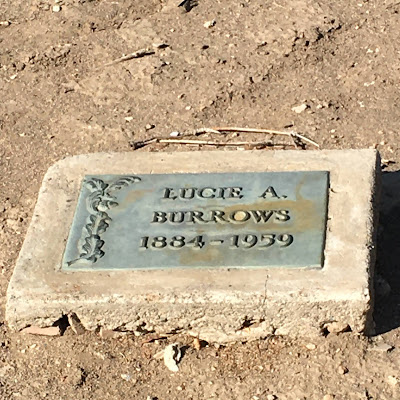
These pictures were taken from a very recent fall visit to the Knights of Pythias Cemetery, located on Nevada Street here in Reno.  It is the final resting place for Lucie A. Burrows, her parents Lena Koehler and Henry Crampton,  and her daughter Gertrude Burrows who died so young.  I hope their stories will not be forgotten. 


  Relationship Reference: Me->Margaret Hansen Boothby (sister Claire Hansen Clark)->Harold Hansen->Vere Burrows Hansen m. John Hansen

Sons of Vere and John Hansen:  Jack, Robley (Bob) and Harold Hansen

Thursday, January 14, 2021

52Ancestors52Weeks Week 2 Theme: Family Legend HER PATRIOTISM UNBOUNDED (Vere Burrows)


Daily Evening Tidings (Published in Grass Valley, California) May 21, 1903


Week 2 Theme:  Family Legend


  In my post of June 25, 2020, I touched briefly on a family story that my Great Grandmother, Vere Burrows Hansen, was the only one to shake hands with President Teddy Roosevelt during his train stop in Colfax, California on May 19, 1903.  I suppose you could say that it was a family legend of sorts.  Merriam Webster defines legend as a story handed down from the past, popularly regarded as historical but not verifiable.   This story has indeed been handed down! But, as intriguing as that story was, I hadn't found any real proof that Vere was actually at the train depot, or had really  shaken the hand of Teddy Roosevelt. 


Nevada County Narrow Gauge Rail Road advertisement for transportation to Colfax.  Ladies and Children were only charged 50 Cents. 

   At the time I wrote the post of June 25, I had not yet rummaged through all the papers and photos that my Auntie Claire had in boxes that were semi organized.  I spent the rest of the summer combing through newspaper snippets, receipts, unidentified pictures, obituaries, and report cards belonging to my grandfather and his brothers.  I came across a fragile pile of whole newspapers from 1903 and 1904 that were published in Grass Valley and Nevada City,  California.  I could tell that several were saved as they contained  articles relating to the death by suicide of my Great Great Grandfather, Alexander Burrows in 1904.  He was Vere's father.  Then, I came across two very brittle newspapers that I carefully unfolded and read several times, as I could not figure out why they were important enough to save.  Lo and behold, this headline stood out in a small article on page 8 of the Daily Evening Tidings, printed May 21, 1903.  HER PATRIOTISM UNBOUNDED it said....

Here is the transcribed article in its entirety. 

DAILY EVENING TIDINGS May 21, 1903. Page 8. HER PATRIOTISM UNBOUNDED Young Lady of this City Receives Unusual Distinction. ________________ Miss Vere Burrows has the Honor of Being the Only One of Her Sex to Shake Hands with the President. _________________ Miss Vere Burrows of this city is a most enviable young lady. She has the distinction of being the last to shake the hand of President Roosevelt during his recent stop at Colfax. That is certainly an honor to be proud of and she is carrying the distinction with becoming grace. This young lady is nothing if not patriotic. She is imbued with the spirit which has made Columbia celebrated in prose and poetry for the daring and patriotism of her sons and daughters. When the idea of tendering a reception to the President was first mooted she made up her mind that she would see him. It would be her first glimpse of a President and she reasoned that it would be an honor worth going miles to witness. She was among the hundreds who left on the excursion Tuesday afternoon and when she reached Colfax her patriotism was ablaze at the sight of so many thousands waiting to do homage to the distinguished guest. She waited patiently for the President’s special to arrive and when it hove in sight her enthusiasm knew no bounds. When the train stopped she was one of the first to elbow her way to the platform on which the President stood. Nothing could cool her patriotic ardor or deter her from her purpose to get close to “strenuous Teddy,” as he is familiarly called. She jostled and elbowed with the good natured crowd until she found herself directly below the rear platform of the train on which the President travelled. Then the improvised platform from which the presentation speech was made was brought forward and she was crowded somewhat out of place. For a moment she was chagrined at being forced from her position, but for a moment only. She stood and watched the President as he intently absorbed every word uttered by Judge Nilon and when he began to speak she was brimful of enthusiasm and patriotism. What a pity it would be to permit such a splendid opportunity to pass without shaking the President by the hand. In a moment she was on the improvised platform standing face to face with the nation’s chief. The engineer had already whistled the signal to start and she saw the opportunity slipping from her when she reached out her hand and exclaimed “Mr. President I would like to shake hands with you.” “Glad to have the honor, young lady,” replied President Roosevelt, and he extended his hand and gave her a hearty strenuous shake. Just then the train pulled out and the President was quickly out of sight. That’s the reason why her friends are envying her the honor he had bestowed on her. And in the after years, when the evening of life begins to cast its shadows like the edge of an approaching shroud, and when the hair that is now beautiful and fair shall be supplanted with locks of silvery gray, she will delight in gathering her loved ones around the hearthstone and telling them that out of hundreds of women who went to Colfax to see the President she was the only one to shake him by the hand.


Nevada County Daily Morning Miner Thursday May 21 1903 Page 5.  This paper was published out of Nevada City, California. 

  So, my Great Grandmother did indeed shake the hand of President Teddy Roosevelt! I had found verifiable proof that she not only was there, but that the family story was true.   She had her "15 minutes of fame",  and then  went on to lead a life full of patriotism and pride in her country.  

  The local Grass Valley paper, The Union, recently published a story that involved this incident in Vere's life.  The author, Steve Cottrell, was writing a series of stories on Teddy Roosevelt and his whistlestop tour that included Colfax, California.  Margaret Hansen Boothby (my mother) relayed the information and the newspaper articles that I had discovered to Mr. Cottrell,  thinking he could use the story somehow. He did  use Vere's story as "bookends" to his story on the search for the Navy ship the Levant. Here is the article as it appeared in The Union December 25, 2020.   I especially loved how he used Vere's High School Graduation picture from 1900. He got the  marriage date wrong by a year...she married in 1904.  And so, her story continues! 


Searching for an uncharted Pacific island

The search for an uncharted island

By Steve Cottrell | Special to The Union

Last month we explained how three Nevada County men arranged to present President Theodore Roosevelt with a collection of gold specimens when his train stopped at the Colfax depot on May 19, 1903. It was a brief stop, less than 15 minutes, but those who were present never forgot seeing and hearing the president — especially Vere Burrows.

A 1900 graduate of Grass Valley High School, Vere managed to nudge her way through the crowd and stood below the train’s rear platform as Roosevelt spoke. When he finished to loud cheers, Miss Burrows called out, asking to shake his hand, so the president reached down and obliged.

Roosevelt then began motioning to James Hague, president of the North Star Mine and one of the Nevada County men who arranged for the Colfax ceremony. Hague and Roosevelt knew each other as members of the elite Century Association, a private club in New York City, and the president wanted his friend to join him as the train proceeded to Sacramento.

While Vere Burrows and other Nevada County residents headed home with life-long memories, Hague sat with Roosevelt in his private car, explaining why a search of the Pacific Ocean south of Honolulu, in an area where Navy sloop-of-war Levant apparently met with tragedy in 1860, was needed. The Navy had long ago concluded that Levant foundered in a storm, but Hague believed it wrecked, not foundered, and some survivors might still be alive on an uncharted island. He needed Roosevelt’s help to undertake a search.

Hague’s theory was based in large part on a mast that washed up south of Hilo in May 1861. It was consistent with a Levant mast and had spikes driven into it in a manner suggesting it came from a jerry-rigged raft. The August 4, 1861, New York Times reported that if the mast was from Levant, “it would go far to sustain the belief that the ship had been wrecked on some shoal, reef, rock or island, and not foundered.”

James Hague was 24, living in Hilo, when Levant set sail for Panama, and prior to its departure had become friends with the ship’s commanding officer, William Hunt, and several sailors. Forty-three years later, with TR’s assistance, the 67-year-old Nevada County mine owner hoped to solve the mystery of the vessel’s disappearance.

Asking Roosevelt to make a ship available to hunt for an uncharted island more than four decades after Levant disappeared may have been stretching their friendship, but in 1904, as part of a May shakedown voyage for the freshly christened Navy cruiser USS Tacoma, Roosevelt and Secretary of the Navy William Moody authorized the ship’s commanding officer to work with a special passenger, James Hague, to search for a possible Pacific island and any evidence of it having been a safe haven for survivors of Levant.

SEARCH

Nearly 8,000 square miles were covered during a zigzag search hundreds of miles south of Honolulu, but no uncharted land was spotted. Although Hague’s charts encompassed about 30,000 square miles, Tacoma, running low on coal, was forced to return to San Francisco after only four days of searching. On June 3, 1904, the Associated Press reported that in addition to needing more coal, “(Tacoma) carried no appliances for deep-sea sounding, so her exploration was wholly superficial.”

Three months later, Hague spoke at a session of the International Geographical Congress in New York City, introduced by Arctic explorer Robert Peary. His topic, naturally, was Levant’s 1860 disappearance and the search for an uncharted Pacific island.

“I had the honor to bring the matter to the attention of President Roosevelt,” Hague told the IGC delegates, “and thereafter…Secretary of the Navy, Mr. Moody, determined to send an expedition as soon as one or more suitable vessels could be spared for the service.”

Although the ill-prepared search was unsuccessful, Hague remained optimistic, suggesting to his audience that the ship’s company “might have landed without the loss of a single life, in which event there might still be some survivors.”

During his lecture Hague talked about a possible second search, but it never materialized. And on August 3, 1908, the 72-year-old owner of the North Star Mine died at his summer home in Stockbridge, Massachusetts.

As for Vere Burrows, 45 days after shaking TR’s hand she married miner John Hansen, a native of Norway and veteran of the Spanish American War. Vere, a founder of the Grass Valley PTA and charter member of the Nevada County Historical Society, died in Grass Valley in 1974.

Historian Steve Cottrell, a former Nevada City Council member and mayor, can be contacted at exnevadacitymayor@gmail.com.

Navy sloop-of-war Levant sailed from the then-Sandwich Islands in September 1860, bound for Panama, but never reached port and was thought to have foundered during a storm. North Star Mine owner James Hague, however, believed Levant wrecked, not foundered, and in 1903 asked President Theodore Roosevelt to authorize a search for an uncharted Pacific island.
Courtesy Library of Congress
James Duncan Hague was a prominent Nevada County mine owner, geologist and friend of Theodore Roosevelt. In 1903, Hague asked Roosevelt to exercise his presidential powers and help him search for an uncharted Pacific island — a request the president fulfilled in 1904.
Courtesy Searls Historical Library

Grass Valley native Vere Burrows Hansen, a 65-year member of Manzanita Parlor No. 29, Native Daughters of the Golden West, was reportedly the only female to shake President Roosevelt’s hand when he spoke at the Colfax railroad depot on May 19, 1903.
Courtesy Patricia Alden and Margaret Boothby


Relationship Reference:  Me->Margaret->Harold Hansen->Vere Burrows Hansen