Saturday, March 16, 2024

#52Ancestors52Weeks....Week 12...Technology....The Crawford Family's Cartes de Visite (That's Plural for Carte de Visite)


Three Crawford cartes de visite 
Each photograph measures  2 1/2" X 4" each. 


    The Crawford family made its way to Sacramento, California from Philadelphia, Pennsylvania in 1852 by wagon (see my previous posts on the Crawford Family).  Along with the family bible and original marriage certificates I have nine small pictures that were with the Crawford possessions.  They are  carte de visite photographs; these became popular after the Crawfords moved to California.  They were made possible by evolving technology in the field of portrait photography and became the craze all over the world until the turn of the century. They are now considered an early form of social media.  The Crawford  photographs were taken in Sacramento and San Francisco, California, between 1863 and the very early 1880's. 


      The daguerreotype was the first successful form of photography in the early 1840's and by the 1850's most professional photographers took either daguerreotypes or ambrotypes. These new technologies drew on knowledge of chemistry and optics and as the photography craze grew the technique was refined. These forms of portraiture had drawbacks;  each picture was unique but  the sitter had to pose for long periods of time (3-15 minutes) and making copies was difficult and expensive. But, the science of photography was rapidly evolving and expanding. 
  
   A new technology was developed in Paris in 1854 which used a special multi-lens  camera to produce multiple small photographic albumen prints that were mounted onto cardboard. They were very affordable;  better yet, the sitter could have a choice of poses without having to sit for long periods of time. Copies were easily made.  The cards were as small as a calling card (hence the name "visiting card") and made portrait photographs accessible to a broader demographic.  It was introduced to the United States in 1859 and became popular with the start of the Civil War.  Carte de visite photography was the most popular photographic format in the nineteenth century and special albums were even patented so that people could collect and save their CDV's of family, friends, the famous and royalty.  It was the start of the family photo album. It was the Instagram of the times!

   The Crawfords must have exchanged these pictures with family and friends.  If there was an album, it has been lost to time. Sadly, there is no family identification on any of the cards......


  This is the only CDV that is dated, and is the earliest of the CDV's.   It is a proof of a small girl, probably around the age of 3 or 4 at most. She had blue eyes and was wearing a dress that would have been worn in the early 1860's.  Her hair was in ringlets.  She may have been sitting in a chair and holding a basket.  Who could she have been?
  
   The Crawford family was in Sacramento by 1852, and may have come with the Cummings family from Philadelphia.  I am still exploring the relationship between these two families.  This picture could not have been my great grandmother Sarah Elizabeth Crawford (born in 1856), which I previously thought. She would have been close to 7 years old in 1863.  It could have been Nellie Cummings, born in Sacramento in 1860.  She is the only family member to fit this timeline. Sadly, Nellie passed away in 1865 of typhoid fever.  


 A colorized version using the editing tool on  Ancestry.com.
Those blue eyes do not match my great grandmother Sarah Elizabeth Crawford's eyes.  This little girl's identity remains a mystery. 


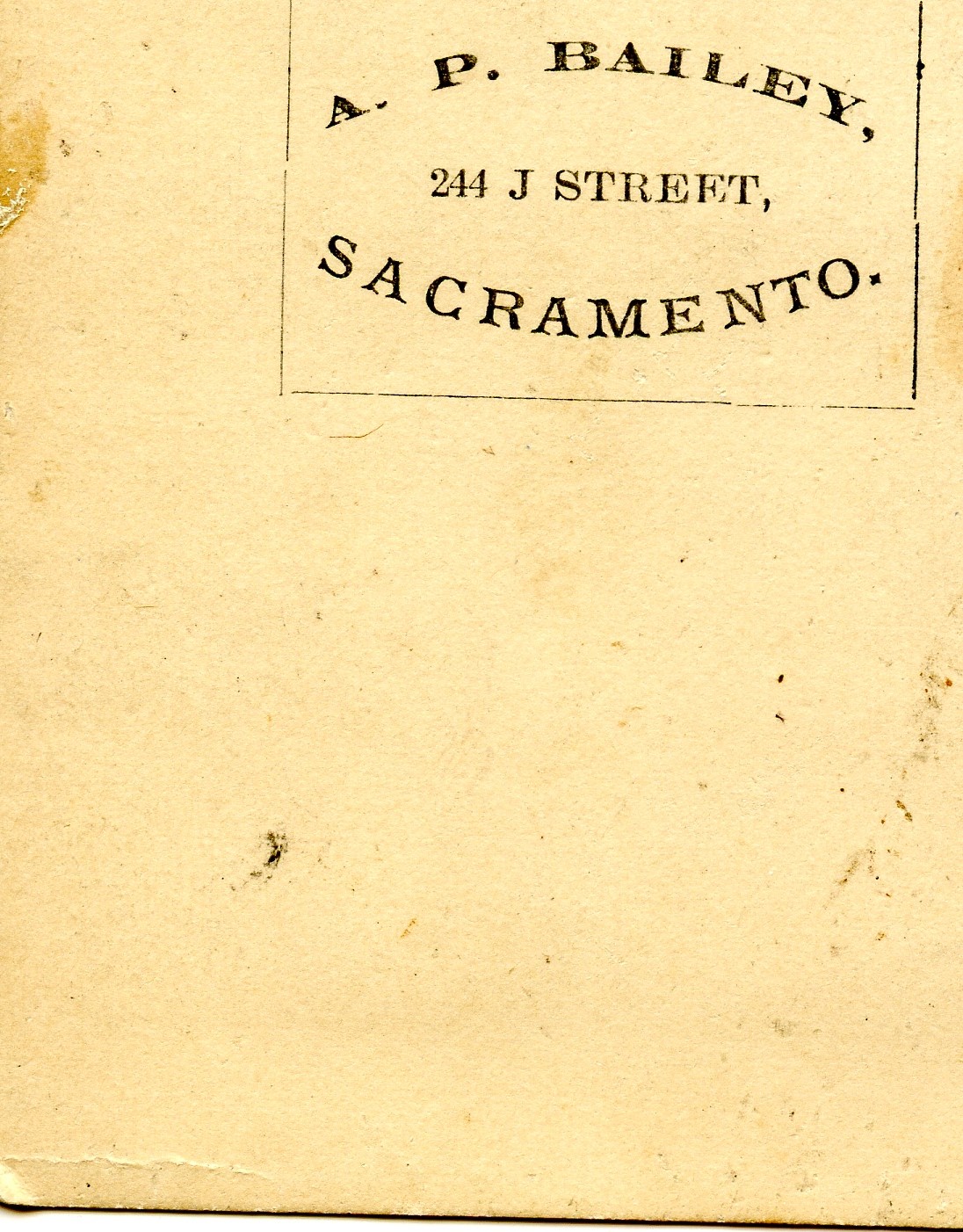
 The back,  showing the photographer's stamp


  This picture was taken in Sacramento at the A. P. Bailey studio on J Street.  Mr. Bailey was listed in the 1868 City Directory as having a photography studio at 244 J Street.  The borders of this CDV (2 line border of different widths) date this picture to the second half of the 1860's.  This young man looks to be around 17 or 18. I believe it is George Byerly Crawford, older brother of Sarah Elizabeth Crawford. 


  This CDV was taken in Sacramento at the J. A. Todd studio (embossed at the bottom right).  Mr. Todd was also listed in the 1868 Directory as working at 117 J Street.  This particular vignette was popular between 1864 and 1867, and the border also dates it to the second half of the 1860's.  This may be Sarah Byerly Crawford, my great great grandmother, who would have been around 41 or 42 at this time.  It is entirely possible that this was Rebecca Byerly Cummings, who would have been close to 50 at this time.  Sarah and Rebecca may have been sisters or close relatives.  


 A close up taken in the same sitting


  This CDV has no studio stamps or markings, but looks very similar to the photographs taken in Sacramento.  The border suggests this was taken in the second half of 1860 also.  This young girl looks to be around 9 or 10.  This may be my great grandmother Sarah Elizabeth Crawford.  I was particularly interested in her cowlick, which appears in later photographs.  In this picture, she is holding a small purse and appears to have very short hair.  Was she ill at some point, or did she just prefer short hair? There were two copies of this picture in the collection.  


This CDV was taken in San Francisco at the Hoebel and Luther Photography Gallery on Third Street.  They can be found in the 1872 and 1873 City Directories.  The Crawfords had moved to San Francisco by the 1870 Census.  This may be Sarah Elizabeth Crawford, several years older than the previous picture taken in Sacramento.  She has the same cowlick and the same short hairstyle which is so mysterious to me.  This picture was most likely taken in the very late 1860's to the very early part of the 1870's. 


  The rounded corners scanned better on this image of the back. 


  This CDV was taken at the Peoples Art Gallery on Third Street in San Francisco.  The hairstyle, clothing, and oval frame with rounded corners date this picture to the late 1870's.  I believe this is Sarah Elizabeth Crawford, right before her marriage to Franklin Hayes in 1881. She looks to be around 19 or 20.  The cowlick is the same as the previous pictures, and her hair had grown out. The Peoples Art Gallery was in business from 1864 until the late 1890's.  John D. Godeus was  operating his gallery at 34 Third Street in 1880 per the San Francisco City Directory. 


The rounded corners did not scan on this photograph. 

  This CDV looks very similar to the above photograph, but has no photographer's stamp on the back.  The cheeks and lips have been tinted.  I believe this is George Byerly Crawford, but this may have been taken when he was in his early 20's, possibly at the time of his marriage to Sarah Christina Maddux in 1873.  The rounded corners date this to the 1870's, but perhaps a bit earlier than the above photograph. If so, it may have been taken in Sacramento. 


  Now comes the fun part...


     Comparison of these three CDV's of Sarah Elizabeth Crawford.  Same person? What do you think? 


The top picture is of Sarah "Sallie" Crawford Hayes taken around 1909; she would have been in her early 50's.  Same person?  What do you think? 


Comparison of these two CDV's of George Byerly Crawford. Same person? What do you think? 


  I feel so fortunate to have these wonderful pictures; the Crawford family took advantage of the new technology of the day, got dressed up and went to the photography studio!  What an experience that would have been.  These days an Iphone is all we need to capture any moment in our lives.  What would the Crawfords think of our technology? These cartes de visite are 160 years old and can still be touched, felt and pondered over.  What will happen to the thousands of images on our devices and how will they be accessed in 160 years? What new technology will be used? ....AI powered cameras,  3-D printing technology to create physical prints of digital images, as well as  virtual and augmented reality experiences with images are already being developed. It is almost mind boggling to think of.  Just as the first photographic portrait would have been way back when. 
https://www.spyne.ai/blogs/future-of-photography


 Relationship Reference:

Me:--Margaret Hansen Boothby--Margaret Elizabeth Hayes Hansen--
I
The parents of Margaret Hayes Hansen were Emma Lavinia King Hayes VanDuzer  and Lester Franklin Hayes.
(they had three daughters: Dorothy, Francis and Margaret)
I
The parents of Lester Hayes were Sarah (Sallie) Elizabeth Crawford and Franklin Hayes 
I

The parents of Sarah (Sallie) Crawford were John Washington Crawford and Sarah Byerly of Philadelphia, Pennsylvania, married in 1848. 


Saturday, March 9, 2024

#52Ancestors52Weeks....Week 11...Achievement....Elizabeth Jane Hurd Burrows, Pioneer Woman Lawyer


The Morning Union 20 April 1935
Mrs. E. Burrows, Pioneer Woman Lawyer, Passes 

  Mrs. J. E. Burrows, second woman to pass the state bar examinations and the second woman attorney in California, a member of the vanguard of succeeding generations of women barristers, who  have achieved fame and distinction for themselves and their sex in the matter of the legal profession, died at Oakland yesterday morning at the age of 81 years.  
  Mrs. Burrows was the mother of Mrs. Vere Hansen of Grass Valley and grandmother of the Hansen boys, a former resident of Grass Valley and mother of an original family of 12 children, all of whom were born in this city. 
 
  Her passing yesterday morning was not entirely unexpected by family members as her health had been declining in recent months and Mrs. Hansen and sons made frequent trips to Oakland to visit her in recent months.  With capabilities and vision engendered by a family of pioneer forebearers, Mrs. Burrows, herself a pioneer in the light of the present day period, completed a most remarkable life.


.....Brought Here in '56

  Mrs. Burrows was a native of Pennsylvania, but was scarcely two years of age when she made the trip over the Isthmus with her parents, and came to Nevada City in 1856.  Her residence in Nevada City and the state of Nevada, where the family became one of the most prominent in the state, was overshadowed by her Grass Valley residence.  She passed the state bar examinations in 1887 when women attorneys were few, but she reflected credit on her profession.  The late A. Burrows, husband of Mrs. Burrows, was also an attorney, serving as attorney for Grass Valley at one period. ........  


 From The Morning Union 4 March 1926
Jane's son Don Burrows passed the  California Bar Examination.  This article states that Jane was the third woman to pass the California Bar. 


The theme for this week is achievement.   Elizabeth Jane (Hurd) Burrows was my great great grandmother, and I have written extensively about her life in the past. You can find her stories in the Labels section on the right side bar.  She "completed a most remarkable life" as her glowing obituary states.  

   On the surface, becoming the second (or was it third?) woman in California to pass the state bar and become an attorney seems like quite an achievement.  When you put it into historical context it becomes something quite amazing!  Did Jane Burrows really have the distinction of being the second woman lawyer and attorney in California? I think she came close!

  Clara Foltz (1849-1934) was California's first woman lawyer, passing the bar in 1878.  In 1876 Clara's husband abandoned her and her 5 children so Clara began to give public lectures on suffrage to make ends meet.  Her main aspiration to help support her family was to become a lawyer.  She  wanted to take the bar examination, but at that time the state of California allowed only white males to become members of the bar. She successfully secured passage of the Woman's Lawyer Bill in the California state legislature, changing the wording from "white male" to "any citizen or person" who was eligible to become a member of the bar. 

  Clara worked along side her suffragette friend Laura Gordon, the first woman to run a daily newspaper in the United States (the Stockton Weekly Leader) to get the wording of the law changed.  In September of 1878 Clara passed the bar examination as the first woman to do so in California. In December of 1879, Gordon was admitted to the State Bar of California as the second woman to do so.  She went on to become the second woman to be admitted to the bar of the United States Supreme Court in 1883. 

https://en.wikipedia.org/wiki/Clara_Shortridge_Foltz  
https://en.wikipedia.org/wiki/Laura_de_Force_Gordon. 

   Both Clara and Laura sought more formal law training but were denied access to Hastings College of the Law (because they were women and the rustling of their skirts might distract the male students). Both women filed a case against the school and successfully argued the case  before the California Supreme Court.  Neither woman graduated due to work, activism and family obligations.  Even though Laura Gordon was the second woman to become a lawyer in California, I believe that Jane Burrows was right up there with these women trailblazers. She would have been one of a small group of women to be admitted to the Bar between 1879 and 1887.  Her obituary states she was the second, but it would have been more accurate to say she was the third (as stated in her son Don's article).  Either way, both Clara and Laura would have been exemplary role models for Jane Burrows!

 
 The Morning Union 1 Oct 1887 Grass Valley, California

    A little snippet of information found in The Morning Union on 1 October, 1887 reads:  "Mrs. E.J. Burrows of Grass Valley has been admitted to practice in the Superior Court".  Clara Foltz' experience involved a 3 hour oral exam overseen by a committee of 3 judges in San Jose. I wonder if it compared to Jane's experience? This was such a small announcement for such an amazing achievement! 

    8 of Jane's 12 children had been born in Grass Valley, California by 1887.  Her husband Alexander Burrows had been a successful lawyer, mining law expert, and writer for at least 10 years by the time Jane was admitted to practice.  Where she found the time to study we will never know! She probably apprenticed under Alexander through his practice until she was ready to seek admission.  I do know that I have not found any evidence that she practiced her profession publicly, but she was probably a great help to her husband with his many cases, or she provided help with smaller legal matters. This was seen at the time as a more accepted way for a woman in a small town to practice law.  Jane even described herself as the "consulting council of the concern" (from A. Burrows biography published in Memorial and Biographical History of Northern California, 1891).  She went on to have 4 more children. 


  Jane Burrows' personal Rules For the Government of Practice in the Superior Court of the County of Nevada, State of California, adopted October 16, 1893.  Her name is imprinted in gold leaf on the cover. 
5"x 7"
In our family collection. 

 Title Page 

Page 1 of the Rules (there were 18 pages of rules)

Last page
Roll of  Attorneys
Mr. A. Burrows and Mrs. E.J. Burrows are listed.  No "Mrs. A. Burrows" for Jane! 


Jane Burrows' calling card.


Jane Burrows  1855-1935
Photograph taken around 1893 in Virginia City Nevada, probably when her mother Harriet Hurd passed away.  
Shared by the William Nankervis Archive on Ancestry.com


    Jane Burrows was a woman of remarkable intelligence, strength, and courage.  She was probably a little strong-willed as well!  She eventually divorced Alexander Burrows in 1894 (on charges of cruelty and the inability of the couple to live happily together); another life event that might be considered outside societal norms for the time. In 1907 her daughter Gwendolyn was killed in the Eagle Rock railway wreck, and a lawsuit was filed for damages.  We don't know if Jane personally filed the lawsuit, but she certainly had the skills and force to threaten the rail company.  She ended up with $3,000 in the settlement.  She was obviously a strong role model for her son Don, who also became a California lawyer. 


    I wish I knew more about Jane's desire to become a lawyer. What was her intrinsic motivation? She must have known of Clara Foltz and Laura Gordon and watched their work on behalf of women. Were they her inspiration? Or maybe it was a little competition between husband and wife.... I would also love to know her thoughts on suffrage for women and how much that cause played a part in her life.  

  Was she proud of her accomplishments?  Her family certainly was.  I know that she came from a pioneer family that was quite resilient and strong.  They highly valued education and learning; one sister became a nurse and several of her sisters became teachers in Virginia City and Reno, Nevada.  Her youngest sister became principal of McKinley Park Elementary school in Reno in 1925;  Edith Hurd was part of an exemplary group of women teachers and principals that had a tremendous influence on education in the Reno area for many years.  I'm sure Jane, as the oldest sister, was a major influence in her younger sisters' lives also.  

   Author Barbara Allen Babcock details how Clara Foltz felt the conflict between career and motherhood. At one point during an 1885 case she was emotionally torn as she left her children to travel out of town on a client's behalf.  Later on, she wrote about "time's treachery" as her children grew into men and women and what she had missed. She said "I have lost more for myself that I have gained for all women.  All the pleasure of my young motherhood I sacrificed for woman's."  I wonder if Jane experienced the same emotions.  Perhaps that is why she did not publicly practice, but rather remained in the background of her husband's career.  Clara had her mother's help with childcare and housekeeping; maybe Jane did not have the support system to have a career and motherhood at the same time. Her sisters and mother lived in Reno and Virginia City, Nevada and not in Grass Valley.  Maybe her husband wasn't as supportive of her efforts as we thought.  We just don't know. 
Valparaiso University Law Review (Vol. 28, No. 4 (1994) art. 4) 


  Jane Burrows' story continues to amaze me.  She struggled with many of the same issues that women still struggle with today; balancing motherhood and home life with a career, women's rights and finding an identity and a voice outside of social norms and expectations of the day.  Barbara Allen Babcock laments in her article about the lack of a complete, consistent chronology of the first American women lawyers.  Most women joined the bar with a "small flurry of publicity and then fell from public view as they practiced in the local, largely unchronicled, fashion of most lawyers."  Even though Jane's obituary may have gotten some facts a little mixed up, we get the idea that her pioneering achievement was of particular importance. I think Jane, Clara and Laura would have been good friends! 


 Clara Shortridge Foltz
Wikipedia


Laura de Force Gordon
Wikipedia


  *I highly recommend this article on Clara Shortridge Foltz.  It is a fascinating journey into California history and women's rights. 

Barbara Allen Babcock, Clara Shortridge Foltz: "First Woman", 28 Val. U. L. Rev. 1231 (1994). Available at: https://scholar.valpo.edu/vulr/vol28/iss4/4 

web address: https://scholar.valpo.edu/cgi/viewcontent.cgi?article=1917&context=vulr 


*Also recommended reading: 

Lady Lawyer, Clara Shortridge Foltz by MS Sharon C Avey    CreateSpace Independent Publishing Platform (November 3, 2015) (available on Amazon)

Woman Lawyer:  The Trials of Clara Foltz by Barbara Babcock   Stanford University Press; 1st edition (December 12, 2012) (available on Amazon)


Relationship Reference: 
Me->Margaret Hansen Boothby->Harold Hansen->Vere Burrows Hansen->Elizabeth Jane Hurd Burrows                 


Saturday, March 2, 2024

#52Ancestors52Weeks....Week 10...Language.... Occhio Bello-Suo Fratello....and You Know the Rest


This is a sweet and simple child's Italian rhyming game that my Nino (my paternal grandmother) used to play with me and my sister when we were babies. I am sure she used it to teach her boys (my Dad and Uncle) when they were just learning to talk, also.  When I had my first child in 1986 I asked Nino to write down the words so I wouldn't forget.  This is a poem/game that was passed down from her mother Caterina Bertanosco Brondolo (Nonna).   It is a playful game for teaching facial body parts and family relations to a young child just learning the Italian language; I love the imagery of the church being your mouth and your nose being the church bell.   I don't remember if there was a tune that went with it, but my favorite part was always the ding-ding, ding-ding!  


A postcard of Vesime from Nino's extensive postcard collection. 
  
  Nino was born in the little northern Italian town of Vesime, Italy in 1911, and came to America through Ellis Island with her mother Caterina and two brothers in 1917 (see my earlier post from February 8, 2024 on her immigration experience). Vesime is located in the Piedmont region of northern Italy, and the unofficial but recognized regional dialect is Piedmontese (pew-mon-tase).  It is a small country town dotted with vineyards, red tiled roofed houses and many chapels with ringing bells, referenced by the poem as "chiesa grande col campaning che fa ding ding-ding ding"... (essentially the ringing bells in the church tower).  It isn't hard to imagine the sounds of church bells ringing daily in town and what a meaningful connection that would be to a small child.  Imagine your nose ringing like the church bells! 


 Nonna (Caterina Bertanosco Brondolo) holding her great granddaughter Stephanie (my sister) in 1967.  Photograph taken in Nevada City, California. 


Nino, Nonna (holding my baby sister Stephanie), Dad (Dale Boothby) and myself 1967.  Photograph taken in Nevada City, California.

   
   Like many immigrants of her era Nino wanted her children to grow up speaking English.  So, my Dad and Uncle didn't learn their mother's native language.  She did use certain phrases and words with the family on a regular basis. "Manga" was frequently used during family get togethers.  And we always used the phrase "Ti Amo" when we said our goodbyes.  There might be some choice swear words in Italian that are still used...... When I was born, Nino originally wanted me to call her "Nonnina" which meant "little Nonna" (little grandma) but when I began talking the best I could do was "Nino", which of course stuck, and she became everybody's Nino. 

  When Mom was taking voice lessons as part of her music major studies at UOP she needed help with Italian art songs.  Some of the songs were familiar to Nino so she helped Mom with the pronunciation and meaning of words.  Nino was a lifelong devoted fan of Italian operas, also.  She adored Beverly Sills. 

  But Nino also realized that the vocabulary and dialect that she and her mother Caterina and brother Frank still used with each other here came from "the old country".  She was essentially still speaking the Italian of her six- year-old self that left Italy in 1917.  Nino had been having trouble translating the letters her brother in Italy would send because she did not know the evolving and more modern vocabulary of Italy. She took a trip to Italy to visit family in 1972.  When she came back she said her Italian had not "kept up" with the times.  So, she took Italian lessons while living in Sonoma so she could understand the Italian that was used by her extended family in Italy.   I have some of the letters her brother and other family members wrote to her in the 70's.  I may need to take Italian lessons also! I would love to someday hear their voices through their writing. 

 But for now I will remember this sweet poem and the connection it represents between the "old country" and Nino's life lived in California.  It is time to teach it to my grandchildren! 


 Nino (on the right) around 1920, shortly after coming to San Francisco.  She was learning to speak English at school.  


Relationship Reference:  Me->Dale Boothby->Tersilla Brondolo Boothby (Nino)-> Caterina Bertanosco Brondolo (Nona) 


Sunday, February 25, 2024

#52Ancestors52Weeks...Week 9...Changing Names....The Crawford Wedding Certificates Provide Clues to the Name Cummings


   This week's theme is Changing Names...as I was going through files this week I came across two wedding certificates from the Crawford Family. Sarah Byerly changed her name to Sarah Crawford and her daughter Sarah Elizabeth Crawford changed her name to Sarah (Sallie) Hayes upon marriage. As I was looking closer at the documents, I discovered some valuable clues.....


   Wedding certificates are wonderful ways to find new clues when researching families.  The Crawford family not only kept two marriage documents, but recorded family marriages in the Crawford family Bible (see previous posts from January 2024). This was first time I had really looked closely at these wedding certificates. 


 The Marriage Certificate for John Washington Crawford of Philadelphia and Sarah Byerly of Philadelphia, February 23, 1848. 
10 1/2" X 8".  In our family collection. 
 Sarah Byerly became Sarah Crawford.    


 Their marriage was also documented in the records of St. Paul's Episcopal Church in Philadelphia. They were married by J.A. Roche, Minister.  Ancestry.com


 This marriage certificate is the oldest original family document I have, and  dates from February 23, 1848.  It is still in good condition, and the ink has not faded much.  The embossing around the edges is beautiful.  I have just started researching the Crawford family, who lived in Philadelphia in the early 1800's. I can imagine how it must have been carefully folded up and put in the family bible when the family made their way west. 

  I found two names listed as witnesses on the certificate.  Since I had just gone through the family bible, these names sounded very familiar to me.  The first name was Henry Cummings. That name was familiar because John and Sarah's third child was named William Cummings Crawford.  Was Cummings originally a maiden name? Who was Henry Cummings and what was his relation to Sarah or John? 

  The second name was Cristian Byerly.  Was this a brother to Sarah? Maybe her father?  The spelling of Cristian is interesting also. The Byerly family was originally from Wurttemberg, Germany. Who was this Cristian Byerly?  John and Sarah's second child was named George Byerly Crawford. Sarah's maiden name was definitely used for his middle name.

  After some sleuthing,  I was found a Rebecca Byrley (spelled differently) on Ancestry.com.   She had married William Cummings in Philadelphia in 1839.  She and William came to Sacramento in 1849.  Together, they had 10 children.  One child was named Benjamin F. Cummings (keep this name in mind for later....).  Could Rebecca be Sarah's sister or another female relation? William's obituary states that his brother was Henry Cummings.  Could this be the Henry Cummings that signed the marriage certificate?    


Henry Cummings marriage registration for October 5, 1848.  He married Catherine Jeffries in the St. Paul's Episcopal Church in Philadelphia.  They were married by the same minister as Sarah Byerly and John Washington Crawford.  These two couples were married 7 months apart, in the same church, by the same minister.  Ancestry.com


The marriage license of Robert Franklin Hayes and Sallie Elizabeth Crawford February 19, 1881. (front)
Sarah (Sallie) Elizabeth Crawford became Sallie Hayes. 
The document measures 12" x 13 1/2".  In our family collection. 


The back of the marriage certificate provides some wonderful clues! 

     The back of this marriage certificate is a bit hard to read, as the ink is fading.  It states that the residence of Robert Franklin Hayes was 10 Elgin Park, and he was 26 years old.  Sallie Elizabeth Crawford lived at 40 1/2 Zoe Street and was 24 years old.  Then, we get to witnesses.....the first witness to the marriage was written as B.F. Cummings, who lived on Kearney Street, San Francisco.  I checked the 1880 census, and he did live on Kearney Street, and was a jeweler. He lived with his brother Louis B. Cummings who was also a jeweler.  B. F. was none other than Benjamin Franklin Cummings, son of William Cummings, who was married to Rebecca Byerly.  By the 1900 census, Benjamin was living with his mother Rebecca, who was born in Pennsylvania, and whose parents were born in Germany.  Sarah Byerly was born in Pennsylvania, and her parents were born in Germany (Wurttenburg). I believe Sarah and Rebecca were either sisters or close relatives. Sarah obviously had strong ties to the Cummings family through this marriage. 

  The next witness on the marriage certificate was K. McCorrick. She lived at 42 1/2 Zoe Street and was probably a family friend.  She was found living next to the Crawfords on the 1880 census as Kate McCorrick, and was 19 years old.  She lived with her mother.  

 This is William Cummings' obituary, shared by a Find A Grave contributor:

"Death Summons Comes to Another Pioneer--William Cumming the Latest Victim of the Fell Destroyer--"

"Death continues to knock at the doors of the old Pioneers, with a steady and relentless hand.  This morning the fire bell tolled out the news of the death of William Cummings, the pioneer jeweler, who passed away at his residence, on Eighth street, between H and I, at 4:45 A.M.  Deceased was born in Philadelphia on March 21st, 1821.  He learned the trade of a silversmith and pursued that vocation in Philadelphia and Boston.  During the gold excitement of 1849, however, he joined the William Penn Mining Company and came to California, arriving in San Francisco just in time to celebrate the Fourth of July, 1849. After spending a few days at the Bay he came up the Sacramento in a schooner and went to Willow Bar, where he engaged in mining.  The William Penn Company soon collapsed, however, and Mr. Cummings came to Sacramento, having but $50 with which to start in life.  He formed a partnership with a man named Hastings, and they were in the jewelry business together about two years.  Then Mr. Cummings went into the jewelry business for himself at 408 J street, where he remained for eighteen or twenty years. Mr. Cummings was married to Rebecca Byrley, in Philadelphia, in 1839.  They had a family of ten children, of whom only three are alive-William, Louis and Benjamin-all of whom are jewelers in San Francisco. Mrs. Cummings still survives.  Mr. Cummings retired from business some years ago, having an income that would keep him comfortable.  He was a member of the order of Red Men and an Exempt Fireman.  He always led an exemplary life, and was a most devoted husband and father, and true friend.  He was especially popular with his fellow Pioneer, and one of them said this morning, with tears in his eyes: 'William Cummings was in every respect a good man; I had as great regard for him as though he had been my brother.'  Mr. Cummings had been in failing health for some years, but death came suddenly and painlessly at the end.  His funeral will take place to-morrow afternoon at 4 o'clock.  The Pioneers will assemble at their hall at 3:30 0'clock, and march from there to the Red Men's Hall."

-Sacramento Evening Bee, 15 July 1891

  This memorial also links William Cummings to Henry Cummings, 1823-1891 of Philadelphia. He was originally buried at St. Paul's Episcopal Church and later moved to Fernwood Cemetery, along with his wife Catherine Jeffries.  


This was written on Rebecca's Find A Grave memorial:

"Rebecca (nee Byrley) and William Cummings were the parents of 10 children.  William traveled to California during the summer of 1849 to search for gold, leaving his pregnant wife and 4 young children living in Philadelphia with his younger brother Henry.  Rebecca and the children reunited with William in California within the next two years.  Eight of her children predeceased Rebecca, as did her husband."  


    I  wondered what brought John Washington Crawford and Sarah Byerly to California all the way from Philadelphia.  They were in Sacramento by October of 1856, when Sarah Elizabeth (Sallie) was born.  Did they come with Rebecca and her children before that?  That would be around 1851, 1852, right after the 1850 census that showed the family still living in Philadelphia.  Records show that Henry stayed in Philadelphia the remainder of his life.  Did these two families come together?  This seems very plausible to me! Of course there are areas that need more research. What was the family connection to St. Paul's Episcopal Church?  And who was Cristian Byerly? 


  Even though women changed their surnames through marriage, many times they passed down their maiden names as middle or first names in their children.  The surname Cummings was also used as a middle name,  and must have had a special significance to Sarah. Using the marriage certificates, the family bible, and a little sleuthing on genealogy sites I believe I have come up with another branch of this family.  They are buried in the Sacramento City Cemetery in Old Sacramento.  Time for another visit to the cemetery!


 William and Rebecca Cummings are buried in the Sacramento City Cemetery, 1000 Broadway, Sacramento, California.

Find A Grave


                      John Washington Crawford m. Sarah Byerly

                                                                    I

                     Sarah Elizabeth (Sallie) Crawford m. Franklin Hayes

                                                                    I

                                  Lester Hayes m. Emma Lavinia King

                                                                    I

                              Margaret Elizabeth Hayes m. Harold Hansen

                                                                    I

                                        Margaret Hansen m. Dale Boothby

                                                                    I

                                                                  Me