Friday, February 24, 2023

The King Family in Devon: Simon King and Ann Parker

 Simon King and Ann Parker were most likely the parents of William King, the father to Charles John King, my great great grandfather.  Proving that connection has been quite a challenge. This is my preliminary research so far....and is always subject to change....

 Devon/Cornwall Google Maps.  Chulmleigh,  Chawleigh, Shobrooke, Exeter, Chudleigh and Teignmouth to Plymouth, Devon; to Saltash to St. Austell, Cornwall. These are all the areas that the King families lived and worked,  or were recorded as having been born or baptized from the late 1700's to the late 1800's. 


   This is the first piece of evidence that I started with. 


 Chawleigh parish registers. "A ? Register of all Baptisms, Marriages and Burials within the Parish of Chawleigh in the Deanery of Chulmleigh for the year 1792...Aug. 26. Simon son of William King & Mary his wife".  

"England, Devon Bishop's Transcripts, 1558-1887," database with images, FamilySearch (https://familysearch.org/ark:/61903/3:1:3QS7-L94Y-9ZBH?cc=2515875&wc=QZ1P-1VB%3A1589444436 : 11 September 2019), 004394947 > image 226 of 297; Devon Record Office, Exeter.

  This recorded baptism shows that a Simon King was baptized August 26th of 1792 in Chawleigh, located in the Deanery of Chulmleigh; he was the son of William King and Mary (possibly Webber).   A DNA cousin (a  descendant of Simon King, brother to Charles John King) recently shared information with me on Simon King (senior) which was dated 1815. This is from a document held at The National Archives (UK); here is the specific link. 

https://discovery.nationalarchives.gov.uk/details/a/A13531184 

Reference:  3009A-99/PO12/470

 This document gives some intriguing clues to Simon's early life, and would put is birthdate roughly at around the early 1790's. 

 "Simon King...Now in Chudleigh, born in Chawleigh, when he was about 12 went to work for Farmer Willaby for a year and then another, he then went to Shobrooke and worked for Farmer May for a year, he then threshed barley for him by the score, he then came to Chudleigh and Mr. Whiteway where he stayed 6 months, he then went to Mr. Gerry and after 9 months he married in Chudleigh." 


 Now, to the marriage of Simon King and Ann Parker... 
 
 
Simon King and Ann Parker Marriage Banns from February 25, 1812.  Chudleigh, Devon, England. 

 England, Devon Bishop's Transcripts, 1558-1887," database with images, FamilySearch (https://familysearch.org/ark:/61903/1:1:QGLJ-4HZV : 11 September 2019), Simon King and Ann Parker, Chudleigh, Devon, England, United Kingdom; citing Marriage, The Devon Record Office, Exeter.


  The marriage entry of Simon King and Ann Parker reads:  "Banns of marriage of Simon King of this parish and Ann Parker of this parish were read 19th of January, 26th January and 2nd February 1812.  Marriage entry; Simon King sojourner in this parish of Chudleigh and Ann Parker of this parish were married in this parish by banns this 25th day of February in the year 1812". (information provided by MAngove I do not have an actual copy of this information). Banns were read out on three successive Sundays in a parish church, announcing the intended marriage and giving opportunities for objections.  

  So, I began researching this Simon King family.  

 Simon and Ann (possibly) had the following children, based on birth/baptismal records and census records from Ancestry and FamilySearch...

1.   Mary King b. 15 Aug. 1812  Chudleigh, Devon.  She was listed as a daughter of Ann on the 1841 Census and was living with her aunt Mary Parker Jory in 1851.  


"England, Devon Bishop's Transcripts, 1558-1887," database with images, FamilySearch (https://familysearch.org/ark:/61903/3:1:3QS7-L94Y-98JR?cc=2515875&wc=QZBV-MXN%3A1589444304 : 11 September 2019), 004395051 > image 289 of 292; Devon Record Office, Exeter.


2.  Ann King (May) b. 14 Nov. 1814 Chudleigh, Devon.  Father Simon's occupation was listed as labourer at the time of her birth. I do not have the original image. 


3. Elizabeth King baptized Dec. 8 1816 in Chawleigh, Devon (possible child; baptismal records are not conclusive.  She was listed on the 1841 Census and may have died by 1844). 

4. Sarah King (Ruse) b. 1819 Chudleigh, Chalwleigh, Teignmouth, or Chumleigh, Devon (based on census information from 1841 to 1901.  No baptismal records found.  Birth year extrapolated from census records). 

5.  Amelia King (Rundle) b. 1821 in Chudleigh, Devon (based on census information; no baptismal records found).  

6.  Simon King b. 1822 or 23 Chudleigh, Devon (based on census information; no baptismal records found). Occupation:  Shoemaker. 

7. William King baptized Nov. 7, 1824 in either Chawleigh, Chudleigh, Stoke Damerel or Devonport, Devon, depending on which census and baptismal record you look at).  I have spent considerable time trying to definitively link this William, who I know to be the father of Charles John King, to the family of Simon and Ann King originally from Chudleigh. 


 Marriage Record for William King and Catherine Levers Brown

"England, Devon, Parish Registers, 1538-1912," database with images, FamilySearch (https://familysearch.org/ark:/61903/3:1:939N-QW5K-K?cc=1804330&wc=M618-2P8%3A146828401 : 28 July 2021), 004634233 > image 210 of 251; from "Church of England parish registers 1538-1911," database and images, findmypast (http://www.findmypast.com : n.d.); citing images provided by FamilySearch International

William King and Catherine Levers Brown were married in the Stoke Damerel Parish Church on February 23, 1848.  William was living at 7 Barrack Street and Simon King was listed as his father.  Both were working as carpenters.  One witness was William Giles Jory, son of Mary Parker Jory. Mary Parker was most likely the sister of Ann Parker.   All these clues point to a connection between William and the family of Simon and Ann.  The only discrepancy would be that by 1841 William's mother Ann was remarried to James Hill and was listed as a widower on her second marriage record. Simon was not marked as deceased on the register. I believe that he had either passed away by 1841 or was no longer in the area or involved with the family.   


8.  James King b. 1 March 1827 Devonport, baptized May 3 in the Princes Street Chapel (Independent) (family living on Market Lane) Devon, buried November 2, 1827, family living on Barrack Street, Devon. 


England, Select Births and Christenings, 1538-1975 Ancestry


"England, Devon, Parish Registers, 1538-1912," database with images, FamilySearch (https://familysearch.org/ark:/61903/3:1:939N-QW9H-2?cc=1804330&wc=M618-KM9%3A146809301 : 20 May 2014), 004634217 > image 336 of 377; from "Church of England parish registers 1538-1911," database and images, findmypast (http://www.findmypast.com : n.d.); citing images provided by FamilySearch International.

9.  John King b. 1828 Devonport, Devon.  Baptized in the Princes Street Chapel (Independent) on October 31, 1828.  Simon's occupation was Porter. 


England & Wales, Non-Conformist and Non-Parochial Registers, 1567-1936 Ancestry


10.  Harriet King b. 1834.  She appeared on the 1841 Census, and did not appear on any census after that. No baptismal records found. She may or may not have been a daughter of Ann King. 

11.  Matilda King (Blowey) baptized on August 3, 1835 in the Parish of Stoke Damerel, Devon. No address was recorded. 


"England, Devon, Parish Registers, 1538-1912," database with images, FamilySearch (https://familysearch.org/ark:/61903/3:1:939N-Q7S9-Z7?cc=1804330&wc=M618-V2Q%3A146809201 : 20 May 2014), 004634089 > image 275 of 306; from "Church of England parish registers 1538-1911," database and images, findmypast (http://www.findmypast.com : n.d.); citing images provided by FamilySearch International.

****************************************************


  The reason for moving to the parish of Stoke Damerel (Devonport) is unknown, but Simon and Ann King moved sometime between 1824 and 1827 and had three or four more children together before the 1841 Census.  There are some discrepancies as to the exact date of death for Simon (was it between 1838 and 1841?) Or was he still alive when daughter Ann was married in 1839, or when son Simon was married in 1844 or when son William was married in 1848, as he was listed on all three marriage registers with no notation that he was deceased. What exactly was his occupation at the time of his death? William's marriage records stated that his father Simon was a carpenter.  Ann remarried in March of 1841 before the 1841 Census was taken. She was enumerated with James Hill on the 1841 Census, living on Barrack Street. 


    Chudleigh is a mere 35 plus miles from Devonport, but must have seemed far away in the early 1800's.  Moving from a primarily rural farming and wool production area to a larger port city must have been quite a change for the family, also.  Simon was a husbandman  (farmer) and laborer, but his son Simon became a cordwainer (a boot/shoe maker) by 1844 and William's occupation by 1848 was described as  carpenter. It is not known what type of carpentry he did; it could have been naval or as a commercial tradesman. Perhaps both father Simon and son William had begun working as carpenters together.  Three of  their daughters married men with good trades (shoemaker, stonemason and sailor in the Royal Navy).   Perhaps economically it made more sense for the family to move to this location where Simon and Ann's children could improve their lives.  

  What is known about this family group after their relocation to Devonport comes from Baptismal records from 1827 and 1828, marriage registrations from 1839, 1841 and 1844, and  Census records from 1841 up through 1901.  While doing more in depth research, it soon became clear to me that finding exactly where the Kings lived in the Stoke Damerel parish was going to be difficult.  Many street names are no longer found on modern maps. Why? 


The "Bomb Book". This document recorded where and when various devices were dropped on Plymouth by the Germans from 1940-1944. 


From the Plymouth "Bomb Book" (enlarged). Notice the damage level for Plymouth and Devonport. 
 https://www.theboxplymouth.com/blog/history/blitz-80-the-bomb-book from April, 2021

   Unfortunately,  the Royal Dockyards were targeted from 1940-1944 in numerous and devastating bombing raids; much of the area that the Kings lived and worked in was obliterated along with most of Devonport and Plymouth's  shopping districts and adjacent neighborhoods.  WWII blitz raids killed 1,200 citizens, injured 5,000 people and destroyed or damaged 23,000 homes. The Devonport/Plymouth area looks very different today than it did before 1940.  Many streets were altered (shortened or renamed) or were done away with all together during reconstruction. Many of the terraced row houses  the Kings lived in were replaced with new, modern housing after the war. 


The Bomb Book is housed at "The Box"...Plymouth's museum, art gallery and archive.  Formally known as the Plymouth City Museum and Art Gallery it reopened in 2020 as The Box. 


 From The Plymouth Bomb Book.  The area circled in green is the area of Devonport that the Kings lived in before the turn of the century.  Red dots denote where devices hit in this particular raid

   Luckily, old maps and photographs of the area in the 19th Century give us a sense of location and place. The National Library of Scotland has a wonderful website with many older maps of the area available (maps.nls.uk);  I added it to the Links section on the left if you want more information.   I used their maps as well as maps from other research sites to help with location identification.  It also helps to have a bit of history of the area and explanation of place names to help interpret census information.


Plan of Plymouth Dock, 1811 from https://someolddevonchurches.files.wordpress.com/2016/09/plymouth-dock-1811.jpg

  Devonport was formerly named Plymouth Dock, or just Dock.  Robert Waters was given a contract to build a dock in 1690 by the Admiralty, and Plymouth Dock grew around it as a small settlement to house workers employed by the Naval base being built there. Its population continued to grow. It was given the name Devonport in 1823 and became part of the city of Plymouth in 1928. 

  Stoke Damerel was one of the ancient parishes in Devon.  The village of Stoke is located a little ways inland, but the parish included stretches of the coast west of Plymouth and north of Devonport.  The Kings settled in Devonport in the general neighborhood where Market Place is located on the above map. They lived in the parish of Stoke Damerel. 


 This map is from 1901, but gives a good idea of where Devonport is in relation to Plymouth.  Mt. Edgcumbe is a part of Cornwall which is located right across the River Tamar.  The area that the Kings lived in is circled in blue. 

  So, walking through the records, we can see where this King family and their children lived and worked. 


   Again, this is the birth and baptismal record for James King, born March 1, 1827 to Simon and Ann King.  It was registered in the parish of Stoke Damerel, and the family lived on Market Lane.  James was baptized in the Princes Street Chapel (Independent). This is the earliest record I could find for this family in Devonport. Simon was working as a porter at the time.   Unfortunately, James died and was buried in October of 1827, after his family had moved to Barrack Street.  His brother John was born in 1828 and was baptized in the same chapel as James.  John died in 1838. 

"Unenviably Plymouth was in the top twenty towns for mortality" during the Victorian period. The town of Plymouth was ranked seventh in national unhealthiness in the 1840's and experienced intermittent outbreaks of cholera and typhus. https://plymhistoryfest.files.wordpress.com/2020/05/filthy-plymouth.pdf

 It was probably hard on the family to lose two small children within such a short time, but was not surprising considering the living conditions at the time.  Harriet and Elizabeth may have died during this time period as well. 
 
   Devonport Map, before 1800, showing the Anglican Church of St. Aubyn on Chapel Street.  This church survived the blitz, and is now the Devonport Library and Cafe. 

  According to olddevonport. uk, Princes Street, sometimes printed on maps as Princess Street, was one of the principal business streets in town and ran parallel to Fore Street. The Princes Street Congregational Chapel was built in 1801 and was located somewhere in this vicinity. The King family lived on Market Lane and  Barrack Street which were also in this vicinity, and I thought  the exact location of Market Lane was lost. I enlisted help from the Old and New Pictures of Devonport, Mountwise and Other Parts of Plymouth Facebook group and the general consensus was that Market Lane was most likely located  where Sydney Street is marked on this later map (below) from 1890-1920. The large Devonport Market was located at the junctions of Catherine Street, Market Street, Tavistock street,  Barrack Street, Cumberland Street and Duke Street.  It would have been very accessible to the King family. 

Map of Devonport from 1890-1920.  The historic market site has now become Market Hall housing a technology hub and immersive reality dome. realideas.org


 This is a marriage registry for Ann King and William May dated October 13, 1839.  They signed with their marks. William May was a shoemaker at the time of their marriage. I do not know if this May was related to the May family in Shobrooke. They were both living on Southside Street, Plymouth. They were married in the Parish Church of  St. Andrew in Plymouth (Anglican).  Ann's father Simon King's occupation was listed as farmer.  
  This church was heavily damaged during WWII and has since been re-roofed and restored.


 This is a marriage registry for Ann King and James Hill dated March 10, 1841. Interestingly, both Ann and James were living on Bath Street and were married in the Parish Church at St. Andrew's in Plymouth (Anglican).  Bath Street was a short distance from Southside Street where Ann King's daughter Ann lived in 1839 before her marriage.  Ann Parker King's  father was James Parker. Ann was 47 at the time of her remarriage; was her father still living? The marriage was witnessed by Mary Parker Jory, Ann's sister. James Hill was around 55 years of age. 

"England, Devon, Parish Registers, 1538-1912," database with images, FamilySearch (https://familysearch.org/ark:/61903/3:1:939N-QW98-JG?cc=1804330&wc=M618-BNL%3A146885301 : 20 May 2014), 004634333 > image 146 of 252; from "Church of England parish registers 1538-1911," database and images, findmypast (http://www.findmypast.com : n.d.); citing images provided by FamilySearch International.


The 1841 Census  Devonport/Parish of Stoke Damerel

**The 1841 Census was the first English census that produced useful information for genealogists. Occupants were recorded on the night of Sunday, June 6, 1841.  Household occupants were to fill out the census form a few days prior which was then collected by the enumerator on June 7th.  That information was then transcribed into the enumerator's schedule.   The result was that exact ages were not always recorded, or the relationship between household members or exact places of birth. Since the census was taken in June, many family members may have been working away from home if they were farmers.  The 1841 census was a little confusing for this family, but I believe I have worked out family members and their relationships. 

The census of 1841 listed Ann Parker King as Ann Hill, as she married James Hill in the spring of 1841. The family had moved back to Devonport from Plymouth.  She was living on Barrack Street  (no number  but most likely number 7)  with her husband James listed as head of family (occupation: Pensioner). Listed as part of the household were Ann's  children Mary King, Elizabeth King, Simon King (aged 18), Matilda King,  Amelia and Harriet as well as her daughter Ann May. Husband William May was not enumerated so was not home at the time.  Harriet and Amelia were listed under Ann May and appear in transcriptions as Harriet May and Amelia May (daughters of Ann May).  Because of age discrepancies these two girls must have been daughters of Ann.  Daughters Mary and Elizabeth (ages 25, 20) listed their occupations as "laundry", so were working to help support the family.  Interestingly, son William was not enumerated. He would have been 17 years old as of this census. Where could he have been? I was unable to find him in any 1841 census.  Perhaps he was working or serving  an apprenticeship somewhere in the area or out of the area.  Daughter Sarah and her husband Richard Ruse were living in the parish of Plymstock, also a part of Plymouth, but across the River Plym. Richard was a stonemason. 

Sometime between 1841 and 1844 Simon King (Jr.)  met and then married Ann Bumpass. William Jory was a witness to their marriage. Simon King was listed as father, and was working as a labourer. He was not listed as deceased. 

   The marriage registration for Simon King (Jr.) and Ann Bumpass.  They were married June 25, 1844 in the Parish Church of Stoke Damerel (Church of England).  Simon's occupation was "cordwainer" (shoe and boot maker). His father Simon's occupation was labourer. 


   The marriage registration for William King and Catherine Levers Brown February 23, 1848. They were also married in the Parish Church of Stoke Damerel. Catherine's father Samuel Brown was a carpenter in the Navy. He was listed on the 1851 Census, but by 1861 wife Elizabeth was a widow.  He was alive at the time of this marriage. 

Somewhere between 1841 and 1848 William began learning the trade of carpentry, met and then married Catherine Levers Brown in 1848. William Giles Jory was a witness to his marriage. His father Simon King's occupation was listed as carpenter.  Again, he was not listed as being deceased.  Was his occupation also wrong? He was primarily known for working as a farmer or laborer. This remains a mystery. 


File:Stoke Damerel Church in winter - geograph.org.uk - 1111563.jpg


 This church dates from the 15th century, survived WWII and continues to serve the residents of Devonport as a parish church.


The 1851 Census Devonport/Parish of Stoke Damerel

**The 1851 Census was taken on the night of Sunday, March 30, 1851. It also recorded the county and parish or town of birth. 


The census of 1851 lists Simon King (Jr.)as head of family, living at number 7 Barrack Street with his family.

The census listed Simon and Ann as well as their young daughter. Simon was a shoemaker.   Also living at number 7 Barrack Street were: 

*James Hill and Ann Parker/King/Hill along with Matilda King
*William May (laborer), Ann and their three children (also listed was a John May/laborer listed as a 'visitor' who may have been a brother or close relative of William)
*Richard Ruse (stonemason), Sarah and their two children
*John Rundle (laborer) and Amelia.
18 total family members lived together. 


  Besides the King family there were four other families living at number 7 Barrack Street. According to localhistories.org there was a serious shortage of housing in Plymouth at this time and overcrowding was a problem.  In 1850 the average number of people living in each house was 10.  There had been a large outbreak of cholera in 1849 that was most likely caused by population density and poor sanitation.  Close proximity of cess pits and privies to dwellings, and the pollution caused by livestock made for lives of squalor, misery and disease. Proper systems of drains and sewers were not built until the late 1800's, meaning that sewage flowed through the streets and into the harbor. plymhistoryfest.files.wordpress.com.  Daughter Elizabeth may have  died in January of  1844  from causes unknown, but unhealthy living conditions could certainly have contributed.  It is hard to imagine what the living arrangements and  conditions were really like for these families at number 7 Barrack Street in 1851. 
  
  The type of unit that was enumerated was probably the typical terraced, three or four storied building, possibly with shops on the street level.   It is hard to say how big number 7 was, but it may have looked similar to this section of Marlborough Street which was just a few blocks away.  This picture was taken around the turn of the century, and things looked a little cleaner and tidier than they may have been in the 1850's. 

https://www.devonportonline.co.uk/millennium_devonport/visiting/streets/marlborough-street/marlborough_street.aspx


By 1851 eldest daughter Mary King was living at number 20 Catherine Street  with the family of Mary Jory who was a widow and whose occupation was 'china dealer'. Along with Mary Jory was her daughter  Matilda Brown and Matilda's son Albert.  Mary Parker Jory was most likely the sister of Ann Parker.  The Jory family were glass and china dealers in Devonport. Before his death, husband Giles Jory was an earthenware dealer.  Mary Jory sold her wares at the Devonport Market in 1852, as did her son James who was a glass cutter (olddevonportuk). There may be a Brown Cornwall connection with Matilda's husband Thomas Nicholls Brown, but I need to do some more research there. 

By 1851 William King (my 3 times great grandfather) was living at number 10 Charlottes Row and was a carpenter by trade.  He was married to Catherine Levers Brown and they had one son, William Jr.  Right next door to the Kings were Samuel Brown and Elizabeth Levers Brown, Catherine's parents.  Samuel Brown was a pensioner in the Royal Navy. Charlottes Row was near Charlotte Street, in Morice Town. Morice Town was built as housing for workers in the Dock Yard, and named after Sir William Morice who owned the land. 


  Shown above is an 1860 Map of Devonport and Morice town.  Highlighted in yellow are Barrack Street, Catherine Street and their proximity to Charlotte Terrace and Charlotte Street at the top of the map.  I went on the assumption that Charlotte Row would be somewhere in this neighborhood, and would be a small side street.  After a little more research, I did find the exact location of the street on a more up to date map. 

 From The Western Morning News Plymouth, Devon 14 June, 1949.  The newspaper article mentioned street amendments taking place in this neighborhood in 1949. Charlotte Row was a small side street parallel to Charlotte Street. 

   So, William and Catherine King lived not too far from William's brother Simon, his mother Ann and sisters Sarah, Ann and Amelia on Barrack Street. The empty space between the two neighborhoods would become Devonport Park sometime in the 1850's. 


The 1861 Census  Devonport/Parish of Stoke Damerel

By this time the families had spread out a little more from their Barrack Street address of 1851.  The housing situation and family economics may have improved enough that each family could have their own living space. 

*Ann Parker King/Hill is not found on any census after 1851. Her death date is unknown. 
*I could not find any information on Mary King after the 1851 Census. 
*William May and Ann King May and their three children lived at number 17 Pond Lane 
*Richard Ruse, wife Sarah King Ruse and their three children lived at number 3 Ordnance Street
*Amelia King Rundle passed away in 1855, possibly after admission to the County Lunacy Asylum. 
*Simon King (Jr.) lived at number 9 Cross Street with his family.
*William King (my third great grandfather) was still living at number 10 Charlotte Row, with Catherine, William, Samuel and daughters Susan and Laura.  Elizabeth Brown, Catherine's mother, lived with the family also. 
*Matilda King Blowey was living as head of household, tailoress,  at 51 Grandby Street with her two sons. Her husband was a sailor, and may have been at sea during this time. 

*The Jory family was still living at 20 Catherine Street.  Mary was 73 years old, and still worked as a glass and china dealer.  Her son James was a glass cutter, and lived at the same address. Son William Giles Jory, who was listed as a witness on the marriage register of both Simon and William King, also lived at 20 Catherine Street.  He subsequently worked in the Royal Navy as a ship's steward and then a licensed victualer.  His Naval records show that he served aboard ships named Atholl, Amethyst, Beagle, Implacable, Royal Adelaide, Prince Regent and Royal Albert. He passed away in 1898. 


   Pond Lane may have been off Cherry Garden Street.  There was indeed a pond there at one time.  Cross Street was located between Cherry Garden and Barrack Streets (highlighted in yellow).  Identifying Pond Lane and Cross Streets was difficult, and I had some wonderful help from the Old and New Pictures of Devonport, Mountwise and Other Parts of Plymouth  FaceBook members in locating these areas.  Not pictured in this map is Charlotte Row in Morice Town. 

The 1871 Census    Devonport, Devon and Saltash, Cornwall

*Ann King May, along with her son and his family lived at number 3 Ordnance Street with Richard and Sarah Ruse and their four children. 
*Simon King (Jr.) , wife Ann, and three sons had moved to number 32 Cherry Garden Street
*William King and wife Catherine had moved to number 90 Fore Street  in Saltash, Cornwall,  with their children.  This is the first census that my great great grandfather, Charles King, appeared in. He was seven years old. Saltash was just across the Tamar River.  William King worked as a carpenter and his wife Catherine worked as a shop keeper. 
*Matilda King Blowey was now living at number 5 Mill Pleasant in the Parish of Stoke Damerel with her two sons.  She listed herself as the wife of a sailor, and her husband in not enumerated on this census as well. 
*Mary Parker Jorey may have passed away in 1869. 

The area that  Mill Pleasant used to be located was  just outside the neighborhoods that the rest of the King families lived. It was an extension of Fore Street, which eventually turned into Paradise Road and led to the Stoke Damerel Church. 


The 1881 Census    Devonport/Saltash/West Ham

*Ann King May passed away in 1876. 
*Sarah King Ruse, widower,  lived at number 3 Ordnance with a daughter and grandson. 
*The widow of Simon King, Ann Bumpass King, lived at number 16 Cherry Garden Street and was working as a bookbinder or bootbinder.  She was 57 years old.  It appears that the numbers on Cherry Garden Street had changed from the previous census, and number 16 may have been the same residence as in 1871. She passed away in 1886.
*William King, Catherine Levers King, and their daughter Laura and son John (Charles John King, my great great grandfather) were living at number 15 Fore Street in Saltash, Cornwall.   William was a carpenter/joiner and Charles was a carpenter's apprentice.  He was 17 years old. 
*Matilda King Blowey had moved to West Ham where her husband was now a Royal Navy pensioner.  She passed away in 1908. 

The 1891 Census  Devonport/Saltash

*Sarah King Ruse lived at number 9 Morice Street with several Ruse family members. Morice Street was located next to Morice Square, right off of Grandby Street and very near Ordnance Street. She passed away in 1901. 
*By 1891 William King had moved to St. Austell, Cornwall, to live with his daughter Laura.  He was still working as a carpenter when he died in 1901.  Charles John King was living in the same neighborhood with his wife Anna Levers King and my great grandmother, Emma Lavinia King.   

The 1901 Census   Devonport, Devon

The daughter of Simon King and Ann Bumpass, Elizabeth Ann King Michell (Mitchell) was living at 47 Cannon Street with her son Walter, and brothers Charles and William King.   Her son William King Michell proved a will for an Elizabeth King (widow) in 1869 who died at 3 Ordnance Street.  I'm not sure which King this Elizabeth married, but there must have been a close connection there.  That is the same residence where Sarah King Ruse lived  earlier.  There were May family members at that address also. Cannon Street  was located at the top of Queen Street. 


  Given this analysis of records, I do believe that my great great great grandfather William King was the son of Simon King and Ann Parker.  The King family moved to Devonport from Chudleigh, and tended to stay in the same neighborhoods and with the same family groups. Some addresses remained the same through several generations.  They also passed  the same first names down through succeeding  generations, and used King as a middle name in some families.  Connections with the Jory family also give interesting clues. However, the fate of Simon King senior may never be known. Until more records are found or transcribed, we will never know the rest of his story. 

*****************************************************

   This was taken from devonportonline.co.uk  and gives a more concise description of Plymouth Dock than I can. I believe this description of where the King family lived in the early to late 1800's helped shape the next generation of Kings,  namely that of my great great grandfather Charles John King and his brothers.   They grew up to  serve in the Royal Army and Navy.  I will continue with the family of William King and Catherine Levers Brown in the next post.....


Plymouth Dock - A Garrison Town

Overview

Typically, Devonport/Plymouth Dock is considered first and foremost a naval town - both by our own local residents, and by non-residents. While that remains true, Devonport was and still is a naval district and dockyard area, there is a period in our history when we were also recognised as one of England's major garrison towns. And that period is not too far in our past.......

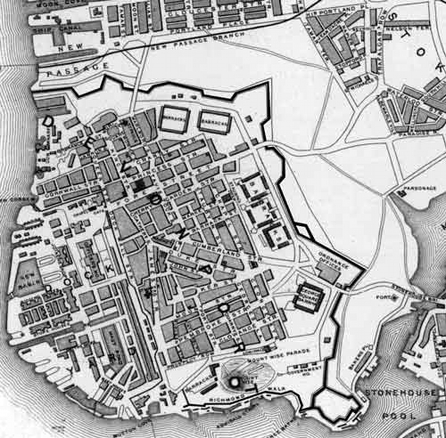
This 1850 map, below, presents the situation very clearly. On one side, to the west, we were hemmed in by the Admiralty; they had claimed almost the entire river frontage for the dockyard and navy. On the north and east we were surrounded by the Army, with a series of barracks encircling the land side of Devonport. The thick black line outside of the barracks, surrounding the town, was the garrison wall - in some places 20 foot high, in other places 30 maybe 40 foot high. Residents called this wall 'The Lines'. The Lines were built with one purpose - as defensive fortifications surrounding Devonport to protect the dockyard from attack. Abutting the outside of the garrison wall was a dry moat/ditch. Finally there was the glacis - a wide band of grassland arcing around the entire town - shown on the map as plain white space with footpaths across it.

map_Devonport_c1850
Devonport - extracted from the Map of Plymouth, Devonport and Stonehouse engraved by Rapkin, published by Tallis c1850

Although residents of the period were virtually hemmed in, (for many years the only land exit was via drawbridge) I prefer to think of them as being protected. I suspect that the isolation created by both the garrison wall, and by the green arc beyond that, nurtured a territorial culture that exists to this day. Devonportees, of all residents within Plymouth, have the strongest sense of place.

For 140 years the townsfolk of central Devonport lived inside the walls - and if you were born inside the garrison, 'within the Lines', you were a true Devonportee. As the town grew and expanded with the new build of Morice-Town, Stoke, etc., then of course many Devonport people were born 'without the Lines' - this adding to Devonportees' sense of place, whether you were born 'Within or Without'.

A Colourful Scene

Throughout the 18th and 19th centuries Plymouth Dock was crowded with soldiers - with Infantry (Marlborough, Granby and Cumberland barracks), Royal Engineers and Artificers (Frederick Square barracks), Royal Artillery (Legonier Square barracks), and in Mount Wise barracks were the Royal Engineers' workshops. Around 1854 began the build of Raglan barracks, replacing Frederick, Legonier and Cumberland barracks. Raglan held 2000 men and their officers, that is, two full regiments. The garrison church in nearby Cumberland Road could seat 1000 men. The town was indeed crowded.

Can't you just imagine the colour and spectacle of life in Devonport then? Unlike today, uniforms then were worn both in and out of barracks. Also, uniforms and military costumes during those centuries were more flamboyant and colourful than now. The grandeur of dress was important to each regiment - little touches here, more feathers in the hat maybe, more buttons, badges or gold braid... Regiments would scrutinise each others’ uniforms minutely. Myerly 1996 commented ** When an officer appeared one Sunday evening (c1804?) at the Plymouth Dock promenade wearing hussar boots with a silk tassel hanging from the pointed brim, Captain Mercer wrote: "I shall not in a hurry forget the sensation caused ... ‘Oh, the puppy!’ was heard on all sides. ‘If he has not silk tassels to his boots! Only think! Silk tassels on boots!’* Such pride in their outfits enhanced the Esprit de corps of a company or regiment. It was all part of the spectacle, an ever changing spectacle, since regiments moved in and out of Devonport constantly - some stayed only months, some years, some returned regularly for long stays, such as the Devon & Cornwall Light Infantry. There were Regiments of Foot, Rifle Regiments, Volunteer regiments, the Plymouth Dock regiment, the Plymouth Dock Cavalry, the list goes on. The town was alive with colour, mostly red.
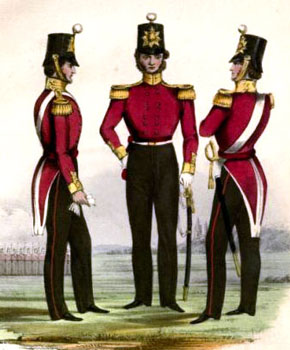
46th Foot Regiment c1850

The 46th Foot Regiment c1850


Tuesday, January 24, 2023

Charles John King ......."Having Referance to My Trip to America"


  Having Referance (reference) to My Trip to America


 After making full preparation which lasted several days & employing all the female skill that we were in possession of at home. The day of departure  eventually arrived for my final farewell to all things that I had become familiar with at home and according my own wish I determined to break the trying ordeal of parting with those friends who had become dear to my heart. I had been timed to leave home at 3 o clock pm on Thursday April 26th 1894, up to this time I had kept from my Darling child as far as possible the secret of my departure from her & in order to carry this out we had arranged to send her away to a friends house with her great aunt to spend the afternoon. I shall remember for a great while that last kiss, she came to me full...

....full of childish (innocence?) to say goodbye not knowing that on her return in the evening her father would be many miles away, her dissapointment (sic)  no doubt will be told  to me on the first occasion that I receive a letter from my Darling wife...As nearly as possible to the time appointed I reluctantly & with tears took my parting with Mother & sister & with my wife (began?) the journey on foot for a short distance...for it had been arranged previously that we should be picked up about 2 miles from home by a waggonet(t) that had been  previously ordered to drive us to Lostwithiel with a friend & my luggage that walk being the last I had taken with my wife at home...I shall remember it for a very long time. Having been overtaken as appointed we were not long making the distance to Lostwithiel...We were very kindly entertained for the time we were waiting by a friend & it was here that...
 I took my parting with my wife.  Of all the partinings this was the most heartrending that had taken place between us during the whole time we had been married, for events had not called upon us to separate for long together but now through no fault of our own we were called upon to wrench ourselves asunder.  God knoweth the hearts of all men & I trust that day when he cometh to judge the quick and the dead, that it will be found that I had done what I could to avert the calamity that had overtaken us.  I think it wise to dwell no longer on the events that transpired at this time.  They are treasured up in our hearts & come what may nothing can erase them whilst we are separated & I trust when the time of our reunion arrives...I left Lostwithiel  by the 6:57 pm train to Bristol & arrived at North road Plymouth...I found it necessary to change carriages & shortly resumed my journey to Bristol where I arrived...
...at about 12:35 am from which place I rebooked to Liverpool but by some mistake due to the booking clerk I discovered on arrival at Birmingham by the Midland Railway about 4'30" am that because my ticket was via Birmingham L.N.W. (London North Western?) I was doomed to wait at Birmingham 1 1/2 hours which time I whilst in going around Birmingham that part which lies in the vicinity of the Railway station & from what I saw I should say that it was a very nice place, although I was struck with the number of offices that were apparently idle which I thought did not look very healthy for business in the city...I left Birmingham at 6 o clock am & after a run of about 4 hours through very fine country arrived at Liverpool (Lime St) about 10 am...I had my luggage put in the cloakroom & had a wash & brush up in the lavatory of the station for which I paid 2 (?) & was very...
...much benefitted thereby...My next exploit was to find Messers Fairburn Martin and Fleets establishment, the brokers with whome I had booked my passage which did not prove altogether an easy task for it seemed to me as though no one knew where they lived.  On my way however I called into a barber shop & had a shave which if my wife could seen me when I came out would have said disfigured me.  I however felt that recognition under the circumstances would be more difficult hence my object in doing it...I had at length reached the place that I had been in search of & was relieved of my few traps for the time being & after enquiring after the ship, the Alaska of the Guiron Line I took a walk down around the docks & wharfe...The ship was then lying off in the river taking in cargo & coal & was looking in pretty good trim...Nothing particular of note ocurred whilst I was in Liverpool except I wrote a letter to my wife in which I told her of my safe arrival...
...at Liverpool in the evening of the same day several men from Cornwall arrived by train 3 men & two lads was going out by the same ship whilst one other man & a woman & child was going by the "Umbria" of the Cunard Line.  I found that this person with her child was traveling to Los Angeles in Lower California & seeing that our interest was so identical it was agreed that we should meet again in New York & commence the journey overland together. The three Cornishmen before alluded to were disposed to the same room in the ship as myself. On the following morning we were (?) early & breakfasted at about 8 o clock in preparation for embarking which was to take place at 9 am but although we were on the pier at the time appointed we found that wait was the order so that by the time we got on board it was quite 11 oclock but even then the cargo was not all in & so it proved to be 4 oclock before we left our anchorage. Dinner was...
...served up on board at about (1 ?) o clock which consisted of soup roast beef or  mutton & rice pudding vegetables.  Shortly after (?) pulling anchor & getting under way the Umbria was seen to be moving & although we began our journey at a fairly good pace it was not long before the Umbria passed us on her way to Queenstown.  Tea was provided on board at 5 o clock & consisted of corned beef bread & butter pickles & marmalade. Supper at 9 pm of biscuits & cheese.  I retired at about 9.30 pm & was aroused for breakfast before seven as we were nearing Queenstown I expect on Sunday morning we did not however arrive here until about 12 am & we found that the Umbria had not yet left but at about 12 45 pm she went out of harbour we took on board passengers at Queenstown chiefly steerage although a few were second...(steerage passengers vs. second class passengers) I think our compliment of second was fairly complete. We left Queenstown of Sunday April 29th at about 1 pm and between 4 & 5 hours later we lost sight completely...

 ...of the coast of Ireland and consequently Great Britain.  During the evening many of the passengers were sea sick but although I felt very queer I managed to get to bed that night without sickness.  About 9 pm on Sunday we had for dinner roast fowel  & mutton & vegetables & for tea meat & pickles butter and marmalade.  On Monday April 30th I got up about 7. 30 & was very sick & continued so all day & was unabled to take any food...We passed two steamers one homeward bound & one outward bound. At 1 oclock the log was taken & it was found that we had travelled 356 miles from Queenstown in less than 24 hours.  I retired shortly after five having attempted to eat a small portion of food but was unable to...On Tuesday May 1st I awoke very much better than when I retired on the previous night...I ate a small breakfast, after which....                                                                                           
...I went on deck and remained there all the morning. We had dinner at 12 oclock of roast pork or beefsteak pie cabbage & potatoes soup, & rice & rhubarb.  We passed a large sailing ship about 4 oclock homeward bound & in full sail, the log was taken & it was found that we had travelled 368 miles since the previous day at one oclock.  After tea we passed another large sailing ship homeward bound...I retired about 7.30. On Wednesday May 2nd I got up about 7.30...the weather was a little rougher than on the previous day & the day began with sea sickness with many of the passengers. I ate a little breakfast of coffee & bread & butter & went on deck where I remained until dinner time...Nothing of note occured (sic), dinner was soup roast beef potatos (sic) & mashed turnip & rice pudding & current cake...at one oclock the log was taken & it was found that we had travelled 375 miles. The wind...

...has been blowing very strong from the S.W. & the sea is rougher than it has been since leaving England.  Nothing noteworthy has taken place today beyond several (steerage?) passengers being sea sick...I had tea at 5 oclock & after spending 2 or 3 hours on the deck I deemed advisable to return which I did at nearly 8 oclock feeling rather poorly & was terribly afraid I should be bad through the night but I thank God was not...Thursday morning after rather a rough night I arise just after seven it had been smart rain just an hour or so before...I went down to breakfast of boiled eggs or pork chops.  I ate a little bread & butter & drank a small quantity of coffee but was too bad to stay long at the table long so in a very few minutes was on deck again where I remained all the morning...I have been slightly sick twice...

...although not very much  yet I feel bad. I read my scripture lesson portion as I always manage & have also read the first ten chapters of Hebrews together with other scrap gleanings from the word. I was unable to go down to dinner today although rabbit & roast mutton was the fare today. I shall feel heartily thankful when I arrive in New York for it seems to me that almost anything on land is better than the monotony of life on board ship. I have been thinking a great deal about my darling wife & child & I have concluded that it will be very much better for them when they come to take passage on a fast boat for it seems to one that to save a day only of this dreary monotonous life is a distinct gain.  About 12 30 pm we passed a large steamer on the north side of us, she was homeward bound & I believe belong to the Allen (sp. Allan) Line probably returning from Canada. The weather continued rough throughout the afternoon & it was with difficulty that I kept myself from... 

...being sea sick. As it was I was very far from being well.  At 5 oclock I went below for tea but was unable to do justice although I had scarcely anything for the day...I ate a small piece of cold beef & bread & a scone & marmalade.  I went on deck again & read the remaining chapters of the Epistle to the Hebrews & commenced to read the Epistle to James. Our ship up to 1 oclock had traveled 358 miles so that we had covered more than half the journey on the sea. I sat on deck until after 8 oclock when I retired feeling very poorley (sic); but was not properly sick.  I took 2 doses of Belladonna during the day & I think that tended to revive me.  On Friday May 4th I woke early & was feeling very much better & was up before 7 oclock & went on deck...the sea was much calmer but it was a thick...

...fog & a pelter of rain & did not look up to much for a pleasant day.  I however walked the deck listening to the fog horn & watching the changing atmosphere which however did not prove uninteresting.  I saw many species of flying fish spring up out of the sea & flying for some distance...they did not however raise very high above the surface of the sea. I should think they were from 6 to 9 in long & had the appearance of large swallows flying close to the water. At 8 oclock I came down to breakfast & for the first time for several days I ate a fairly good meal.  Beef steak & salt herrings was the fare... I did not quite understand what was said so I ordered herring but soon discovered that it was not to my taste & I immediately set the mistake right by ordering a piece of steak which with some boiled potatoes with their jackets I ate with relish &
 ...enjoyed  a good breakfast... 
hot rools (rolls?) & butter & coffee being the accompaniment ...how quickly one is able to tell a change in the weather at sea for when it is a bit rough the table is scantily full but this morning many turned up for the first meal. The fog continued on without much abatement & so the hours up to noon passed without incident of any kind.  Consequent upon the fog the air became much colder & people were hanging about in the saloon more than I had seen them on any other day.  Today we had for dinner boiled beef or fish soup potatoes turnip & rice & rhubarb.  I may say that this is a peculiarity I had not seen any where except on this ship...Boiled rice & stewed rhubarb the two are very nice together & invaribly (sic) when rice is served up a small light pastry is served somewhat in the shape of a very small rool (roll?). 
  ...The ship run today 365 miles...  The fog continued nearly all day & the fog horn was kept going nearly all the time.  Tea was served up as usual at 5 oclock which consisted of much the same fare.  There was nothing else of consequence took place & I went to bed about 9.30...On Saturday I got up at about 6 45 am...It being a splendid morning...  The fog cleared up late the night before & the sea was beautifully calm & the sky clear with a distant (?) on two ships passed early in the morning before breakfast...Breakfast was served at 7.30 am consisting of beef steak or minced collops potatoes bread butter coffee & c. (cream). The morning was passed very pleasantly in promading (promenading?) the upper deck & conversation.  We also passed a fine steamer going homeward & dinner...

...was served at 12 oclock at noon...Today it consisted of roast beef potatoes parsnips or sea pie & vegetable with rices & stewed prunes as dessert...soup as usual first.  The weather remained clear & beautiful all the afternoon although toward evening a slight breeze from the NW with a very little sea sprung up. A large steamship passed on the north side of us homeward bound.  Tea at 5 oclock of corned beef cold roast beef bread butter pickles marmalade and c. (cream). Toward night expectation was high as to the probability of the passing of the Lucania of the Cunard Line homeward  bound (bound crossed out)  which was timed to leave New York at 6 am but no sight or sign of her appeared up to 9 pm.  Supper was served at 9 pm of biscuits & cheese...at 9 30 I retired...
    ...Sunday May 7th at 6 30 am I began to arouse & was up at about 7 am after dressing & cleaning went on deck tho, the weather was fine, but a dense fog had set in during the night & the fog horne (sic) was kept constantly blowing as a warning to approaching vessels, several pelt (?) boats were in the vicinity although we were now over 300 miles from New York, but being so far from land, none was taken on board.  The Lucania was supposed to have passed us during the night some time but I don't think she was sighted. We had breakfast at about 8 am which consisted of bacon & eggs or beef steak bread butter boiled potatoes & coffee. Nothing of consequence transpired during the morning but the conversation was in the main upon the subject of our arrival in New York, & this...

...was sufficiant (sic) with many to fill up a good bit of spare time...Dinner at 12 noon of soup boiled fowel or roast beef potatoes sauce bread & plum pudding... after dinner I walked about on deck for an hour or so & layed down on my berth & slept for a couple of hours as the weather was so cold & damp that there was no inducement offered to move about on deck. We had several showers of rain during the day...our run was given as 379 miles & also at 390 miles but I cannot say which was correct but however it leaves us with a little over 200 miles to run which ought to be done by the early morning. Tea at 5 oclock of corned beef cold roast beef bread butter pickles marmalade...
 

...current buns & tea.  This I anticipate will be the last tea I shall take on the ship but do not know what may transpire ere another 24 hours passes.  


*********************************


 And here we come to the end of Charles King's journey to America from England in the spring of 1894.  He disembarked from the Alaska in New York and made his way to San Francisco, California.  Several months later he was reunited with his wife Anna and his daughter Emma after they made the voyage over on the Majestic. Thank you PamM for initially transcribing Charles King's writings and sharing the original manuscript.  

 Relationship Reference:  Me->Margaret Hansen Boothby
->Margaret (Betty) Hayes Hansen->Emma Lavinia King Hayes Van Duzer->Charles J. King

Did you know? 


Minced Collops

Meat and Meat Dishes
Historic

Minced beef with onion and seasonings. The word 'collop', in use from at least the 14th to the late 19th Centuries refers to a cut piece of meat, ready for cooking as the modern 'steak' or 'rasher'. The use, in these two receipts, to indicate a very finely cut, or minced, meat, is unusual and seems to occur only in Northern England and the Borders.


http://www.foodsofengland.co.uk/mincedcollops.htm


Original Receipt in 'English Housewifry' by Elizabeth Moxon, 1764 (Moxon 1764)

454. To make MINC'D COLLOPS.
Take two or three pounds of any tender parts of beef, (according as you would have the dish in bigness) cut it small as you would do minc'd veal; take an onion, shred it small, and fry it a light brown, in butter seasoned with nutmeg, pepper and salt, and put it into your pan with your onion, and fry it a little whilst it be a light brown; then put to it a jill of good gravy, and a spoonful of walnut pickle, or a little catchup; put in a few shred capers or mushrooms, thicken it up with a little flour and butter; if you please you may put in a little juice of lemon; when you dish it up, garnish your dish with pickle; and a few forc'd-meat-balls.
It is proper for either side-dish or top-dish.


Original Receipt from 'Lancashire Evening Post' - Wednesday 23 October 1935

MINCED COLLOPS

Required; 1 lb minced fresh beef, one very small onion, salt and pepper, some white stock, a dessertspoonful of oatmeal.

Bring a little good dripping to boiling point, and put in the onion, finely minced. Cook for a minute or two, but do not let it get too brown. Put in the meat and beat until all the lumps Into which it may form are smooth; then add the stock, and the salt and pepper, cover and simmer very gently for about an hour, stirring it now and then. Then put in the oatmeal (to thicken it) and cook until you judge that this is done. Many people use water instead of stock, because the meat makes its own stock as it cooks. In Scotland this is always served with a border of boiled rice, and oatmeal Is not Inevitable. You can omit it if you like. The rice, when ready, should be rather grainy and dry.


Sunday, September 4, 2022

A New Beginning......A Trip to Egypt and Back with Charles John King on a New Blog!


  I will be starting a new project....a stand alone blog to publish Charles King's memoirs of his 1884-1885 trip to Egypt and back. You are invited to come on this journey with me (and my Great Great Grandfather...)!  The new blog address is:


     toegyptandback1884.blogspot.com


1908 Watercolor of the Aswan, Nile, Egypt
Conrad Hector Rafaele Carelli (1869-1956), and English watercolorist and painter. Pinterest.com

Sunday, July 3, 2022

John Hansen Marching in the Fourth of July Parade, Grass Valley, California......

    I am sharing a series of pictures taken at a Fourth of July parade held in Grass Valley, sometime in the mid 30's (I don't know the exact year of this particular parade...).  The parade route started at West Main Street and turned the corner onto Mill Street.  These pictures are from the Hansen family collection.  


  A parade float going down West Main Street and past Alpha Hardware.  Note the gasoline pump in front of the store. 


A float from The Unique... 


Advertisement for Grass Valley stores, 1935. 


 A marching band going down West Main Street past the Holbrook and the Grass Valley Cafe. 


 This float had just turned the corner from West Main onto Mill Street.  The First National Bank is in the background.  


This is what West Main Street looked like in the 1930's! 
From the Nevada County Historical Society PIC 4 GR 767


  John Hansen marching in the Fourth of July Parade.  The parade just turned onto Mill Street from West Main Street.  He was wearing his Spanish American War Naval uniform. 

  "John Hansen volunteered for duty with the U.S. Navy during the Spanish American War... (he served as a seaman in 1898). Though being an immigrant from Norway, he was fiercely proud of his adopted country, became a citizen, and served as Grass Valley counsilman and later as Mayor. His American flag was put out each morning and taken in each evening at his home on West Main Street.  He marched in many parades in his uniform, even into later life."  quote from Margaret Hansen Boothby shared on the FaceBook site You Know You're From Nevada County if You Remember.... June 29th, 2022. 


Above photograph enlarged.  


 John and Vere Hansen's home at 418 West Main Street taken July 17, 1942.  Their sons Jack, Bob and Harold Hansen were serving in WWII at that time.  The American flag was proudly displayed from the front porch.

Happy Birthday America!  


Relationship Reference:  Me->Margaret Hansen Boothby->Harold Hansen->John and Vere Burrows Hansen


Monday, June 6, 2022

Burrows Working Tree.......Adam Burrows and The Sligo Union Workhouse


 Sligo Union Workhouse Map from workhouses.org.uk/Sligo/


  Adam Burrows was born sometime around 1842  and was the older brother of my Great Great Grandfather Alexander Burrows.  I know a bit of his life history from the previous letters I have shared in earlier posts.  For some reason, Adam was not able to live by himself and was dependent on his family to take care of his needs.  He ended up living and working in the Sligo Union Workhouse after his father, Alexander Burrows of Drum, died in 1889.  Adam lived there until his death in 1915.  How did he end up there? What kind of life did he experience? I was fortunately able to find quite a bit of information online and DNA cousins added other resources to help with Adam's story. 

  Adam was at home in Drum as late as August of 1890 when both Jane White and Emy Burrows wrote to Alexander in Grass Valley, California.  Drum House was in a state of disarray and Adam was not able to get his meals; he went to Crawford's farm next to Drum House to eat.  He was sleeping alone at night. At this point, it looks like the family had no one to take care of him at home, and the house was to be sold.  Adam's appointed guardian, his brother Tom, was not in the area and though expected home, apparently never came back to take over his responsibilities. Sister Emy was already planning on going back to New York.  Sisters Jane White and Margaret Porteus lived a distance from Drum and had homes of their own to take care of. Adam's brothers Alexander and John had been living in America for quite some time.  Adam's life was in the hands of the Reverend Thomas Moulsdale, the executor of Alexander of Drum's will and the Rector of Ballysumaghan Church.  

    By December 1890, when Jane White last wrote to Alexander, Adam was "in the poor house..his legacy is doing him little good...Moulsdale won't allow anyone to interfere with him..".  The Reverend Moulsdale had placed Adam in the Sligo Union Workhouse. 

  The new Sligo Union Workhouse was erected in 1840-2 on a nine acre site a mile to the north of Sligo. Designed by the Poor Law Commisioner's architect George Wilkinson, the building was based on one of his standard plans to accommodate  1,200 inmates.  (see map above). The buildings in the Sligo Workhouse followed Wilkinson's typical layout.  An entrance and administrative block at the south contained a porter's room and waiting room at the center with the Guardian's board room  on the first floor above. The main accommodation block had the Master's quarters at the center, with male and female wings to each side.  At the rear, a range of single story utility rooms such as the bakerhouse and the washhouse connected through to the infirmary and idiots' wards via a central spine containing the chapel and dining hall. Adam was most likely living in the idiots' ward.


Floorplan of a typical Irish Workhouse findmypast.com


An enlarged section.  The Idiots Ward is at the bottom left hand corner. findmypast.com


   The Workhouse housed the poor, sick and starving of Sligo during the Great Famine in the mid-1840's, and there is now a memorial to those buried in the workhouse graveyard that you can visit.  The fever hospital is the only building left of the workhouse.  The site is now the home of St. John's Hospital.  (Information taken from The Workhouse in Sligo, Co.Sligo https://www.workhouses.org.uk/Sligo/). 

  Note the location of the Famine Graveyard in the map below (in green letters).   I also noticed the location of the St. Joseph's Special School nearby.  It currently serves children ages 5-18 with profound to moderate to mild learning disabilities. Also note the location of the Clayton Hotel Sligo to the right.  It was the location of St. Columba's Hospital in the mid to late 1800's through 1922 and was the county asylum. 


Google Maps St. John's Hospital location Sligo, Ireland.  

  By the second half of the 19th century the makeup of the workhouse population reflected the changing role of the institution.  At the end of the 1800's around 75% of the inmates in Ireland's workhouses were officially classified as sick or as "other", a group which probably comprised mostly the elderly and the infirm. (thestoryofireland.blogspot.com).   Adam was around 48 years old when he went into the workhouse at the end of 1890 and was 73 years old when he died there in 1915.  What exactly was his infirmity? 


Published 7 Nov. 1896 Unknown source/newspaper

According to this newspaper article written on the 7th of November, 1896, Adam was classified as an imbecile as well as a lunatic. The term imbecile implied someone of limited mental ability who was unable to manage themselves or their own affairs (comparable now to an IQ of 25-50 or someone with a moderate learning disability).  In the 1911 Irish Census, Adam was classified as someone with dementia.  Dementia was also used interchangeably with the term imbecile on that census. (Ireland Census 1911).   We can safely say that Adam had some kind of mental deficiency which prevented him from living by himself or taking care of himself.  The court was being petitioned to have him declared a lunatic.  According to the Lunacy Regulation (Ireland) Act of 1871 ..."the word 'lunatic' shall be construed to mean any person found by inquisition idiot, lunatic or of unsound mind and incapable of managing himself or his affairs.." (www.irishstatutebook).   Robert Porteus, the husband of Margaret Burrows, was asking the court to take control of  Adam as a lunatic and that his trust be used by the court for his continued maintenance. As of 1896 Robert had become Adam's guardian, most likely because Tom was in South America. 

  Why had the family given up responsibility for Adam? In the letters of 1890 both Emy and Jane mentioned the difficult circumstances at Drum after their father had died.  Emy mentioned her "sufferings in Drum" and how she suffered as her "poor mother did, which you are well aware of".  Perhaps she was referring to taking care of Adam at home. Adam asked her to stay, but she said "that I dare not do". Taking care of a family member with disabilities can be extremely difficult, especially without help. She also mentioned that her older sister Margaret wanted Adam to go to the asylum.  Once Emy left for New York, there was only the Rev. Moulsdale looking out for Adam's interests. Why wasn't Moulsdale fulfilling his duties pertaining to the will? 

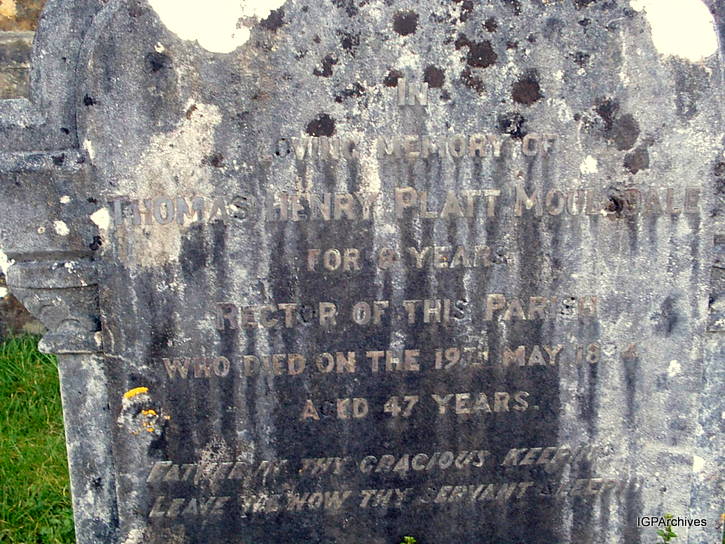
  Two years earlier, the Sligo Champion Newspaper reported the death of Reverend T H P Moulsdale on the 26th of May, 1894.  He unfortunately met with a serious accident at cemetery hill in Carraroe Townland as his trap overturned while he was passing another horse and cart on the lane on the 19th of May.  Thomas did not survive the accident. His wife Amy Moulsdale was injured in the fall, but survived. The newspaper article described Thomas Henry Platt Moulsdale as being "exceedingly popular in Ballysumaghan where he had resided for more than eight years past.  He had previously been in Manorhamilton for a considerable time and was there also much respected and esteemed".  He was buried in the Ballysumaghan graveyard along with several other Burrows family members.  (Thank you, KKelley for sharing this article). 


"In loving memory of Thomas Henry Platt Moulsdale for 8 years rector of this parish who died on the 19th of May 1894 aged 47 years 'Father in thy gracious keeping leave we now thy servant sleeping'...." Ireland Genealogy Projects Archives/Sligo Headstones

  It is sad to think that after all the planning Adam's father had done to make sure he would be taken care of Adam would end up living in the workhouse with provisions from the will under control of the court. His family was no longer willing to watch over him and the Rev. Moulsdale was dead. What little legacy Adam had left to him was just enough to maintain him in the workhouse, the place where the most vulnerable in society ended up. 

   What were conditions like there?  The British Medical Journal published reports on workhouse conditions in Ireland in 1895-6, including the Sligo Workhouse Infirmary.   Adam would have been housed there during their commission  visit. I have taken excerpts from the report to share here  (you can see the entire report on the Sligo Workhouse at workhouses.org.uk/Sligo/ under BMJ Reports on the Nursing and Administration of Irish Workhouses and Infirmaries, 1895-6).  Using our modern era to compare levels of care it was very difficult to read this report.  

..."There is an average of 140 patients, who were thus distributed:  the men in the hospital proper, where also we found the female lunatics placed at one end of the block and the male lunatics at the other.  In this block there were about 70 beds....At the time of our visit there were 70 women and 38 men...."

..."The patients in this hospital included a cretin of 23 years of age, who in size and general appearance resembled a child of 5 or 6.  The poor little creature seemed to be a general pet in the ward, or perhaps we should rather say that he furnished some amusement to the inmates.....The bedsteads in this division are "harrow" frames, with straw ticks and pillows; a board let into the wall forms the bed head.  The majority of the cases were helpless old age and chronic diseases..."


Harrow beds were wooden frames or platforms for bedding with a walkway in the middle.

  ....."There is no night nurse for these patients.  The day staff is quite inadequate, and, in the words of Dr. Murray's report, 'the night nursing is in the hands of paupers.' ....The listless, apathetic air of the idiots and epileptics (in the female ward) showed that nothing was done in the way of occupation for the lightening of their unhappy lot. The male lunatics are slightly better off; they have the use of an airing court, such as it is, some of them find occupation about the house, and they are not so overcrowded.  As the workhouse is close to the county asylum the more dangerous inmates are removed thither as there is room in the asylum..."

...."It is the same old tale, almost nauseating in its iteration, of the entire absence of anything like decency or sanitation, when we come to the conveniences provided for the inmates.  Outside are privies on the waggon system; indoors, bucket, pails and commodes are used in the infirm wards...a basin and a round towel are provided for common service among the sick, and a bath or two, without hot water.  Every drop of water has to be carried to the wards for use, and carried away when used, and when warm water is required it must be heated in a kettle or fetched from the main kitchen..."

   Starting in 1899 the Sisters of Mercy provided the nursing staff in the workhouse infirmary in Sligo.  The Roman Catholic Religious Order was associated with their care for the poor and sick, and were also employed as teachers.  They were used in other workhouses around Ireland as well.  Hopefully, the conditions in the workhouse improved with the addition of the more qualified nursing staff.  

  What was Adam doing in 1901?  The 1901 Census of Ireland is the earliest complete census to survive the Public Records Office explosion during the Irish Civil War.  Adam was listed on this census, number 28 at the bottom....


Census of Ireland, 1901 Form 1 Return of Lunatics and Idiots in Public Institutions (top)


Adam Burrows, Irish Church, Cannot Read, aged 59, Occupation/None, not married, born in Co. Sligo, Imbecile. How long affected? 50 years. 


   Adam was also found on the 1911 Census.  His age at the time was 70 years, and his occupation was listed as labourer.  It is not known what kind of labor he performed, but at least he was able to perform some kind of work by this point.  His disability was now listed as "dementia". 

  The Sligo Champion reported on the 8th of May, 1915 that there was to be a public auction of  "Four Houses in the town of Manorhamilton in the matter of Adam Burrows, a Lunatic". Two of the four houses were vacant and two were being let to tenants at a gross rental of L10. It is not known why this part of Adam's legacy was being auctioned off at this time. Adam may have been in poor health and not expected to live much longer.  


  Adam died in the Sligo Union Hospital on the 19th of December, 1915.  He was 73 years old. 


Adam Burroughs (Burrows) of Ballysumaghan, male, bachelor, 77 years, Occupation/none, Chronic dementia, years (duration of illness), exhaustion.  He died while living at the Sligo Workhouse.  I believe his age was closer to 73, not 77. Exhaustion refers to the fact that his lengthy infirmity drained him of strength. 

  
    Was anyone left to mourn Adam's passing?  Margaret Burrows Porteus had died in 1903.  Jane Burrows White was still alive but would be gone by 1918. My Great Great Grandfather Alexander had died in San Francisco in 1904. John Burrows passed away in 1914 in Oklahoma. Emy had passed away in New York in 1905. It is not known when Tom passed away, or where he was living.  I do not know where Adam was finally laid to rest, but it was most likely somewhere in Sligo. 

   
   At the time Adam was living in the Sligo Union Workhouse there was also another county asylum in the area.  The St. Columba's Hospital was located in the same general area as the Workhouse, and was an imposing building.  Adam may have not had adequate funds to be placed here, or he was just not a danger to himself or others as were the inmates housed there. It appears that his disability was primarily cognitive, and not mental.  St. Columba's became the Sligo Mental Hospital in the 1920's, closed in 1992 and reopened in 2005 as the Clarion Hotel. It was rebranded as the Clayton Hotel in 2021 (wikipedia St. Columba's Hospital)

St. Columba's Hospital/Clayton Hotel Sligo

   Adam Burrows' story was a sad one, and should not be forgotten.  My Great Great Grandparents,  Alexander and Elizabeth Jane Burrows, also had a son who ended up being institutionalized in the Napa State Hospital in California.  Herbert Spencer Burrows spent most of his adult life in Napa as a patient, also with an unknown disability. I still need to spend time  researching his life as well.  I would surmise that Herbert's care in that institution was somewhat better and more humane than the treatment Adam received in Ireland.  

  What would Adam and Herbert's lives be like today, with the educational support and services we provide now to those with lesser abilities?  How would they have flourished with a supportive family behind them?  As a former Special Education teacher for 30 years I know that they would have done very well functioning in our current society if given the chance. I am truly sorry they were not blessed with that chance. 

**************************************************************************


This is the current Burrows Working Tree listing the children of Alexander Burrows of Drum and Frances "Fanny" Elliott.


1. Margaret Burrows 1836-1903 (married Robert Porteus) of Clara/Claragh Irish
*daughter Frances "Fanny" Porteus Graham 
*daughter Jane Elizabeth "Jenny" Porteus Golden/Goulden

2. Jane Burrows 1838-1918 (married Adam Elliott White) of Sligo.  The White family lived at WhiteHall (Whitehall), County Leitrim, Ireland.
 *son Robert Alexander White born at Whitehall, County Leitrim, Ireland.

3. Adam Burrows 1841-2 to 1915 (was living in Drum in 1890; lived at the Sligo Union Workhouse sometime after that. Adam died in 1915 in the Sligo Workhouse Infirmary.)

4. Alexander Burrows  1847-1904 (married Elizabeth Jane Hurd in America) my G G Grandparents; they lived in Grass Valley, California.

5. John Elliott Burrows 1849-1914 (came to America) m. Margaret O'Leary in St. Louis. Children Frances Burrows Riley and Thomas A. Burrows.

6. Thomas Rutledge Burrows  (bequeathed house and land in Drum and was to look after Adam per will of 1889.  Left for America shortly after his father's death).  m. Georgina Foster b. 1871 d. 1890.  Per marriage index Ireland, Civil Registration of Marriage, she married Thomas in 1888 in Ireland.  This relationship was also mentioned in Emy's letter of 24 June, 1890.  The death of Georgina and their two children were mentioned in Jane White's letter of 4 December 1890. I currently have no information on where Thomas lived or died after 1890, other than he was in South America in 1896. 

7.  Ismena  "Emy" "Emma" Burrows (spent time in America in 1889 but went back home to Ireland to claim her inheritance, per letters written in 1890. Left for America again in September of 1890.) Per letters from New York, New York in 1893, 1905 and 1906 Emy Burrows married Hermann Bucher and went by Emma.  She and Hermann married 7 Nov. 1892. Emma died on 14 December 1905.