Friday, March 5, 2021

52Ancestors52Weeks Week 9 Theme: Multiple (Harold Hansen Had Multiple Occupations)

Harold Hansen 1937.  Picture taken at the Hartsook Studios, most likely in Oakland, California. 


 2026 Update:   Parts of this blog post are now  a part of the Nevada County Historical Society's Online Walking Tours, found under Cornish Choir A Living Culture!  Check it out next time you are in Grass Valley! Download it on your phone or find it here: 

 Margaret Boothby's experience with the Cornish Choir is on stop 10! 


Thank you to Rose Murphy and Lisa Redfern for letting our history be a part of your project. 

Check out the link to the right under Nevada County Historical Society Online Walking Tours for other posts mentioned in this project.


  This week's theme of Multiples was a tough one.  My family on either side does not have any history of twins, triplets, or anyone that married multiple times (aside from the occasional divorce and remarriage).  So, I thought about my Grandfather, Harold Hansen, and the history of multiple and varied jobs he held throughout his life.  If you ask my mother, this was a source of constant consternation, worry and fret by my Grandmother Betty Hansen.   Understandably so, as my Grandfather didn't always provide a steady stream of income and the family had to depend on my Great Grandmother, Emma VanDuzer, for support  quite a few times.  But, I would like to take the emotional component out of the story for this post, and instead focus on the jobs themselves.  As I did not directly experience the ramifications of my Grandfather's job history, I feel I am able to look at things with a little different perspective.  


  "For a preface to my story, let me say that as the years have rolled on, I am convinced that the Lord deemed that I was to be a special person with a special job to do, and He has been watching that I do it, and as my story unfolds you will understand my reasoning and that He has guided me through thick and thin, and has brought me safely so far, and will be with me until the end.  So much for the preface, now let the accounting of my life begin."  ........Harold Hansen 1991

  So began the Life Story of Harold Hansen, which was compiled from his own writings and audio cassettes that he recorded in 1991 shortly after the death of his wife Betty.  He had a tape player, and would try to record his thoughts and daily routines on a regular basis.  My Auntie Claire (his youngest daughter) took this information and began typing out a rough manuscript piecing together the snippets of information. I used the beginnings of this manuscript for my earlier blog posts on his life as a boy growing up in Grass Valley, California in the early 1900's.  She managed to get through his trip in 1930 to Norway.  The rest of his story on tape that she began transcribing is still in a notebook with her comments and questions about timelines and facts  in the margins. 

  These tapes were made at a time when Grandpa was beginning to forget things and loose his train of thought.  Auntie Claire transcribed them as they were, adding comments about spots where there was lots of blank time (a nap perhaps?) and spots where he would begin to sing.  He could usually remember all the verses of hymns or songs.  But, his stories got jumbled up here and there.  He seemed to always go back to his beloved hymns and songs when he lost interest or his train of thought.   At some point, I will finish transcribing and typing out his tape recordings and add to Auntie Claire's manuscript.  But for now I will focus on the many jobs he had throughout his lifetime. 

  Harold Lloyd  Hansen was not a stranger to hard work.  He grew up on his parent's 5 acre ranch near the Idaho Maryland Mine in Grass Valley, California with his two older brothers Jack and Robley.   They had chickens and cows to take care of  and grew hay and oats.  The boys delivered fresh milk on their "dairy route" before school, and picked up empty bottles on their way home.  They sometimes delivered  eggs, produce and fresh cut flowers to their customers.  All three boys developed a a good strong work ethic from both of their parents living on the ranch.  
  
  In my Grandpa's Junior year of high school  he played football as well as basketball and baseball.  During a basketball practice he fell and injured his knee.  He went to Sacramento for repairs (he didn't say if it was surgery or other treatment) and was not able to play sports again.  He said that "I developed an inferior complex, lost the class presidency, did poorly in grades so missed out on Berkeley. "  In fact, he barely graduated from High School in 1928. This set up a pattern of  behavior that stayed with him the rest of his life.  The Great Depression and World War II didn't help, either. 

  His first job right out of high school was working for the Forest Service at Lewis Mill, south of Loyalton, California.  He was part of a summer crew that constructed a phone line on Babbitt Peak to Sardine Peak at 8,900 feet.  Grandpa talked about how the men had to brush out cottonwood trees and haul the poles up the hill that was so steep they had to crawl.  They were above the timber line where the wind blew pretty fiercely, and the men needed special tools to get the lines up the poles. He described himself as "the flunky on the job".  He fetched cement, water and lumber, as well as cooked for the men.  Once a month he had to go get supplies from Loyalton or Truckee.  He also kept camp for the fire fighters who were working on fire in the area.  One of his other jobs was to go to Hobart Lumber Company to get "1/2 a blacksmith shop" loaded onto a 1912 Liberty Truck to haul to camp, going back up the mountain  at a 14% grade.  At this point, he thought he found his calling in life and decided he wanted to be a forester.  He  enrolled in classes at Sacramento City College for the Fall. 

  While studying botany in Sacramento he joined the Glee Club, started performing around the area and met a girl named Louise.  He developed his love of singing and performing at this time.  Between singing and Louise, his grades began to slip. Being a forester just wasn't going to happen. 

   He decided that he wanted to go to sea and become a sailor like his father John Hansen was as a young man.  In 1930, at the age of 20, he worked his way to Norway on the ship  Balboa cooking for the crew and serving as a general deck hand.  His uncle owned a shipping business and got him on the crew for the trip over and back.  He enjoyed his time with family in Norway, but decided on the return trip that being a sailor was not for him, as it was hard work and "not as exciting as I expected".  And, Louise had lost interest in him and married someone else.  So, being a sailor and following in his father's footsteps didn't happen. 

  During the height of the Great Depression  he went to work at the Idaho Maryland Mine in his home town of Grass Valley.  His father had also worked as a miner and had even helped to reactivate this mine.  The economy in Grass Valley was still going strong  because of the mining industry.  Most men in the community that were not attending college worked in the gold mines at some time or another.  Grandpa started out at an entry level job,  earning $2.88 an hour as a rock crusher.  In a few months he was working at the 850 foot level as a mucker, loading and dumping ore cars full of rubble.  Both of those jobs required a great deal of strength and were considered to be menial jobs. But, he was working. He even survived several close calls with rock falls and dynamite! He would fall back on this job several more times in his future. 

  During this time he also took  singing lessons with the Choral Class at St. Mary's Academy, and also from an organist/music teacher named Marshall Giselman out of the Bay Area.  Mr. Giselman broadcast organ recitals every Sunday afternoon from KPO Radio out of San Francisco (from the remote broadcasting location of the California Palace of the Legion of Honor) and taught music to pupils in Northern California.  Grandpa began singing with groups around town for commencement programs and recitals; he also began to sing solos for programs and services at different churches in Grass Valley.   He began his "radio" career in 1933, with the help of Mr. Giselman. 

1933 newspaper clipping source unknown


    This newspaper clipping talks about the musical program given in Grass Valley at the home of Mr. and Mrs. Arthur B. Foote, who owned the North Star house (designed by architect Julia Morgan).  Arthur Foote was the manager of North Star Mine, and his wife, Mary Hallock Foote, was a famous illustrator and writer.  They often hosted community and civic events in their home.  The program was put on by Marshall Giselman and his students.  I can just imagine an afternoon of beautiful music inside the cool stone interior of the home.  I hope that Grandpa's parents were able to attend. It would have been a real privilege to be a part of any function given by the Footes! What an honor.  

  I'm sure a career as a singer didn't pay well at the time (or at all) and Grandpa couldn't find any other work that interested him , so he went  (or was probably sent by his father) to Reno, Nevada where his Uncle Roy Burrows had an iron works and construction business.  He worked for awhile making columns for a building as an apprentice.  His older brother Robley had also worked for Uncle Roy for a time, and had eventually started his own construction company in Reno.  While in Reno, Grandpa attended the Baptist Church with his brother  Bob (Robley) and his wife Alma, and enjoyed singing solos during Sunday services.  Not enjoying the life of a construction worker apprentice, he picked up and moved once more looking for his calling in life. Perhaps he could make a living out of his singing. 

  He decided he was going to go to Oakland to continue his studies in music.  He found a vocal coach who was a Christian Scientist and who helped him get paid for singing solos every Sunday at the Christian Science Church in Fruitvale, California.   He ended up with a three year contract at that church.  While there, he also had his own radio program at KROW studios in Oakland around 1934/35.  He performed in shows in the area; in one show he played the Ensign in a production of the "Sho-Gun" at the Heath Club Auditorium in October of 1937.   At last, perhaps, my grandfather was doing something he really enjoyed.  But, the effects of the Depression made things difficult for Grandpa. 

   Grandpa found himself lacking sponsors for his radio show, as the depression was still in full force, so he took himself back to Grass Valley in 1937.  I have to wonder what his career would have looked like if he had continued with  his music  and singing studies in the big city.  He seemed to be happy doing what he was doing there.  But, he came back to town, worked in the mines again and sang at the Episcopal Church (his family's church) on Sundays.  Then, he met my Great Grandmother Emma Van Duzer who attended the Methodist Church right across the street.  She said the church needed help with the Easter music, and  her daughter Betty who was a soprano in the choir needed singing lessons.  Well, Harold and Betty were married July 2, 1939, and he continued singing with the Methodist Church Choir for the rest of his life.  


Harold Hansen second from left singing with the Cornish Choir at the 2,000 foot level of the Idaho Maryland mine on a nation wide broadcast Christmas Day, 1940.  Photo courtesy of Grass Valley Union. 


  My mother's birth certificate lists Grandpa's occupation as "gold miner" in 1941.  He was still singing, as mom relates that she was born on a Sunday and Grandpa came to see her in the birthing hospital (now the parking lot of  the Del Oro Theater).  He commented that she was "not a boy" and then went to the Christian Science Church on Main Street to do his weekly singing there, as he was paid for that job.  He continued to sing for funerals and at other functions in the community, most of which he did not get paid for.  He worked down in the mine during the winter, and during the summer  he worked at the Idaho Maryland sawmill where he "pulled green chain".....a heavy job where men would catch the green boards as they came off the saw and stack them up. 

Grandpa's helmet lantern used in the Idaho Maryland Mine, Grass Valley, California


   With the advent of WWII the mines closed down as they were deemed nonessential.  Grandpa was once again out of a job, and with a wife and young daughters to support he needed to find work.  He traveled to the Bay Area once again and worked on defense projects building Liberty ships at the Richmond ship yard.  He also took another job working for the Hall Scott Motor Car Company which at the time was building engines for a variety of military projects.  I am not sure what a test washer was, but it was nice to put a story to this little pass that I found floating around with other Hansen family pictures. 


"This was mugged when I worked here during the war.  What a mug!" written on the back by Grandpa.  


  Grandpa eventually joined the Navy (he volunteered and joined his older brothers in the fight) spending time in the Philippines, Iwo Jima and Okinawa, and was in Tokyo Harbor during the signing of the peace treaty.  He served as a fireman in the belly of the ship Lenawee, which was another back breaking job.  I posted an entry detailing his service in the war last May (5-26-20).  He came back with what we would now recognize as post traumatic stress syndrome.  

Harold Hansen 1946 after his return from WWII


 When he came back to civilian life he continued to have difficulty finding work that was stable and that he enjoyed.  He was again employed by the Idaho Maryland Mine which had opened back up, and also at the New Brunswick Mine salvaging material because that mine was closing.  But, these jobs were not steady, and he looked elsewhere for odd jobs. When the family home burned in 1950 Grandpa was in Oroville looking for work.  He would often go to Sacramento looking for work, sometimes long enough to stay in a boarding house.  This was probably a difficult time for him, trying to adjust back into civilian life; it did not make things easy on his family at home.  But, he continued with his singing. 

The Idaho Maryland Mine stopped operation in 1957. 


       Grandpa ended up joining a laborer' s union which gave him the opportunity to work even if it was hit and miss. The work was mainly low level, heavy labor.   He worked on summer fire crews in the area, and in the winter  when  the water froze in the NID (Nevada Irrigation District)  flumes, workers were desperately needed to break the ice to get the water flowing again.  He and other men from the union were paid to break the ice in the flumes standing in freezing water up to their waders.  Which was nasty work, to be sure. Grandma began working at McClellan Airforce Base during this time (the Korean War) to help the family financially.  
  
  I was very surprised to learn that Grandpa was involved in several construction jobs in Grass Valley during the 50's.   One was the Country Club Terrace housing development which was headed by Howard Lidster, contractor.  Eventually my Grandpa and Grandma would move into a house on Lidster Avenue in that development.  He also worked as a laborer on the construction crew that was building Interstate 80 over the Sierra Nevada Mountains, right before the 1960 Olympics in Squaw Valley.   He worked with the blasting and drilling crews preparing for blasts to remove solid granite and dirt.  The crews had to work between the Southern Pacific trains coming through.  He told of what happened one day when a blast went off too early.  His crew thought he had been hurt, but he happened to be in the spot where the only blast that didn't go off correctly had been.  He worked several seasons on the I-80 project.  He also worked on the Highway 49 building project, widening the twisty, narrow old road.  These were all projects that helped modernize the area after the war. 

  In 1960 Grandpa once again was in the entertaining spotlight.  He made a little record for the Squaw Valley Olympics, recording it at an Auburn radio station.  I don't know if he got paid for this but he ended up with his own copy of the record!

"Feb. 18, 1960.  Song "Let's Meet at Squaw Valley".  Words and music composed and written by Effie Lois Humphrey.  Soloist--Harold Hansen.  Organist- -Dorothy Simmons.  All of Grass Valley, California".

   Finally, he began working at Beale Airforce Base in the plumbing shop in the early 1960's.  Grandma also worked there as a civilian supply clerk for the SR-71 project (aka the Skunks Works Project) so they carpooled together for several years until they both retired in 1978.   He was not especially excited about plumbing, but it was a job with benefits and a steady income.  And, Grandma made sure this time he stuck it out. They were able to buy their home on Lidster Avenue.   After his retirement, Grandpa continued to work in his beautiful garden in the backyard at Lidster Avenue, and he continued to sing at church and with the local Cornish Choir.   He and Grandma traveled a bit to Alaska, Tahiti and the Holy Land. I am glad that he finally got a chance to take a well-deserved  break.  

  Yes, my Grandpa had multiple jobs throughout his life.  Most of them involved heavy labor and were considered of the low level, unskilled variety.  He never finished college or kept a steady job with the exception of his last job with the Airforce base. And, yes, this caused conflict with his family.  There were many factors that lead to his life choices.  He never found an occupation that he enjoyed or  that paid steadily, with the exception of his singing. His musical talent he used all throughout his life.  All I know is that I remember a grandfather who was a physically strong man, but very gentle in spirit.  He never strayed from his belief that God was always watching out for him and was with him through thick and thin no matter what he put his hand to or what he was doing.  I know that he put his own unique stamp on the community he grew up in, both with his manual labor and with his singing.  I also grew up in that community, and the town that  I know looks the way it does because of my Grandpa's labors. 
  

23, October 1993 The Union  Grass Valley-Nevada City, Ca. 


  This is how my Grandfather was remembered in his obituary.  I am glad he was remembered as a Well-known singer.  That seems to be how he saw himself as well.  His singing career actually began when he was just a little boy of around 4 or 5 years of age.  He had an appendicitis attack and while recovering from surgery in the Jones Hospital he began to sing to other patients.  He cheered them with his rendition of "It's a Long Way to Tipperary" and managed to earn $3.29 which his mother made him deposit in an account at the Nevada County Bank.  Music was the brightest common thread that ran throughout his entire life.   


Relationship Reference:  Me->Margaret Hansen Boothby->Harold L. Hansen->John H. Hansen


Tuesday, February 23, 2021

52Ancestors52Weeks Week 8 Theme: Power Josiah S. Boothby and the Heppner Flood 0f 1903

The town of Heppner, Oregon during the flood of  14 June, 1903 
National Weather Service Public Domain picture


  The theme for this week's 52 Ancestors in 52 Weeks challenge is Power.  I have chosen to explore the power of water and the Heppner Flood of 1903. 

  The power of moving water can be harnessed for many useful purposes when it can be managed carefully.   Moving water  has helped operate mechanical devises such as gristmills and sawmills for thousands of years.  It helped usher in the Industrial Revolution in Britain. Water in canals could be used to move goods and people long distances. Hydraulic mining during the Gold Rush era used high pressure jets of water to dislodge rock to then extract gold.  Even tidal power can be harnessed to generate electricity.  

  Sadly the power of water can be  responsible for a great deal of destruction when it is uncontrolled.  This is the story of the neighboring  towns of Heppner, Lexington and Ione Oregon on the 14th of June, 1903.  My paternal Great Great Grandfather, Josiah Stewart Boothby, was living in Lexington at that time working as a rancher and farmer.  I had no idea that this area endured so much devastation until I began my research into this side of the family.   The death toll was 247 souls and remains the deadliest natural disaster in Oregon history, and the second deadliest flashflood in the United States, behind the 1889 Johnstown flood  and ahead of the 1972 Black Hills flood.  The flood caused over $600,000 in damage, equivalent of $17 million dollars today (Wikipedia Heppner Flood of 1903).  


 The Heppner Gazette 18 June, 1903

  The town of Heppner is located in eastern Oregon, just south of US-84 and the Columbia River.  It lies in a small, tight valley that contains a small little stream that drains into the Columbia River.  Willow Creek is about ankle deep, and can even run dry during the summer.  However, on June 14, there was an exceptionally strong thunderstorm which dumped torrential rain and hail on the watershed of Willow Creek.  Within 15 minutes, smaller streams emptied into Willow Creek, which in turn sent water towards Heppner, which at that time had about 1,500 residents.  The rain and hail were so loud most people took shelter inside their homes, contributing to the death toll. It is thought that the rattle of hail masked the roar of the muddy water, trees, cattle and buildings that came down the canyon and into town.  The water was so powerful it picked up dozens of occupied houses and moved them downstream.  A third of the town of Heppner was gone, as well as a quarter of its population in a very short period of time. Excerpt from the Heppner Gazette....

"Words cannot express the horror, the awful destruction.  Entirely helpless, from the hillsides, the survivors watched the terrible waters take there course. To attempt to battle the great waves meant only suicide without being able to accomplish anything."

"This city is a heap of ruins. Twisted tree trunks against which are piled masses of wreckage mark the residence districts. Scattered throughout this wreckage and the bruised and distorted bodies of the dead..."

 "...the large two story residence building of T. W. Ayres left its foundation and swung around into May Street and crashed into and lodged on some wooden buildings just back of the Palace Hotel....Mr. Ayres was at the power house and his family was at home, when the building started. The family ran upstairs and were rescued when the building stopped ...the family came down on a ladder and were taken out uninjured." 

"Phil Cohn, whose family was out of town, was at home and asleep when the flood struck his house, he stayed with the building until it went to pieces and for a mile he clung to the wreckage, going under a half a dozen times or more, and was finally able to crawl out more dead than alive in W. O. Minor's alfalfa field." 

  The little town of Lexington, where Josiah Boothby lived, was down stream of Heppner.  The telegraph and telephone lines were out, so Lester Matlock and Bruce Kelly rode their horses down the valley, racing the moving water, and warned the ranchers and residents of Lexington and Ione of the approaching disaster.  Lexington was badly damaged, but Ione escaped any destruction.  When the flood had gone, it was apparent what force the water had.  These are excerpts from another local paper, talking specifically about Lexington, Oregon. 

"Fifty men were at work this morning breaking away the piles of trash expecting at any moment to come across the body of some unfortunate who went down in the flood. Yesterday morning, the body of an elderly lady, the wife of ex-judge Keithly, was found in Andrew Rainey's field two miles below Lexington. Mrs. Keithly was in Heppner when the flood came. As Heppner is nine miles from Lexington, it can be readily seen what force the water must have had to carry a body that distance.

  The paper also listed monetary damages suffered by its residents...

"B. M. Booher, one of the prettiest cottages and finest orchards in Lexington, $1,500 ; W. J. Davis, orchards and gardens ruined, $2,000;  J. S. Boothby $1,500 across the creek; Mrs.  Penland, owner of the principal portion of the townsite and several orchards up the creek, will loose $8,000......while some of these figures seem small it means everything to the poor unfortunates. Their all is gone. In many cases not even the soil is left in fit condition to cultivate.  Rocks are embedded in the slime, which covers the land to the depth of 12 to 20 inches." 


Willow Creek dam above the town of Heppner,  constructed by the Army Corps of Engineers in 1981 to prevent further destructive flooding. 

   In 2003, a three-panel stone monument was placed in the town of Heppner to mark the 100th anniversary of the disaster. The monument also lists the names of the victims of June 14, 1903. 


  The present day Community Bible Church in Lexington, Oregon.  It was originally the Methodist Episcopal Church when Josiah Boothby and his family attended, and is best known for being swept off its foundation during the Heppner flood of 1903.  It rode the flood tide down the street and crashed into the Congregational Church.  It was retrieved, replaced and restored and continues to serve the community at its original site. 

 Josiah Stewart Boothby died in 1905, just two years after the disaster.  He was buried in the Penland Cemetery.  I have to think that this event had a profound effect on his health and his family.  His monetary losses were substantial.  My Great Grandfather, Josiah Thomas, was also living and working as a farmer in Lexington in 1900 with his wife Lillie Mae Hayman Boothby.  They had a home there with Lillie's four children by her first marriage (Ciola, Harry, Clyde and Marion), as well as Thomas Josiah Boothby, their first born together.  Although he is not listed with other town members as having lost a home or property, it took the town quite a long time to rebuild the railroad bed and other damaged infrastructure to enable it to function economically as it did before 1903.  By 1910 my Great Grandfather  was farming in Grass Valley, Oregon, so he may have not been able to make a living  in Lexington to support his growing family.   Lexington remains a very quiet little town today, with a population of a little over 200 people, up from 185 in 1910.  Residents are mainly sheep and cattle ranchers, and wheat farmers. 

Saturday, February 20, 2021

53Ancestors52Weeks Week 7 Theme: Unusual Source. Or, How a Weird Tale Solved a Family Mystery (Harriet Bluett Hurd)


 3 June 1935 Nevada State Journal


  This week's theme is "Unusual Source".  Genealogists use many sources to find out facts about their relatives' lives:  Census reports, birth certificates, death certificates, funeral records and city directories can give up a great deal of information to a family historian and help create a basic outline or timeline of a person's life span. But, these resources can be a little "dry".  How do you add a little personality to the dry facts? 

  One of my favorite resources lately has been local newspapers.  They give wonderful and  personal details that  help make people that lived their lives long ago all the more real.  You can really get a feel for  their personalities, their beliefs, their interests and sometimes even hear things in their own words if they are quoted. You may be really  lucky and get to see a photograph! 

  Using newspaper articles as a resource is not that unusual in genealogical research. But,  newspaper stories can  give up unusual details that might help answer questions that have gone unanswered through the usual methods.   I found out something very unusual from a little snippet  in the Nevada State Journal just the other day, when I was searching for articles about another cousin, Alta Powers.  It was certainly a weird story, but it helped confirm a fact that I thought was true, but couldn't prove with the usual resources. 

  For the last several years I have been researching my Hurd/Bluett families that came from Pennsylvania to California and Nevada in the mid 1800's.  They were a hardy bunch that ended up living in the mining town of Virginia City, Nevada.  My Great Great Great Grandmother was Harriet Bluett Hurd.  She and her husband had a total of 10 children, and she came to the west from Pennsylvania not once, but twice.  The first trip the family made was across the Isthmus of Panama and up the coast to San Francisco, and then by stage to Nevada City, California.  Her husband died in a mine accident in Virginia City in 1876, after the family had gone back to Pennsylvania and made yet another trip back out west to settle in Virginia City.    She lived there with her remaining children until her death in 1893 at the age of 58.  

  I had several nice resources on her life to work from, including 40 years worth of US  census records, census population records from Pennsylvania, and local County birth and death records.  I even found several newspaper snippets about her trips to visit family in Nevada City, and her last illness and eventually her death.  I did not, however, have any records of her place of burial.  I had many records of her children's final resting places, but not hers nor her husbands.  The family story was that she was buried in Virginia City, but no one could locate her actual grave. 

  My mother tells  the story of how she and her uncle and grandmother (my GGG Grandmother Harriet's granddaughter)  drove up to Virginia City, Nevada  from Nevada City, California (a day trip to be sure) in the 50's.  They went to the cemetery trying to find where the grave was.  My mom recounts the story..."I can see all of us tramping around the cemetery with the wild winds whipping the long grass around.  Spooky, especially when you are a kid!"  I too, have been tramping around that cemetery looking for relatives, with no luck.  And yes, the cemetery can be spooky with its constant winds, weeds and sagebrush. 

The Silver Terrace Cemetery Virginia City, Nevada.  From Travel Nevada.

  As I was looking for articles with the name of Alta Powers (I had been researching her story at the time) on Newspapers.com during their latest free weekend,  this headline jumped out at me. GROUND COLLAPSES AS RENO GIRL PUTS FLOWERS ON GRAVE. What? Whose grave? Was she Ok? I didn't even have Harriet Bluett Hurd on my radar that day. As I read on, the article gave the exact relationship to the deceased...her grandmother.  That would have been Harriet Bluett Hurd!  It also gave the location of the grave as "near the old Mexico Mine" in Virginia City.  Well, that would have been very close to the vicinity of the Silver Terrace Cemetery.  The grave was probably over one of the many tunnels from the mine, and the ground gave way.   And, thank goodness, my first cousin 3x removed was ok after the ordeal. 

   Considering that there are hundreds of unmarked graves in this cemetery, and at that time the ground was still under threat of collapsing, I will probably never determine the exact location of her burial.  But, now I do know that she was, in fact, buried in Virginia City in 1893.  Her husband is most likely there, too.  Too bad this very strange and weird story didn't get passed on to my Great Grandmother! 
  

Relationship Reference:  Me->Margaret Hansen Boothby->Harold Hansen->Vere Burrows Hansen->Elizabeth Jane Hurd Burrows->Harriet Bluett Hurd

Alta Powers was the daughter of Hattie Hurd Powers, whose mother was Harriet Bluett Hurd. Harriet was a younger sister of Elizabeth Jane Hurd Burrows. 

Friday, February 19, 2021

The Hurd Family: Valuable Heirlooms Donated To Bowers Mansion (Hurd)


An excerpt from the article published in the Nevada State Journal 7 March 1951

  Imagine my surprise when I found this gem of an article in the Nevada State Journal!  As I did more research, I learned that more than 500 families have donated period furnishings that are now housed in Bowers Mansion.  Within this story is a mention of the famous Steinway that was moved from the Meacham house to the Piper Opera House the night Emma Nevada gave her concert in Virginia City (3 December, 1885).  The Hurd and Powers families were very proud of that piano.  


Bowers Mansion taken in the 1860's Nevada Magazine July-August 2014

  Bowers Mansion was built by Sandy and Eilley Bowers who made their fortune in silver mining on the Comstock.  They chose to build their grand home at the base of the Sierra Nevada Mountains overlooking Washoe Lake in 1862.  By 1868 the silver mines had played out and before Sandy could sell his mine he died of a lung condition. Eilley turned the mansion into a public resort to help pay the bills.  She advertised the mansion as having fine baths, a piano, an extensive library, a billiard table and all the comforts of home. Two manmade ponds were available for use and there were landscaped grounds to enjoy. By 1873 the Mansion had become a premier destination with picnickers and "Pioneers" who came every year to reminisce about the early days on the Comstock.  Sadly, by 1876 Eilley lost everything at a public auction, but for the next quarter century owners and managers opened the mansion to the public.  The V &T Railroad offered affordable excursion tickets allowing locals to swim, dance and picnic as they did in the past. (Nevada Magazine July-August 2014). 

  The  Historic Bowers Mansion continues to be a summer respite for locals, as it is now located within Bowers Mansion Regional Park (Washoe County, Nevada). You are able to take tours of the home,  picnic, swim, play and enjoy the grounds May through October.  School tours are very popular, also.  


 Here is the article as it appeared in the paper.....


Original Bedstead, Other Valuables Given To Bowers By Hurd Family

 "Last week, Mrs. B.R Addenbrooke, curator of the Bowers Mansion, received some precious heirlooms that were part of the mansion's original furniture." 

  "They were gifts of the 'three Hurd girls', two of whom are living today in Reno.  Mrs. Annie Hurd Smith and Miss Edith Hurd, two of the well known 'three Hurd girls' in Virginia City in the heyday of the Comstock, live at 120 Stevenson St. in Reno.  Unfortunately many of the pictures of those historic days which the sisters had were destroyed in the flood last winter."  (The Thanksgiving Flood of 1950)

  Piano Cover

  "Now, on the piano in the Bowers Mansion is the piano cover that covered the Steinway piano sent around Cape Horn to James Fair, one of the 'Big Four' of those early days. This is a gift of Alta Powers, of Oakland."

  "It is a large cover, 6x7 feet, of beautiful tapestry. Its colors are blue and tan, and completely around the cover is a deep fringe. The piano was purchased by Robert Meacham, the only coal and wood dealer in Virginia City at that time, and by him given to Alta Powers, his granddaughter, a daughter of Mrs. Ina Powers Sample, of Pasadena, California. (Correction:  Ina was Alta's older sister, not her mother). Mrs. Sample died a few years ago, and the piano was disposed of, but Alta Powers kept the piano cover, which is now the property of Bowers Mansion."

Other Gifts


  "From Mrs. Annie Hurd Smith and Miss Edith Hurd, the mansion received some exquisite pillow slips, bordered in crocheted lace seven inches wide, with insertions set between clusters of hand run tucks.  At the same time Miss Hurd and Mrs.  Smith gave Bowers Mansion some pillow shams, less ornate, embroidered in turkey red thread, and some splashers, fringed and embroidered in turkey red hem are handmade, indicating that the women of that day had much time to spend on work of this kind."

  "But probably the most valued gift received from the members of the Hurd family was one of the original bedsteads that was purchased for the mansion by Eilley and Sandy Bowers, bought from them by Robert Meacham and in turn turned over to the Hurd family. The chair, table and bureau of the early days that were part of the bedroom suite are in Pasadena, but the original bed has never left Nevada, and in the spring will be placed in a suitable room in Bowers Mansion."

 Former Teacher

  "Edith Hurd, who came from Pennsylvania to Virginia City when she was six months old, knew the 'Big Four' of that era very well.  She taught school later in Virginia City.  Her father, William Hurd, was a mining engineer in Virginia City and her brother, John H. Hurd, ran a hoist in the old C and C Mine."

  "The 'Three Hurd Girls' are the survivors of a family of 11.  Their father, William Hurd was killed in an accident in Virginia City.  Mrs. Hattie Hurd Powers was one of the three sisters and Alta Powers is her daughter."

  "Both Miss Gloria Mapes, president of the furnishing committee, and Mrs. Addenbrooke, curator of Bowers Mansion, were very happy yesterday when they got the history of the old bedstead, one of the original pieces of furniture in the mansion.  The response of the 'old timers' who wish to see the mansion restored to its original splendor has been remarkable, and the work of completing the job has been speeded up through the cooperation of many to whom the early day history of Nevada has become highly important."


  All genealogists have to do lists.  Making a phone call to the curator of Bowers Mansion in May (they are currently closed) is now on my list of things to do.  I would love to see if they have any of these items still in their possession, and determine exactly which bedstead belonged in our family.  With COVID restrictions being lifted, I may even get to take a tour!  I have to admit; I have lived in this area for almost 40 years and I have not yet been inside Bowers Mansion.  Now, I have an extra special reason to do some exploring.  Field trip!!

  There are several interesting articles and videos on the Bowers Mansion website through Washoe County.  I especially recommend the article from Travel Nevada entitled Legendary Nevadans: Eilley Bowers of Washoe Valley and the video from Wild Nevada (Episode 509) where you can see the furnishings and accessories inside the mansion.  The clip is about 8 minutes into the video.  The site can be reached at: 

https://www.washoecounty.us/parks/specialty_facilities/bowers_mansion.php


  These are just more tidbits of information I have found from my research that remind me everyday of what a unique connection my family has to this area I have called home and have loved for 36 years.  I hope my grandchildren down the line will  appreciate this also.  I bet my Great Grandmother Hansen never once thought about having a great granddaughter of the future who would be so interested in learning about where she came from and the people that helped get her there!


Relationship Reference:  Me->Margaret Hansen Boothby->Harold Hansen->Vere Burrows Hansen->Elizabeth Jane Hurd Burrows.  

The "Three Hurd Girls" were Elizabeth Jane's younger sisters.  Her sister Hattie Hurd Powers was the mother of Ina and Alta Powers. 

Thursday, February 18, 2021

The Hurd Family: A Night with Emma Nevada, a Relic of Historic Import and Sentimental Treasures from the Comstock (Hurd)


 Emma Nevada in Paris circa 1880 from Nevada Magazine March-April 2020


26 November 1885 Nevada State Journal

  Emma Nevada has several connections to the Hurd family, oddly enough.  She was born Emma Wixom February 7, 1859 in the Alpha Mining camp near Nevada City, California.  The Hurds were living in Nevada City at the time.  Emma's father moved to Austin, Nevada a few years later where Emma's singing talent was discovered when she was just 5 years old. She went on to study voice and language at Mills College in California.  Her beautiful soprano voice took her from Oakland to Europe.  In 1880 she changed her name to Emma Nevada and began an illustrious European career singing in prestigious operas and performing for royalty.  In 1885, she returned to the US and performed in Austin and Virginia City.  In 1902 she performed at her Alma Mater Mills College, as well as in Nevada City.   She died in 1940 at the age of 81, the pride and joy of Nevada. (excerpts taken from Nevada Magazine March-April 2020 issue by Eric Cachinero).  

  An article written in the Reno Evening Gazette 31 July, 1943 gives some insight into the other connection to Emma Nevada.  The family piano is part of the story, and I am sure the Meacham and possibly the Hurd families were in attendance at the opera house on November 26, 1885 to hear the great Emma Nevada.  The family must have been very proud of this event, as it comes up in several stories related through the years.  The article also gives us a  glimpse of what kind of art and furniture was found in Hattie Powers' home!  It is a long, flowery article, and I have condensed it a bit,  but is worth the read.  

ARTS AND ARTISTS

"A relic of historic import and many sentimental treasures which whisper of yesterdays on the Comstock lend special interest to the home of Mrs. Hattie L. Powers, 120 Stevenson Street, Reno." 

 "Strains of 'Tis the Last Rose of Summer', 'Home Sweet Home', and other loved old-time melodies stir one's mind while viewing an impressive large square Steinway piano whose solid ivory keys still gleam their whiteness.  In the early days of Nevada's history, it was shipped from New York, traveling the long distance around Cape Horn to grace the home of James G. Fair, one of the 'Big Four' on the Comstock. Later when Fair's household furnishings were being sold, it was purchased by Mr. Powers' step-father, Robert S. Meacham, pioneer lumberman of the Comstock, who began supplying lumber to the mines in the late 60's  and lived there until 1912."

  "The piano was once used on the stage of Piper's Opera House for it so happened that when Emma Nevada came to Virginia City to sing, those many years ago, there was no Steinway piano for her accompanist.  Since this famed Nevada singer would have none other than a Steinway, Meacham's piano was moved into the opera house for her performance."
 
  "In the Powers' parlor are old time paintings by Mrs. Meacham and by another member of the family, Carrie A. Hurd, sister of Mrs. Powers. There is also a flower study in watercolor by Kate Mansfield, a Comstock painter of the Gay Nineties.  We remembered reading in the Comstock's famous newspaper, 'The Territorial Enterprise', under the date of November 27, 1895, an item which read, 'Miss Kate Mansfield has opened a studio on the corner of B and Taylor streets in the Mallon building and is prepared to give lessons in all kinds of art work, also a special class in drawing for children.  All kinds of decorative work done reasonably.  Portraits in oil, watercolor and crayon.  For particulars, call at the studio.' "

  "........Attracting attention in the dining room is a very interesting oil painting by Mrs. Meacham painted under the tutelage  of Kate Mansfield..it depicts a dining table  spread with embroidered white cloth and laden with various fruits and dainty cakes."

  "In the bedroom is a sturdily constructed marble-topped dresser of the Civil War period, brought down from the Comstock, which boasts a secret drawer. A fine desk in the dining room is a Virginia City relic which has happily withstood the wear of many years."
 
  "Adorning a bedroom in the Powers' home is a large plate glass mirror whose very wide silvery frame displays the joint artistry of Kate Mansfield and Mrs. Meacham in the form of a lovely spray of chrysanthemums painted in oil, a few of whose autumn tinted blooms extend onto the mirror. It is a charming example of home decoration in the Gay Nineties."

  "In those 'oil-lamp' days, it was the mark of a lady to follow some artistic pursuit and Grandmother Meacham painted on china as well as canvas. Her many fine articles of hand-painted china attest to her marked aptitude for the work.  Whole sets of decorative china, some of which are the exquisite, fragile 'egg-shell' have been handed down to her granddaughters, Miss Alta Powers of Reno and Ina Powers Sample of Pasadena, California. Unique indeed to the present generation is a kidney-shaped set of 'bone' dishes used to receive bones from meat courses and there is a score of butter pats bearing charming decorations by this pioneer Comstock mother who sought beauty for her home in this frontier community." 

 "Mrs. Meacham devised a design which included the Meacham monogram and this was used on a set of silverware made at Schreve's in San Francisco from bullion she had sent down from the Comstock Lode."

  "Mrs. Powers possess a necklace whose pendant is a five-dollar gold piece marked on one side with Grandfather Meacham's monogram R S M."

  "Still another heirloom which has descended to one of the granddaughters is a quaint heart-shaped locket on which is pivoted a gold nugget taken from the Ophir Mine on the Comstock and it is surrounded by tiny turquoise stones and chip rubies.  A token of affection, it was presented years ago by Grandfather Meacham to Grandmother Meacham." 
  

 According to Alta Powers in her memoirs (previous post) the piano was handed down to first Alta, and then went to Ina's house in Pasadena. After Ina's death, Alta sold the piano to a "Pasadena lady whom I knew would treasure it and take care of it".  I hope she did.  


  Schreve and Company is still in business in San Francisco on Post Street.  They have been in business since 1852.  By the 1860's they had established their reputation as the finest silver and goldsmith in America, and became one of the more elite jewelry businesses in San Francisco. Their building on the corner of Post and Grant was a brand new "earthquake proof" building which opened in March of 1906, and was one of the few buildings to survive not only the earthquake, but the fire on April 18, 1906.  After the earthquake the company reopened and eventually  introduced their first line of  flatware, as well the publication of  their first series of illustrated catalogs. (shreve.com/our-story).  Grandma Meacham died in 1912, so she could have devised her design for the set of silverware from Schreve's after 1906.  


  If you have lived in or visited Reno or Sparks you may remember this Golden Rooster from John Ascuaga's Nugget.  It is solid (not hollow) 18 carat gold. Weight is 15 pounds.  Newman's Silver Shop of Reno and Schreve's of San Francisco teamed together to create this masterpiece for the Nugget Casino.  It was auctioned off in 2014, selling for $234,000.  (Reno Gazette Journal  27 July, 2014). 
What a unique connection to the treasures of Grandma Meacham!


Monday, February 15, 2021

The Hurd Family: Stories From the Comstock During the Turn of the Century (Hurd)

Ina and Alta Hutchinson Virginia City, Nevada Circa 1900  Shared by Mimi Swaney on Ancestry.com

  Ina and Alta Hutchinson were the daughters of  Hattie Hurd Powers and Avery Rhodes Powers.  They were both born in Virginia City, Nevada.  Ina was born in 1895 and Alta was born in 1899.  In 1900 the family lived on the east side of "C" Street with Robert Meacham and Altana Powers Meacham.  Robert Meacham was the step father to Avery, and owned the local lumber yard in town.  Avery also worked at the lumberyard as an accountant.  

                                                     Ina Powers circa 1897-8 shared by Mimi Swaney on Ancestry.com


  Ina attended the Fourth Ward School and graduated in 1912 in a class with 6 students.  She went on to graduate from the University of Nevada, Reno, and then taught at Southside School before continuing her education at the University of California, Berkeley in 1932.  She worked as a speech therapist, and as a teacher of the deaf.  She was affiliated with the John Tracy Clinic for the Hard of Hearing.  She also taught at Pasadena Junior College.  She passed away in 1948 at the age of 53.   
  

Ina Powers before 1920 shared by Mimi Swaney on Ancestry.com


  Alta Powers worked as a telegraph operator, a stenographer and a bookkeeper in Reno, Nevada.  She lived with her parents in Virginia City and then later with her aunts Annie and Edith in Reno.  She lived with her mother in Reno when her parent's  marriage ended and Avery remarried.  Later in life, she moved to California, living in Oakland and Pasadena.  She led a very busy social life, and was a member of several social and business groups.  She and her friend Lois Cloud were mentioned in many newspaper snippets during the 30's and 40's.  She loved to travel and was an amateur photographer.  She was even on a basketball team in 1932...


13 February 1932 Nevada State Journal


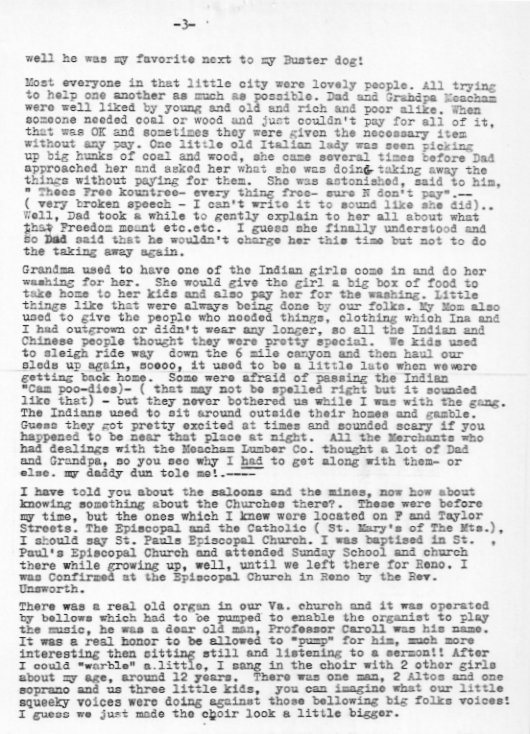
  Alta was also a keeper of the family stories.  I was fortunate to find her typed memoirs on Ancestry.com.  These are priceless, as they really give a feel for living on the Comstock at the turn of the century.  Pay attention to the story of the piano, as it comes up later in the story of the Hurd girls.  This is the second set of Memoirs; I cannot find the first set.  This was shared by an Ancestry member named azbombero in 2014.  


Alta Powers as a young lady shared by Mimi Swaney on Ancestry.com


Alta Powers shared by Mimi Swaney on Ancestry.com

  Alta passed away in 1999 at the age of 99, and is buried in Inglewood, California. It looks like she and her friend Lois Cloud were residents of a residential care facility in Jackson, California towards the end of their lives.   Alta was buried in the same mausoleum section as Lois at the Inglewood Park Cemetery. 


Relationship Reference:  Me->Margaret Hansen Boothby->Harold Hansen->Vere Burrows Hansen->Elizabeth Jane Hurd Burrows.  Hattie Hurd Powers was the second to youngest sister of Elizabeth Jane.  


  What's next? .....Alta was also a keeper of "the stuff".  What happened to the Hurd belongings?  And where was Harriet Hurd buried?